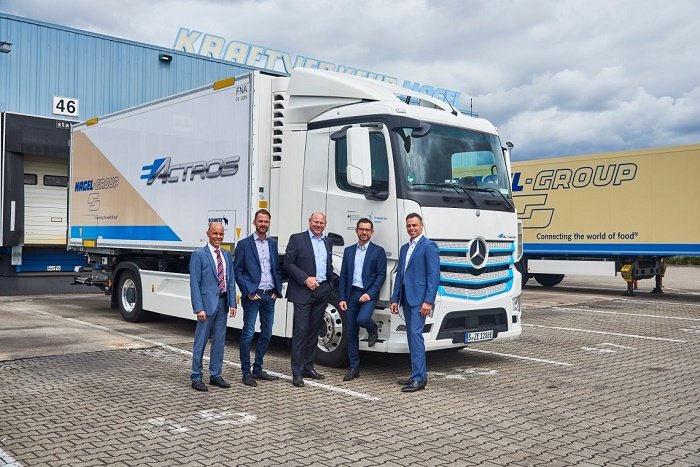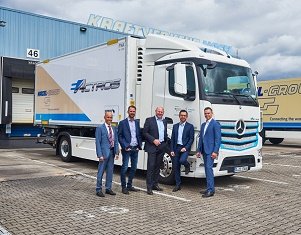
Do electric trucks meet the highest standards of quality required by chilled logistics? The Nagel-Group’s on-road tests lasting around one year should provide the answer. The food logistics company has been operating an eActros from Mercedes Benz in Hamburg since July.
The fully electric 18-tonne truck is ideally suited for distribution in urban areas. The specified range stands at 200 kilometres. The Nagel-Group will not be making full use of this range initially. “We plan to use the vehicle on daily tour to the city centre in Hamburg to deliver chilled foodstuffs to various consignees,” says Tobias Jardon, Branch Manager of Kraftverkehr Nagel in Hamburg at the official handover of the vehicle.
The eActros is equipped with lithium-ion batteries with a capacity of 240 kWh. The truck is charged at night at the Kraftverkehr Nagel’s Rungedamm branch to avoid delays during the day. The company has set up its own charging station specifically for this test.
The test lasting around one year is intended to show to what extent chilled logistics, which demands the highest quality, can rely on the fully electric vehicle. “Electric mobility provides the opportunity to reduce emissions and meet delivery requirements in urban areas. At the same time, there are many practical challenges and this test will help provide a better understanding of these challenges,” says Carsten Taucke, CEO of the Nagel-Group. Hamburg offers the right urban environment for this on-road testing.Carsten Taucke explains further: “We have been operating locally for 60 years from strategically placed locations and we have established long-term customer relationships. We intend to secure this market position by using state-of-the-art technology.
This test now launched by the Nagel-Group is part of a series of practical trials by Mercedes Benz for the eActros. The aim is to achieve series production maturity for heavy electric trucks for inner-city distribution operations from 2021. In addition to the Nagel-Group, nine customers from different sectors in Germany and Switzerland are taking part in the customer trials.Oliver Kraft, Head of Key Account Management Mercedes-Benz Trucks: “We are delighted that the Nagel-Group with its longstanding experience in food logistics is one of the customers that is jointly testing the eActros with us. The handover of the vehicle to the Nagel-Group completes our ‘innovation fleet’ for practical trials of the electric truck.
The Nagel-Group operates around 7,000 vehicles every day. The company is increasingly focusing its attention on the right mix of drive systems which is both ecologically and economically sustainable.