Esta página solo está disponible en inglés. Ir a la portada en español

×

Questa pagina è disponibile solo in inglese. Home page in italiano

×

Diese Seite ist nur auf Englisch verfügbar. Zur deutschen Startseite

×

Cette page est disponible uniquement en anglais. Aller à la page d'accueil en français

×

Supreme Delivers More to Refrigerated Carriers in 2020

Supreme Delivers More to Refrigerated Carriers in 2020

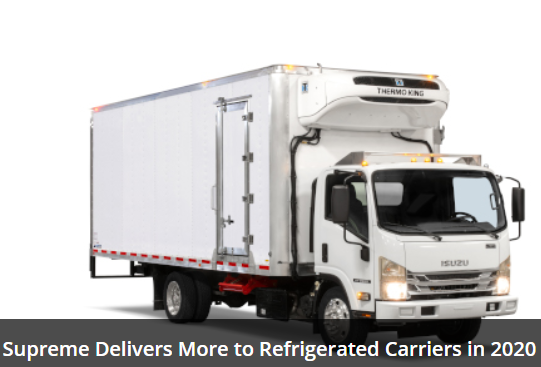
Supreme, a leading North American provider of final mile equipment, delivers more solutions for refrigerated carriers with its new Kold King truck body and Gruau refrigerated insert for cargo vans, both of which will be shown at NTEA’s Work Truck Show in Indianapolis March 4-6, 2020.

“The Supreme brand our customers have trusted for more than 40 years is better than ever as part of the Wabash National family. By combining Supreme’s 40+ years of extensive knowledge in the final mile industry with Wabash National’s R&D capabilities, advanced composite technologies and manufacturing excellence, we’re able to deliver engineered solutions built to perform and last longer,” said Tim Marling, vice president of product and business development for Wabash National’s Final Mile Products business.

The new Kold King refrigerated truck body is 200 pounds lighter and up to 25 percent more thermally efficient, delivering more payload, less fuel consumption and fewer TRU hours. In addition, its smooth, seamless interior liner provides a brighter, more durable food-grade surface. The overall design significantly reduces potential leak points and water intrusion, and its damage-resistant, one-piece header reduces downtime.

In addition to industry-leading refrigerated truck bodies, Supreme offers state-of-the-art cargo van insulated inserts available for all of the major OEMs through a partnership with Gruau. The Gruau insert is a FSMA-compliant, complete refrigeration upfit solution that includes lightweight, low-profile modules designed for efficient climate control while retaining maximum cargo space and preserving the van’s exterior. The system improves thermal efficiency up to 20 percent compared to other refrigerated vans and increases the life of the reefer unit through more efficient temperature maintenance. In addition, since the insert is a modular system, there is no mold or foam degradation to worry about. That’s why customers choose Gruau’s refrigerated insert system as their FSMA-compliant delivery solution for vans.

“We work alongside our customers to deliver the best-fit solutions for their operations because our mission is to enable customers to succeed with breakthrough ideas and solutions that help them move everything from first to final mile,” Marling said. “The new Kold King truck body and Gruau insert are just the latest in our commitment to changing how the world reaches you.”

Get the daily refrigeration briefing

One email a day. Trusted by 3,000+ RACHP professionals.

More on Cold Chain

All on Cold Chain →

Insights

Secop's Solar Direct Drive (SDD) System Earns WHO PQS Approval – The Team Behind It
Article

Secop’s Solar Direct Drive (SDD) System Earns WHO PQS Approval – The Team Behind It

Partner's material In March 2026, Secop’s Solar Direct Drive Power Management Module was granted WHO PQS prequalification and officially listed in the WHO Catalogue of Prequalified Immunization Devices. The WHO IMD-PQS (Immunization Devices Performance, Quality and Safety programme) is the global benchmark for cold chain equipment used in immunisation. Being listed in its catalogue is

22 Jun 2026
Case Study - Effect of Louvers or diffusers on air flow distribution and cooling time on a meat log during Chill cycle
Tech Guide

Case Study – Effect of Louvers or diffusers on air flow distribution and cooling time on a meat log during Chill cycle

By Kushal Aurangabadkar An experimental analysis was conducted on a cooler space measuring 3.66 m × 6.096 m (12.0 ft × 20.0 ft), equipped with an ammonia refrigeration coil, five 30 cm (12 in.) fans, and five diffusers. The study measured airflow patterns, cooling rates, and heat transfer efficiency in meat storage by testing two configurations:

Kushal Aurangabadkar · 21 Jan 2026
Total Cost of Ownership (TCO) for Modular Refrigeration Systems in Life Sciences Distribution Centers
Tech Guide

Total Cost of Ownership (TCO) for Modular Refrigeration Systems in Life Sciences Distribution Centers

by Ramez Naguib, P.E. Introduction Life sciences distribution centers are under immense pressure to deliver consistent temperature control, comply with increasingly stringent regulations, and optimize operational efficiency. Traditional built-up refrigeration systems often prove cumbersome, costly, and slow to implement. In contrast, modular, factory-assembled refrigeration systems have emerged as a compelling alternative. Drawing on lessons from

14 Jan 2026
Everything on Cold Chain: 2,045 articles, 2 case studies, 23 insights

Most read this month

All news →