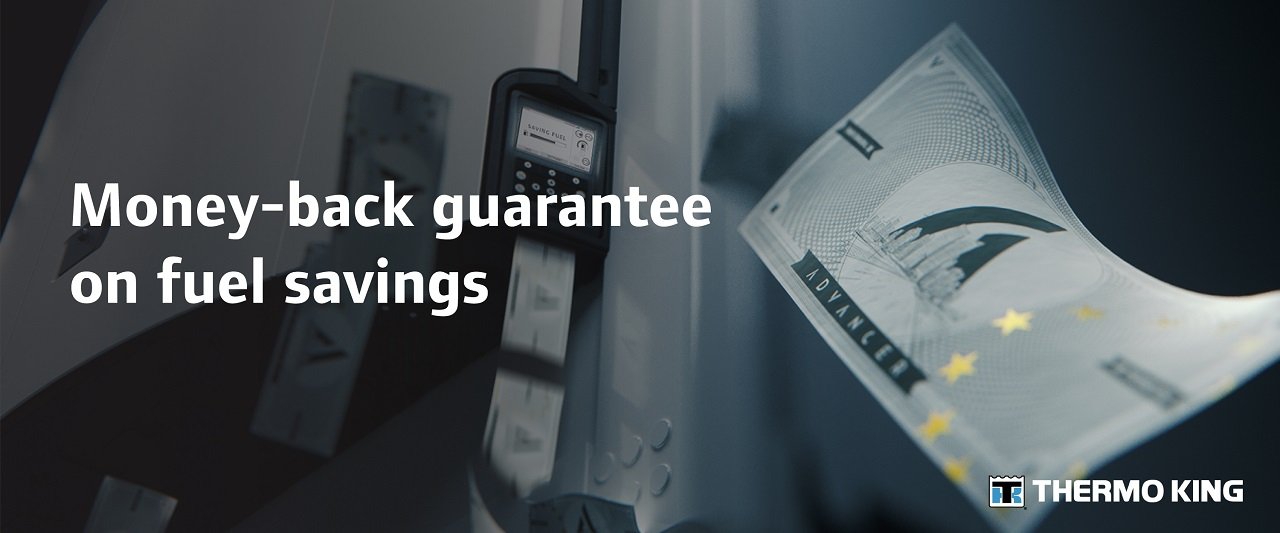
Thermo King announced today a new campaign to showcase the fuel-saving capabilities of the Advancer A-Series trailer refrigeration unit. Thermo King now offers to pay back the difference, if Advancer does not meet the 12-month fuel-saving target calculated with the customers.
Thermo King A-Series units are up to 30% more fuel-efficient than the market average and are the first in the industry to give complete transparency of fuel levels and fuel consumption. Customers can easily access the fuel consumption data of the unit – recorded, displayed, and made available remotely via telematics.
“The total savings with Advancer depend on our customers’ individual operations. Fortunately, we can make a detailed calculation at our dealership, tailored to our customers’ specific needs,” said Donal Cox, vice president of sales and commercial leader at Thermo King in Europe, Middle East and Africa. “By filling in key information in the TK SmartSaver application, our dealers can calculate the exact savings the customers will achieve by using the Advancer unit. If the fuel saving amount isn’t reached in the given period, Thermo King will pay back the difference.”
Transporters interested in the Advancer fuel-saving guarantee should contact their nearest Thermo King dealer, where they can calculate their individual fuel-saving target. The target is based on customer’s specific operating profile, taking into account running hours, the average ambient temperature or whether they transport mostly frozen or fresh goods.
Thermo King Advancer A-Series is available in three different versions, the A-360, A-400, and A-500, and includes unique features that comprehensively address a wide range of operational and financial challenges, including:
-
Up to 40 percent quicker pull down and up to 30 percent better fuel-efficiency than the market average
-
Fully variable airflow that can be regulated for each journey and cargo, and is independent from unit engine speed
-
Unrivalled electrical and fuel efficiency contributing to lower CO2 footprint and engines with 50 percent less emissions than the maximum allowed by latest NRMM Stage V emission standards
-
Electronic engine speed control on the A-400 and A-500 units
-
Lower maintenance costs and enhanced serviceability compared to the predecessor, thanks to sensors offering more insight into the engine, fuel, battery and the performance of other key components
-
Future-ready power agnostic capabilities that can utilize diesel, axle generator, or shore power sources with ease
-
Fleet intelligence as standard, with Advancer being the first-ever unit to offer 2 years of full telematics connectivity in the purchase price.