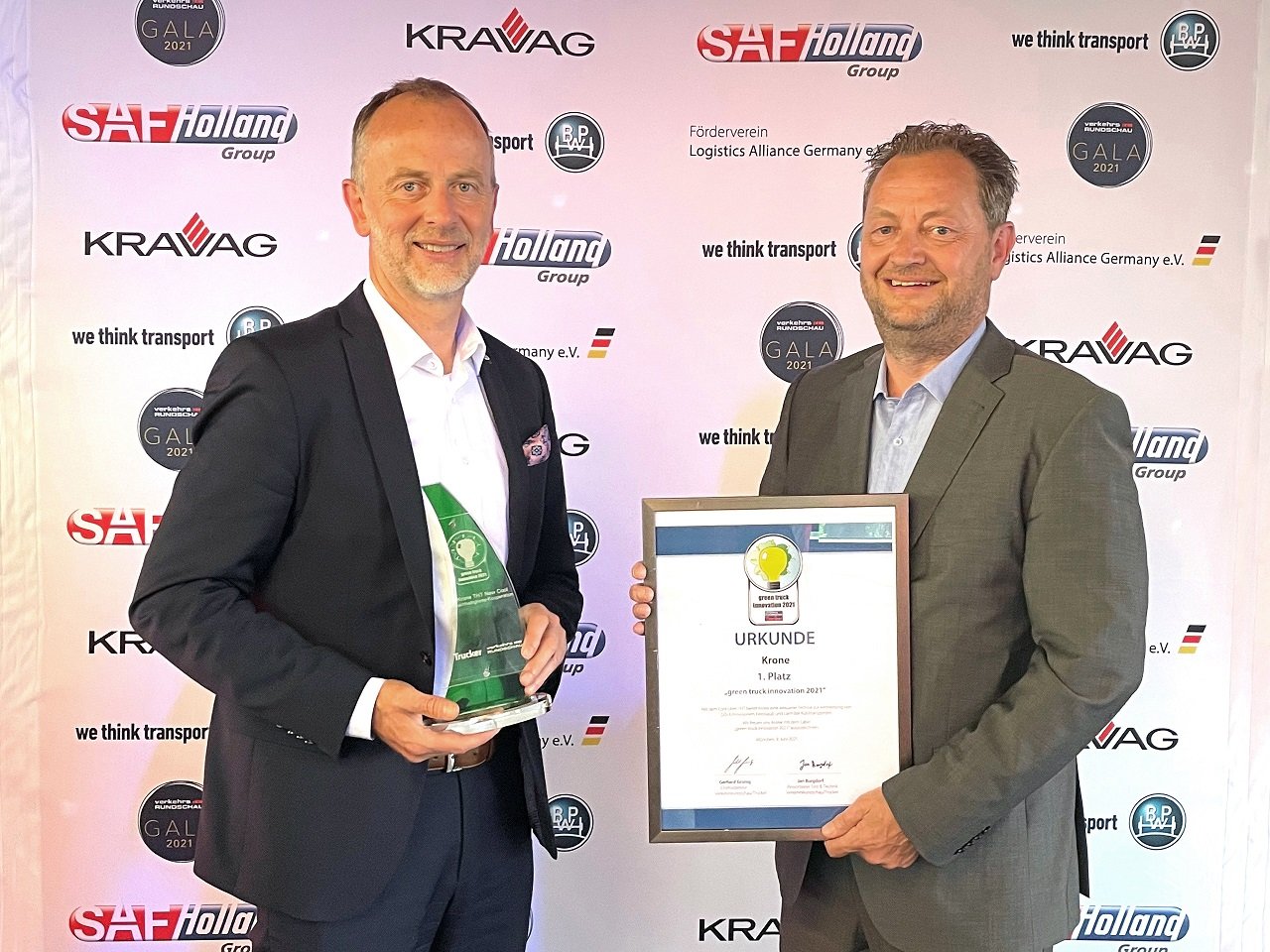
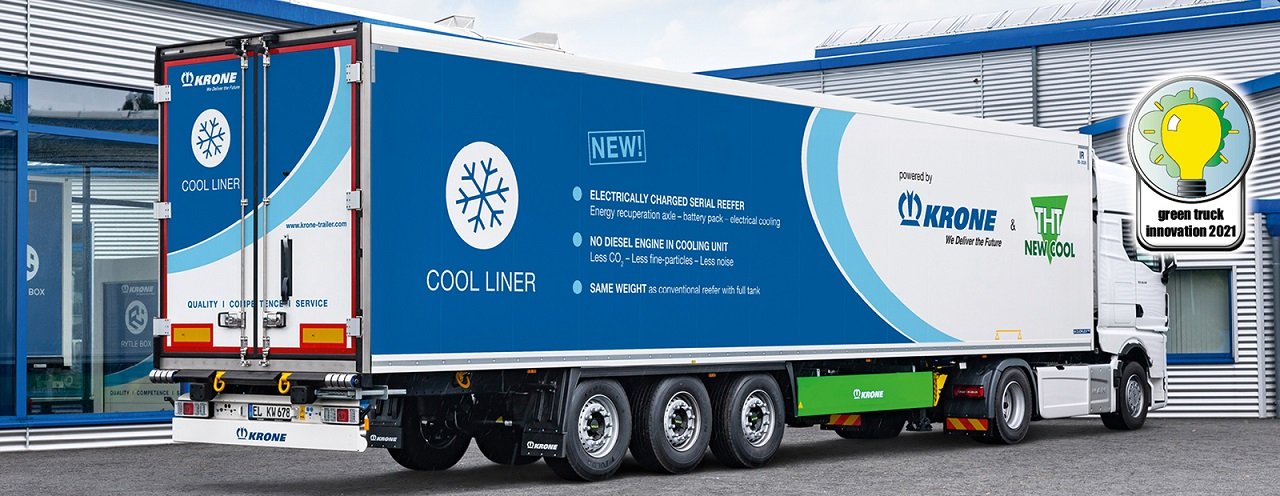
The German trade magazines “Verkehrs-Rundschau” and “Trucker” have awarded Krone and its Dutch partner THT the “Green Truck Innovation 2021” award for the Cool Liner “THT New Cool”.
Krone Managing Director Sales and Marketing, Dr Frank Albers and THT owner Twan Heetkamp received the prestigious award on 9 June at the “VR Gala 2021” in Neuss, Germany.
To achieve the highest possible sustainability in refrigerated transport, Krone is converting the Cool Liner completely to electric operation in cooperation with the electric specialist THT. For this purpose, the second trailer axle is converted to a recuperation axle, which feeds electrical energy to a battery pack mounted longitudinally under the trailer. The third-generation energy storage unit, which weighs only 320 kg, supplies the all-electric refrigeration unit with electricity with the help of intelligent control electronics, so that the “THT New Cool” Cool Liner does not need a diesel unit at all. The total weight of the fully electric refrigerated trailer is the same as that of a conventionally refrigerated trailer with a full diesel tank. This significantly reduces fuel consumption and thus CO2 and fine particle emissions. Another positive effect is the lower noise emission of the electric refrigeration unit. Thanks to this sustainable concept, food transports with the Cool Liner “THT New Cool” pollute inner cities and conurbations considerably less and support climate-oriented transport planning.
Krone Managing Director Sales and Marketing, Dr Frank Albers, sees the prestigious award as a confirmation of Krone’s consistent sustainability strategy: “We are very grateful for this award and the cooperation with Twan Heetkamp. Through such cooperations and projects, sustainable innovations are created. At the same time, it is an incentive for us to continue offering innovative vehicle concepts to the transport and logistics industry. This is also against the background of the further amendment of European environmental legislation, for example with regard to the emission of nitrogen oxides or CO2 limit values”.
Krone Wins Green Truck Innovation Award 2021
Get the daily refrigeration briefing
One email a day. Trusted by 3,000+ RACHP professionals.