Esta página solo está disponible en inglés. Ir a la portada en español

×

Questa pagina è disponibile solo in inglese. Home page in italiano

×

Diese Seite ist nur auf Englisch verfügbar. Zur deutschen Startseite

×

Cette page est disponible uniquement en anglais. Aller à la page d'accueil en français

×

Tesco refrigerated rail freight in the UK

Tesco refrigerated rail freight in the UK

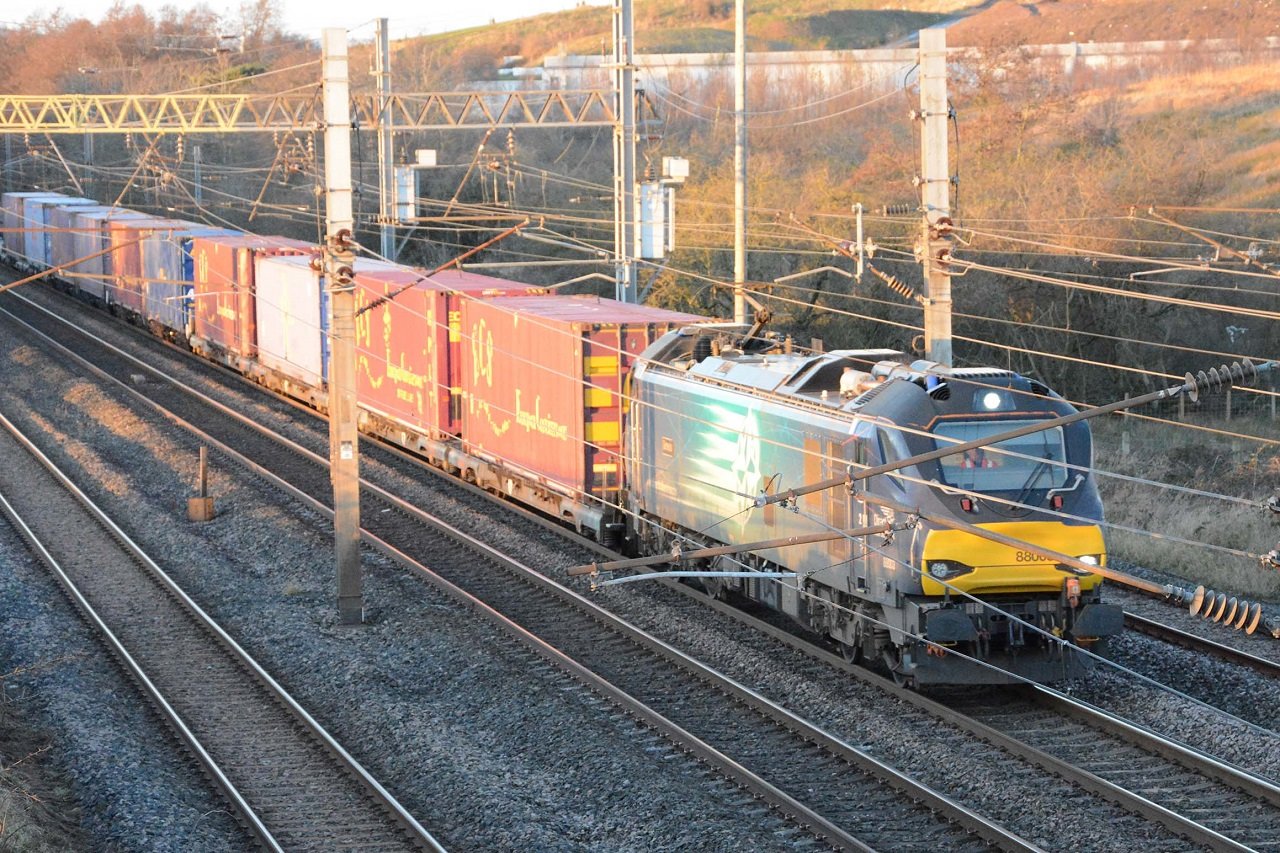
The new service will be the first time Tesco has used refrigerated rail freight in the UK, distributing chilled goods from Tilbury to Coatbridge by low CO2 rail twice a day, seven days a week. This means that rail freight will play an even bigger role in helping Tesco to deliver Christmas this year and over the next couple of weeks this new service will transport hundreds of different products, including festive favourites such as sprouts, parsnips, carrots, onions, oranges and lemons just in time for that all important Christmas dinner.

Using rail has significant environmental benefits. The 415-mile route will use DRS’s Class 88 bi-mode electric locomotives which can run on electricity and produce zero exhaust and greenhouse gas emissions. This service alone will take at least 17,000 containers off the road each year, saving Tesco 7.3 million road miles and nearly 9,000 tonnes of CO2e.

Jason Tarry, Tesco UK and ROI CEO said: “We’ve been using rail to transport our goods since 2008 and this new service reflects our continuing commitment to rail which has clear advantages for our business, our customers and the planet. Our rail service will be an important part of our efforts to deliver a fantastic Christmas for our customers but the journey doesn’t stop here as we continue to increase the number of containers we transport by rail as part of our commitment to reach net zero emissions in our operations by 2035.”

Chris Connelly, NTS Deputy CEO and Rail Director, said: “This is fantastic news, not only for DRS and Tesco but also for the environment. This is an example of how rail can play an integral part in the race to net zero. Each train will remove around 40 lorries from Britain’s roads and we’re running two trains a day, seven days a week, saving 9,000 tonnes of CO2e a year. We’re thrilled to be working with Tesco on this new service, helping them drive down their carbon footprint as they deliver for their customers throughout the UK.”

All rail freight delivers 76 per cent fewer CO2 emissions¹ when compared to road; linking with other rail operations from across Europe at Tilbury Forth Ports ensures that fresh produce can travel with a significantly reduced carbon footprint.

Tesco is increasing its use of rail freight as part of its efforts to meet its commitment to net zero emissions in its own operations by 2035. Over the past year alone the supermarket has increased the number of containers with produce destined for stores transported by rail by nearly 50%.

Get the daily refrigeration briefing

One email a day. Trusted by 3,000+ RACHP professionals.

More on Cold Chain

All on Cold Chain →

Insights

Secop's Solar Direct Drive (SDD) System Earns WHO PQS Approval – The Team Behind It
Article

Secop’s Solar Direct Drive (SDD) System Earns WHO PQS Approval – The Team Behind It

Partner's material In March 2026, Secop’s Solar Direct Drive Power Management Module was granted WHO PQS prequalification and officially listed in the WHO Catalogue of Prequalified Immunization Devices. The WHO IMD-PQS (Immunization Devices Performance, Quality and Safety programme) is the global benchmark for cold chain equipment used in immunisation. Being listed in its catalogue is

22 Jun 2026
Case Study - Effect of Louvers or diffusers on air flow distribution and cooling time on a meat log during Chill cycle
Tech Guide

Case Study – Effect of Louvers or diffusers on air flow distribution and cooling time on a meat log during Chill cycle

By Kushal Aurangabadkar An experimental analysis was conducted on a cooler space measuring 3.66 m × 6.096 m (12.0 ft × 20.0 ft), equipped with an ammonia refrigeration coil, five 30 cm (12 in.) fans, and five diffusers. The study measured airflow patterns, cooling rates, and heat transfer efficiency in meat storage by testing two configurations:

Kushal Aurangabadkar · 21 Jan 2026
Total Cost of Ownership (TCO) for Modular Refrigeration Systems in Life Sciences Distribution Centers
Tech Guide

Total Cost of Ownership (TCO) for Modular Refrigeration Systems in Life Sciences Distribution Centers

by Ramez Naguib, P.E. Introduction Life sciences distribution centers are under immense pressure to deliver consistent temperature control, comply with increasingly stringent regulations, and optimize operational efficiency. Traditional built-up refrigeration systems often prove cumbersome, costly, and slow to implement. In contrast, modular, factory-assembled refrigeration systems have emerged as a compelling alternative. Drawing on lessons from

14 Jan 2026
Everything on Cold Chain: 2,041 articles, 2 case studies, 23 insights

Most read this month

All news →