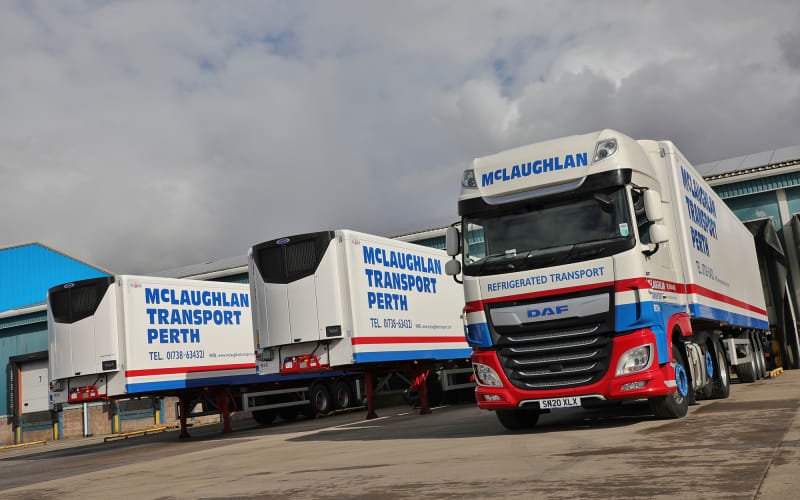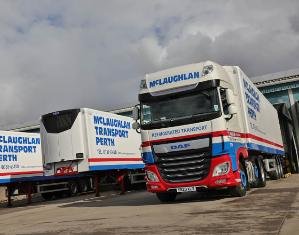
Scottish haulier, McLaughlan Transport, continues to improve the sustainability of its temperature-controlled trailer fleet with three new Carrier Transicold Vector HE 19 units.
Following the fuel-saving performance of three previous Carrier Transicold Vector HE 19 units – similarly mounted to 13.6-metre Gray & Adams trailers – the latest assets add to McLaughlan Transport’s 70-strong temperature-controlled trailer fleet.
The Vector HE 19 units combine Carrier Transicold’s E-Drive all-electric technology with a new multi-speed engine design, delivering up to 30% fuel savings when compared to the previous generation Vector 1950 – delivering a significant sustainability advantage. In addition, the system’s fully hermetic scroll compressor and economiser provides a 40% increase in refrigeration capacity during pull-down, as well as a 50% reduction in refrigerant escape. The delivery of the Vector HE 19 units supports Carrier’s 2030 ESG goal of helping customers avoid more than one gigaton of greenhouse gas emissions.
The system is also 19% more efficient when plugged into the electrical grid on standby, meaning that the Vector HE 19 unit can help to lower diesel, maintenance and electricity costs – all while being 3 dB(A) quieter than the legacy Vector 1950, helping to significantly reduce sound pollution.
Often delivering medical supplies, it is imperative that both McLaughlan Transport and its customers can accurately track and monitor the internal temperature of the trailers to ensure compliance with the strict rules pertaining to pharmaceutical transport. McLaughlan Transport opted for Carrier Transicold’s remote unit monitoring and control system to provide accurate diagnostics and data management and support effective cold chain management.
“Carrier has built a close relationship with McLaughlan Transport over the years,” said Mary Parker, National Key Account Manager at Carrier Transicold UK. “They put great faith in our ability to truly deliver for their business and the Vector HE 19 unit is the latest unit that’s done exactly that. Looking forward, it will be exciting to work with them to trial the next step in trailer technology – new engineless Vector eCool trailer unit, which relies on a cutting-edge, all-electric fully autonomous system, that produces no direct carbon dioxide or particulate emissions.