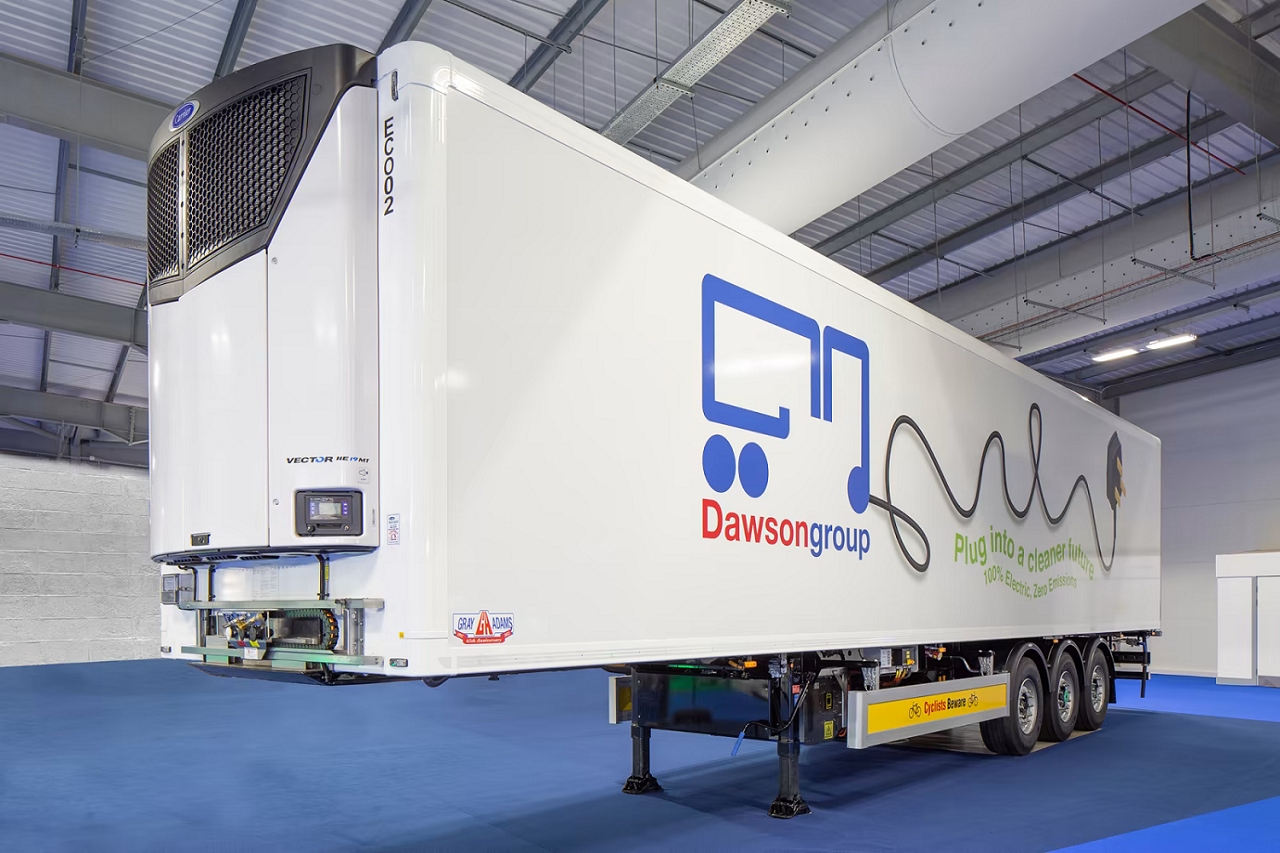
Commercial vehicle supplier, Dawsongroup truck and trailer, has taken delivery of three Carrier Transicold Vector eCool units, the latest UK company to specify the world’s first fully autonomous, all-electric engineless refrigerated trailer system.
The new Vector eCool systems will operate with the engineless versions of the Carrier Transicold Vector HE 19 MT (multi-temperature) and Vector 1550 on two 13.6-metre trailers, with an additional Vector HE 19 MT mounted on a smaller double-axle urban trailer, all built by Gray & Adams. They join a temperature-controlled rental fleet of close to 2,000 trucks and trailers – which is around 90% Carrier-cooled – and will demonstrate to Dawsongroup customers that the Vector eCool system can deliver significant sustainability benefits and cost savings.
“We’ve been working with Carrier for more than 25 years,” said John Fletcher, Managing Director, Dawsongroup. “They are peerless in the industry for quality, support and innovation – so we were excited to see the Vector eCool in action, and we weren’t disappointed. Now, we want to showcase these trailers to customers so that they can see for themselves how the technology can deliver a cost-effective alternative to diesel power that ticks all the right boxes from an environmental perspective. We plan to exhibit one of our new trailers at the ITT Hub event in May.”
The Vector eCool unit combines Carrier’s E-Drive all-electric technology with a new cutting-edge energy recovery and storage system. This converts kinetic energy generated by the trailer axle and brakes into electric power, which is stored in a battery pack that powers the refrigeration unit – a loop that creates the industry’s first fully autonomous system, producing no direct carbon dioxide (CO2) or particulate emissions.
The trailers can be plugged into the electrical grid when parked and fully charge in just two hours using a standard five pin, three-phase standby plug. The system is also ultra-low noise, operating below the PIEK standard, which combined with its emissions performance means it offers the ultimate solution to tightening inner city and urban regulations, while creating a more harmonious working environment for drivers.
“With the red diesel rebate removed and the cost of fuel in general going through the roof, this technology ties in closely with what we are trying to promote as a business to our customers. We want to be able to show that there are workable alternatives – which mostly come from Carrier – available for all types of temperature-controlled vehicles, and we’re certain the Vector eCool system will fit into that bracket perfectly,” added Fletcher.
The Vector eCool system supports Carrier’s 2030 ESG goal of helping customers avoid more than one gigaton of greenhouse gas emissions.