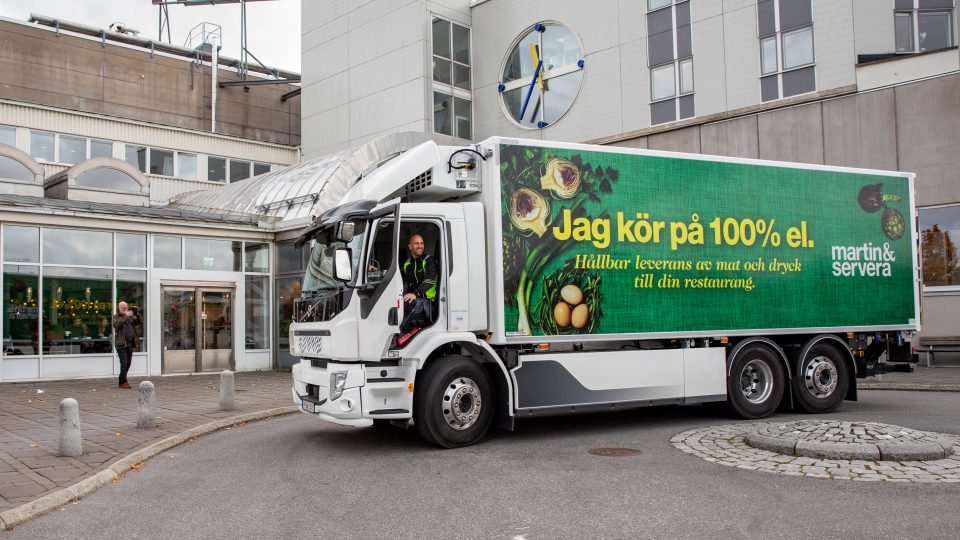
Thermo King announced that Martin & Servera, a leading Swedish wholesaler and supplier to restaurants and commercial food industry, ordered 25 V-1000 vehicle-powered units for their new distribution fleet.
“With over 500 vehicles delivering goods to customers every day, we spend a lot of effort evaluating and testing new technologies that can give us a more sustainable vehicle fleet,” said Håkan Ekmyr, transport manager at Martin & Servera Logistik. “We have a close relationship with Thermo King and have relied on their expertise and support when it comes to transport refrigeration. We knew we can count on them to work with the truck OEM and offer the right non-diesel-powered refrigeration systems for our new fleet.”
Martin & Servera will also benefit from a 60-month service agreement that includes on-site maintenance and repair service, allowing the customer to focus on their operations and maximise the uptime of their fleet.
The V-1000 uses a compressor exclusively developed for Thermo King which, when driven by the truck engine, produces performance previously unattainable in units of this type. This positively impacts the total cost of operation when it comes to fuel consumption, maintenance costs and productivity, making the V-1000 a competitive investment compared to diesel powered unit with equivalent performance.
For flexible operations, the profile of the Thermo King V-1000 makes it suitable for high cabs, while the units are also compatible with multiple vehicle types including CNG, LNG or Biodiesel. The
V-1000 is available in both 12V or 24V options and can fit trucks that range up to 25 tonnes to fit customer’s multiple application needs.
When compared to an equivalent diesel unit, the Thermo King V-1000 delivers the following performance indicators:
- Up to 54% less fuel consumption than an equivalent self-powered system, depending on the customer application.
- Up to 33% lower maintenance costs including both parts and labour thanks to the absence of a diesel engine.
- The V-1000 weights less than half of an equivalent diesel unit, savings 250 kg without standby and 150 kg with standby option. This means much more carrying capacity for the vehicle.
- The V-1000 is almost 25% more powerful than an equivalent diesel unit, delivering 10,055W 0/30 degrees Celsius of cooling capacity at high-speed position.
- Low speed capacity comes close to matching diesel units, while the standby capacity is 57% higher.
- For total load protection, the V-1000 offers airflow of 3,537 m3/hr – 31% higher than diesel equivalent units
- Heating capacity is 1.3 times higher than the diesel equivalent units.
- No diesel emissions from the unit, no CO2 emissions from the unit, low noise when in operation.