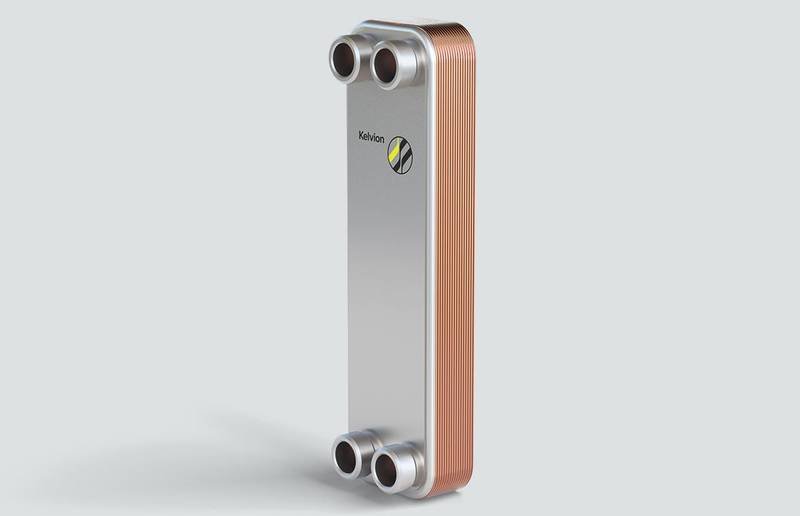
The LC150 research project of the Fraunhofer Institute for Solar Energy Systems (ISE), funded by the German Federal Ministry for Economic Affairs and Energy (BMWi), set itself the task of researching a standardized and refrigerant-reduced refrigeration circuit with propane together with heat pump manufacturers and suppliers. During the project, which has now been completed, the researchers and a consortium of heat pump manufacturers developed a refrigerant-reduced propane heat pump. Kelvion’s GK108H brazed plate heat exchanger was part of a test series.
Less propane, more safety
Propane is a particularly promising refrigerant because it exhibits comparable refrigeration performance to conventional refrigerants, features very good thermodynamic properties and low global warming potential (GWP). Many heat pump manufacturers now offer propane heat pumps, but usually only for outdoor installation. However, propane is highly combustible. Reducing the refrigerant to below 150g is a promising way of minimizing the risk of fire. This approach corresponds to the currently valid specifications of the regulations. According to the current product safety standard DIN EN 60335-2-40:2014-01, flammable refrigerants can be used indoors with lower capacities and a refrigerant charge of up to 152 grams. Fraunhofer ISE has investigated in more detail how this can be achieved.
In a series of tests with heat exchangers, commercially available units with low filling volumes were selected. A key component of the concept is the use of heat exchangers operating with minimal refrigerant use. Kelvion’s GK108H was used in heat pump pilot plants that performed very well in the tests and was also part of the two final best-of refrigeration circuits.
The GK108H is part of the ConBraze series and features a new plate design, low fill volume, high efficiency and thermal performance. “With these features, the ConBraze series more than meets the ever-increasing demand for environmentally friendly, energy-efficient cooling and heating systems, as resources are consistently conserved during both the production and ongoing operation of these units,” says Matthias Funke, Head of R&D at Kelvion’s Nobitz-Wilchwitz site. “New types of vortex cells enable improved heat transfer and thus increased efficiency by generating higher turbulence in the duct. Thus, the units are ideal for the smallest space requirements and highest efficiency.”