Esta página solo está disponible en inglés. Ir a la portada en español

×

Questa pagina è disponibile solo in inglese. Home page in italiano

×

Diese Seite ist nur auf Englisch verfügbar. Zur deutschen Startseite

×

Cette page est disponible uniquement en anglais. Aller à la page d'accueil en français

×

Transports Tarot Chooses Carrier Transicold Technology

Transports Tarot Chooses Carrier Transicold Technology

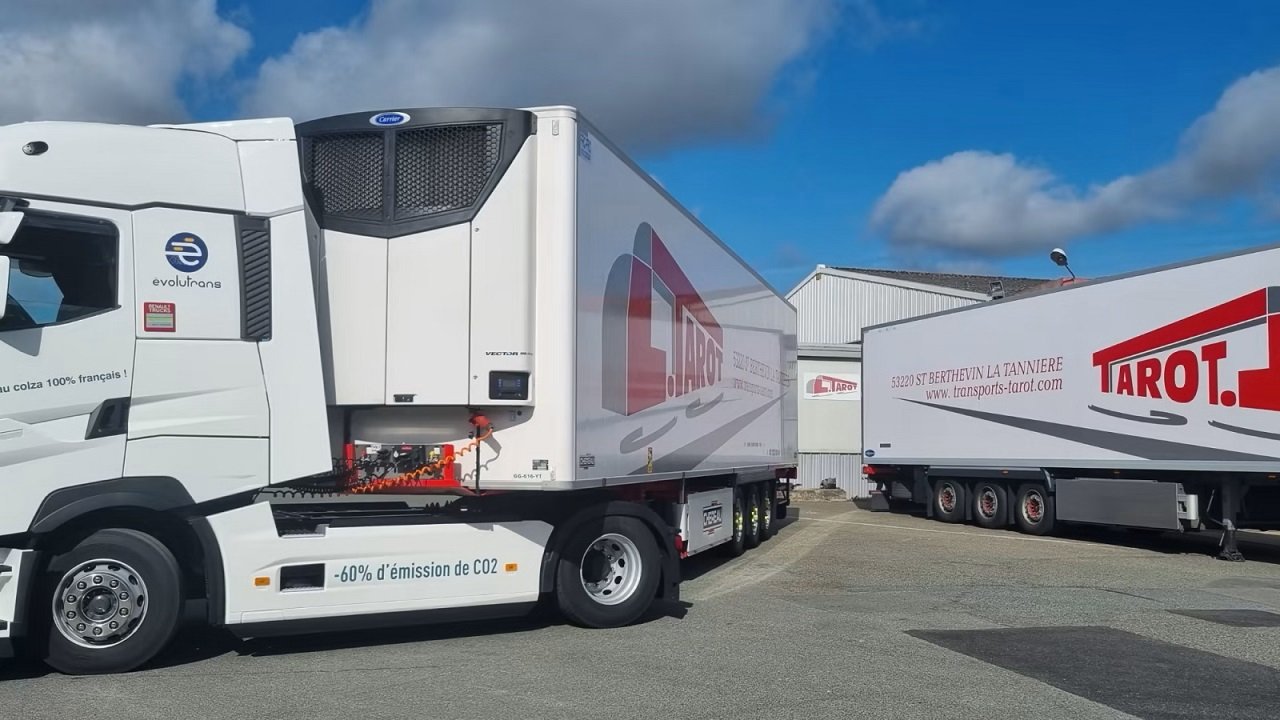
Transports Tarot has fitted three of its truck trailer combinations powered by B100 biodiesel with Carrier Transicold’s ECO-DRIVE technology. Coupled with Vector HE 19 refrigeration units, the solution provides an electric refrigeration system that does not produce any direct carbon dioxide (CO2) engine emissions.

“We are sensitive to the issue of CO2 emissions. That’s why we opted for B100 as a means to gradually decarbonize our fleet of vehicles,” said Loïc Tarot, Managing Director, Transports Tarot. “Temperature-controlled transport accounts for 70% of our business, so we also wanted to take things a step further by introducing a more environmentally responsible solution for our refrigeration units. For us, using ECO-DRIVE technology makes perfect sense.”

The combination of Carrier Transicold’s ECO-DRIVE hydroelectric technology and the Vector HE 19 refrigeration unit for semi-trailers eliminates the need to use the unit’s internal combustion engine. Using a hydraulic pump connected to the truck’s power take-off system, it recovers the kinetic energy produced by the engine, which is decarbonized thanks to the use of B100 biodiesel, and converts it into electricity to power the refrigeration unit. The ECO-DRIVE module maintains constant power throughout deliveries, even when the truck’s engine is idling.

The refrigeration unit emits no direct emissions of CO2 from the engine, and the unit’s noise level is reduced by 9 dB, compared to when its combustion engine is used.

“We load the merchandise and deliver to our customers on the same day. Thanks to Carrier’s technology, the refrigeration unit operates in electric mode throughout, while maintaining a high cooling capacity,” said Tarot.

As part of its energy transition, and in order to comply with the requirements of a Low Emission Zone (LEZ) that will be created in the area of Le Mans in 2025, Transports Tarot has launched a multi-year plan to gradually replace 80% of its fleet with new trucks that run exclusively on, or are compatible with, B100 biodiesel.

Founded in 1968, Transports Tarot is a family-owned business, and a regionally acknowledged player in the haulage sector. It has a fleet of 65 vehicles, including 50 refrigerated semi-trailers, which supply fresh produce to the north and east of France, the Rhône-Alpes region and the Paris area.

Get the daily refrigeration briefing

One email a day. Trusted by 3,000+ RACHP professionals.

More on Cold Chain

All on Cold Chain →

Insights

Secop's Solar Direct Drive (SDD) System Earns WHO PQS Approval – The Team Behind It
Article

Secop’s Solar Direct Drive (SDD) System Earns WHO PQS Approval – The Team Behind It

Partner's material In March 2026, Secop’s Solar Direct Drive Power Management Module was granted WHO PQS prequalification and officially listed in the WHO Catalogue of Prequalified Immunization Devices. The WHO IMD-PQS (Immunization Devices Performance, Quality and Safety programme) is the global benchmark for cold chain equipment used in immunisation. Being listed in its catalogue is

22 Jun 2026
Case Study - Effect of Louvers or diffusers on air flow distribution and cooling time on a meat log during Chill cycle
Tech Guide

Case Study – Effect of Louvers or diffusers on air flow distribution and cooling time on a meat log during Chill cycle

By Kushal Aurangabadkar An experimental analysis was conducted on a cooler space measuring 3.66 m × 6.096 m (12.0 ft × 20.0 ft), equipped with an ammonia refrigeration coil, five 30 cm (12 in.) fans, and five diffusers. The study measured airflow patterns, cooling rates, and heat transfer efficiency in meat storage by testing two configurations:

Kushal Aurangabadkar · 21 Jan 2026
Total Cost of Ownership (TCO) for Modular Refrigeration Systems in Life Sciences Distribution Centers
Tech Guide

Total Cost of Ownership (TCO) for Modular Refrigeration Systems in Life Sciences Distribution Centers

by Ramez Naguib, P.E. Introduction Life sciences distribution centers are under immense pressure to deliver consistent temperature control, comply with increasingly stringent regulations, and optimize operational efficiency. Traditional built-up refrigeration systems often prove cumbersome, costly, and slow to implement. In contrast, modular, factory-assembled refrigeration systems have emerged as a compelling alternative. Drawing on lessons from

14 Jan 2026
Everything on Cold Chain: 2,041 articles, 1 case study, 23 insights

Most read this month

All news →