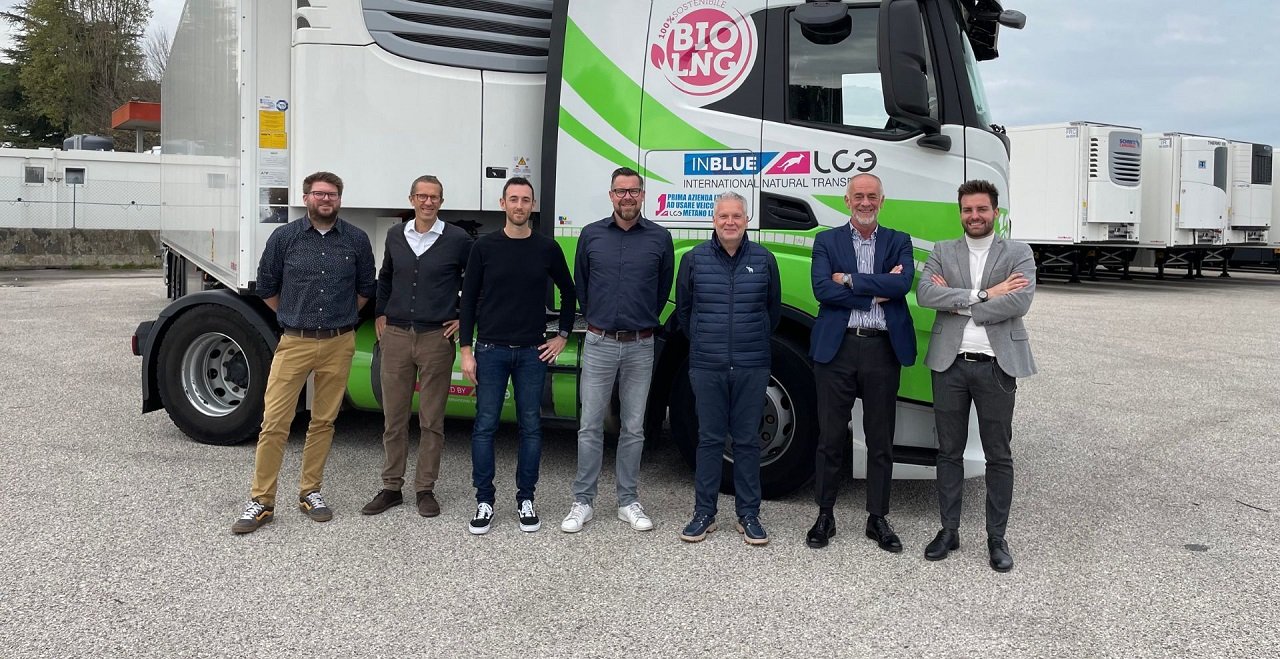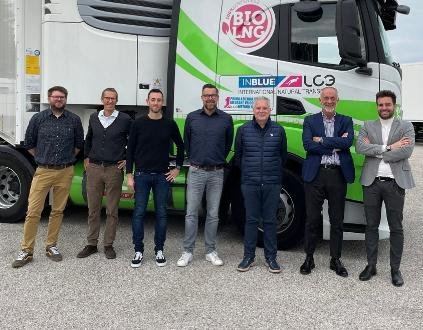
Italian transport firm LC3 has set itself the goal of offering customers high-quality transport and logistics services characterised by safety, punctuality and an environmentally-conscious approach. Founded in 2009 in Gubbio in the province of Umbria, LC3 recently put the first all-electric S.KOe COOL semi-trailers from Schmitz Cargobull into operation. As one of the first fleets in Italy, the all-electric refrigerated trailers do not consume fossil fuels for cooling and therefore do not emit any CO2.
All vehicles run on BIO-LNG, an environmentally-friendly fuel that reduces CO2 emissions. The fleet is deployed for Lidl Italia, a supermarket chain with more than 730 stores nationwide. LC3 is increasingly focusing on a sustainable vehicle fleet to achieve the ambitious goal of zero emissions by 2050, which the European Union has formulated in the Green Deal.
“We see ourselves at the forefront of sustainability and want to continue to drive forward the electrification of freight transport in Italy with the all-electric refrigerated box bodies from Schmitz Cargobull. This makes us a trendsetter for the entire transport industry. The S.KOe COOL is part of this long-term sustainability strategy and we are delighted to be one of the first Italian hauliers to add this vehicle to our fleet,” says Giuliano Baldassarri, Fleet Manager at LC3.
The all-electric S.KOe COOL semi-trailer is equipped with a purely electric refrigeration unit with integrated power electronics, a battery system and an axle generator, meaning it operates emission-free. The electrified vehicle is also extremely quiet, allowing it to be used in urban areas in the early hours of the morning as well as in the late evening.
The electrically powered S.CU ep85 refrigeration unit delivers the same cooling capacity as a diesel-powered refrigeration unit. Designed for emission-free cooling and heating of the load, it offers a cooling capacity of up to 15,800 watts and a heating capacity of 10,500 watts. Batteries on the landing gear replace the diesel tank and also offer the option of installing an additional pallet box with space for 36 pallets. The payload of the all-electric refrigerated box body with battery and e-axle is roughly the same as that of a refrigerated trailer with a diesel unit. The additional weight of the battery in the all-electric refrigerated trailer is almost completely compensated for by the elimination of the generator.
The electrified Schmitz Cargobull generator axle recuperates energy at a certain speed and during braking, thus extending the operating time of the refrigeration machine and reducing the recharging times of the battery via the power grid. The system is fully integrated into the Schmitz Cargobull telematics system so that the respective system status, e.g. battery charge status, remaining range, remaining charging time, etc., can be monitored via the telematics portal.