Esta página solo está disponible en inglés. Ir a la portada en español

×

Questa pagina è disponibile solo in inglese. Home page in italiano

×

Diese Seite ist nur auf Englisch verfügbar. Zur deutschen Startseite

×

Cette page est disponible uniquement en anglais. Aller à la page d'accueil en français

×

Thai Union Opens New Cold Store in Ghana to Bolster Supply Chain

Thai Union Opens New Cold Store in Ghana to Bolster Supply Chain

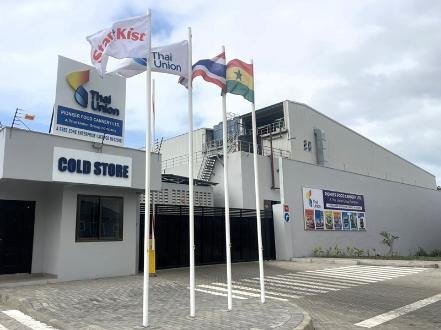
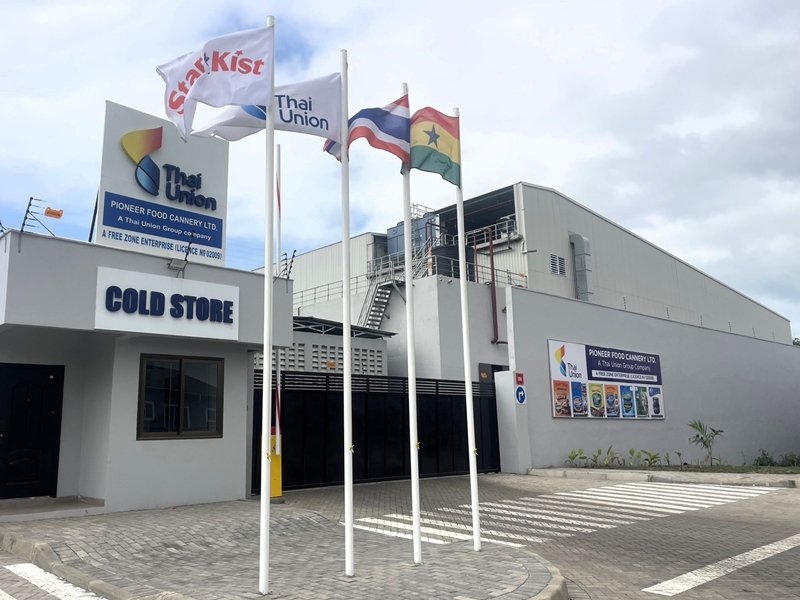
Thai Union has significantly expanded its operations in Ghana with the inauguration of an 8,000-metric-ton cold store for its Pioneer Food Cannery (PFC) factory. Situated in Tema, adjacent to PFC’s manufacturing plant, the new facility ensures year-round temperature-controlled storage of Atlantic tuna, enhancing the factory’s supply chain resilience and the company’s manufacturing capabilities.

The cold store features four storage halls along with a sorting and sizing facility, already in full operation. A USD 14 million investment, this infrastructure allows Thai Union and PFC to maintain consistent production levels throughout the year. By vertically integrating and streamlining the supply chain, the company aims to boost factory performance and yield.

Johnny Ladouce, Plant Director for PFC, emphasized the environmental and operational benefits: “Thanks to our new cold store, we will cut traffic and CO2 emissions while ensuring we can produce throughout the year, independent of fluctuating fish supply. We are committed to Ghana and the communities we operate in by providing both direct and indirect jobs here in Tema.”

Thai Union Group’s President and CEO, Thiraphong Chansiri, highlighted the strategic importance of this investment: “Our PFC factory plays a vital role for our brands across Europe and the U.S. This investment will further improve our supply security and competitiveness. The next investments into PFC will focus on our SeaChange 2030 sustainability plan, including further lowering emissions by installing solar panels and implementing measures to minimize waste, water discharge, and food loss.”

Replacing PFC’s previous rented cold storage spaces scattered across the city, the new facility allows the company to save on rental costs, reduce transportation needs, and maintain complete control over product quality from storage to shipment—enhancing PFC’s competitiveness.

Get the daily refrigeration briefing

One email a day. Trusted by 3,000+ RACHP professionals.

More on Cold Chain

All on Cold Chain →

Insights

Secop's Solar Direct Drive (SDD) System Earns WHO PQS Approval – The Team Behind It
Article

Secop’s Solar Direct Drive (SDD) System Earns WHO PQS Approval – The Team Behind It

Partner's material In March 2026, Secop’s Solar Direct Drive Power Management Module was granted WHO PQS prequalification and officially listed in the WHO Catalogue of Prequalified Immunization Devices. The WHO IMD-PQS (Immunization Devices Performance, Quality and Safety programme) is the global benchmark for cold chain equipment used in immunisation. Being listed in its catalogue is

22 Jun 2026
Case Study - Effect of Louvers or diffusers on air flow distribution and cooling time on a meat log during Chill cycle
Tech Guide

Case Study – Effect of Louvers or diffusers on air flow distribution and cooling time on a meat log during Chill cycle

By Kushal Aurangabadkar An experimental analysis was conducted on a cooler space measuring 3.66 m × 6.096 m (12.0 ft × 20.0 ft), equipped with an ammonia refrigeration coil, five 30 cm (12 in.) fans, and five diffusers. The study measured airflow patterns, cooling rates, and heat transfer efficiency in meat storage by testing two configurations:

Kushal Aurangabadkar · 21 Jan 2026
Total Cost of Ownership (TCO) for Modular Refrigeration Systems in Life Sciences Distribution Centers
Tech Guide

Total Cost of Ownership (TCO) for Modular Refrigeration Systems in Life Sciences Distribution Centers

by Ramez Naguib, P.E. Introduction Life sciences distribution centers are under immense pressure to deliver consistent temperature control, comply with increasingly stringent regulations, and optimize operational efficiency. Traditional built-up refrigeration systems often prove cumbersome, costly, and slow to implement. In contrast, modular, factory-assembled refrigeration systems have emerged as a compelling alternative. Drawing on lessons from

14 Jan 2026
Everything on Cold Chain: 2,039 articles, 1 case study, 23 insights

Most read this month

All news →