Esta página solo está disponible en inglés. Ir a la portada en español

×

Questa pagina è disponibile solo in inglese. Home page in italiano

×

Diese Seite ist nur auf Englisch verfügbar. Zur deutschen Startseite

×

Cette page est disponible uniquement en anglais. Aller à la page d'accueil en français

×

Refrigeration Monitoring Market to Reach USD 16.46 Billion by 2032

Refrigeration Monitoring Market to Reach USD 16.46 Billion by 2032

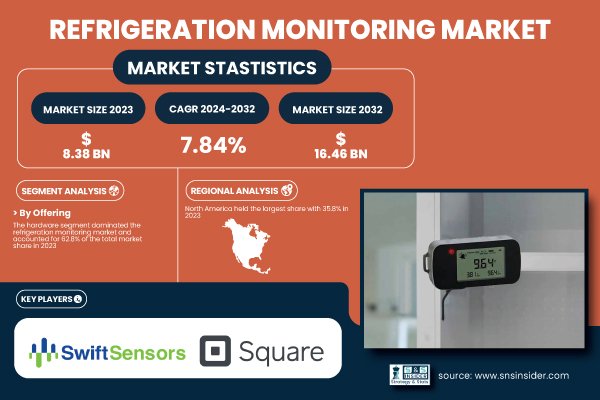
The global refrigeration monitoring market is projected to grow from USD 8.38 billion in 2023 to USD 16.46 billion by 2032, at a CAGR of 7.84%, according to SNS Insider. Growth is being driven by the rising need for temperature-sensitive product transport, stricter food and pharmaceutical safety regulations, and expanding cold chain infrastructure.

The demand for continuous monitoring in cold storage and logistics is increasing, particularly in sectors such as food and beverages, pharmaceuticals, and chemicals. Adoption of smart technologies—including IoT-connected sensors and real-time data analytics—is supporting predictive maintenance, energy efficiency, and product safety across supply chains.

In 2023, hardware accounted for 62.8% of the market due to the essential role of sensors, controllers, and data loggers. However, software solutions are expected to grow at the fastest rate through 2032, driven by the expansion of cloud-based platforms and AI-powered monitoring systems.

Temperature sensors dominated the sensor segment in 2023 with a 31.7% market share and are forecasted to grow at the highest CAGR. Their critical role in maintaining compliant and efficient refrigeration environments across multiple industries is driving this trend.

By application, storage held the largest share at 71.6% in 2023, reflecting demand from warehouses, retail outlets, and cold storage. The transportation segment is expected to see the highest growth rate through 2032, supported by increased investment in GPS-enabled temperature tracking systems.

Food and beverages led the industry segmentation with a 42.6% share in 2023. The pharmaceuticals segment is anticipated to expand rapidly due to the need for reliable vaccine storage and compliance with safety protocols.

Regionally, North America led the market with a 35.8% share in 2023, influenced by regulatory mandates and investments from major corporations. Asia Pacific is expected to register the fastest growth through 2032, as countries like China, India, and Japan expand their cold chain capabilities using IoT-based monitoring technologies.

Leading companies cited in the report include Emerson Electric Co., Danfoss, Honeywell International Inc., Johnson Controls, ABB Ltd., and Frostrol, among others.
Read More

Get the daily refrigeration briefing

One email a day. Trusted by 3,000+ RACHP professionals.

More on Cold Chain

All on Cold Chain →

Insights

Secop's Solar Direct Drive (SDD) System Earns WHO PQS Approval – The Team Behind It
Article

Secop’s Solar Direct Drive (SDD) System Earns WHO PQS Approval – The Team Behind It

Partner's material In March 2026, Secop’s Solar Direct Drive Power Management Module was granted WHO PQS prequalification and officially listed in the WHO Catalogue of Prequalified Immunization Devices. The WHO IMD-PQS (Immunization Devices Performance, Quality and Safety programme) is the global benchmark for cold chain equipment used in immunisation. Being listed in its catalogue is

22 Jun 2026
Case Study - Effect of Louvers or diffusers on air flow distribution and cooling time on a meat log during Chill cycle
Tech Guide

Case Study – Effect of Louvers or diffusers on air flow distribution and cooling time on a meat log during Chill cycle

By Kushal Aurangabadkar An experimental analysis was conducted on a cooler space measuring 3.66 m × 6.096 m (12.0 ft × 20.0 ft), equipped with an ammonia refrigeration coil, five 30 cm (12 in.) fans, and five diffusers. The study measured airflow patterns, cooling rates, and heat transfer efficiency in meat storage by testing two configurations:

Kushal Aurangabadkar · 21 Jan 2026
Total Cost of Ownership (TCO) for Modular Refrigeration Systems in Life Sciences Distribution Centers
Tech Guide

Total Cost of Ownership (TCO) for Modular Refrigeration Systems in Life Sciences Distribution Centers

by Ramez Naguib, P.E. Introduction Life sciences distribution centers are under immense pressure to deliver consistent temperature control, comply with increasingly stringent regulations, and optimize operational efficiency. Traditional built-up refrigeration systems often prove cumbersome, costly, and slow to implement. In contrast, modular, factory-assembled refrigeration systems have emerged as a compelling alternative. Drawing on lessons from

14 Jan 2026
Everything on Cold Chain: 2,036 articles, 1 case study, 23 insights

Most read this month

All news →