Esta página solo está disponible en inglés. Ir a la portada en español

×

Diese Seite ist nur auf Englisch verfügbar. Zur deutschen Startseite

×

Cette page est disponible uniquement en anglais. Aller à la page d'accueil en français

×

Thermo King expands AxlePower trailer refrigeration fleets in Spain

The self-charging system can cut annual CO2 emissions by up to 12 tonnes while powering trailer refrigeration without an external grid.

Thermo King expands AxlePower trailer refrigeration fleets in Spain

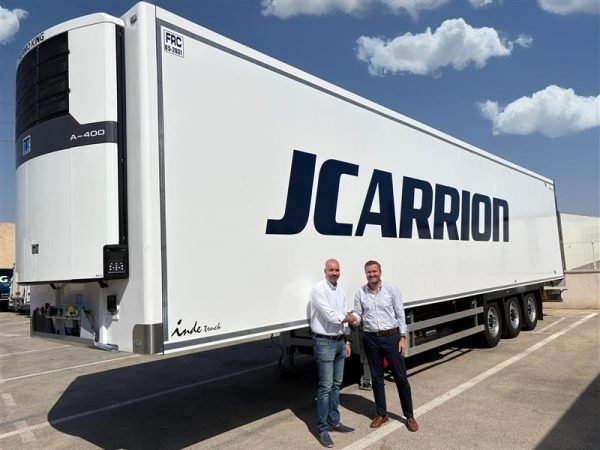
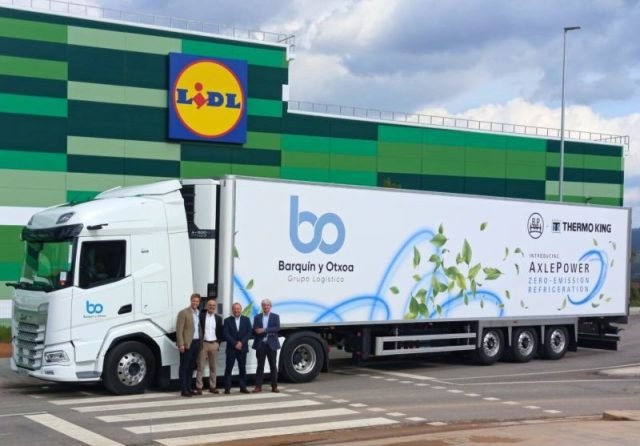
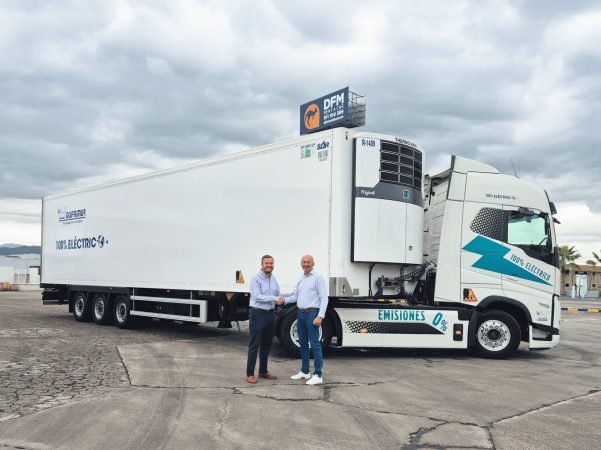
Thermo King said three Spanish transport companies — Barquín y Otxoa, Disfrimur and JCARRION — have added trailer fleets equipped with its Advancer AxlePower self-charging electric refrigeration system. The company said the deployments support a shift toward lower-emission refrigerated logistics in Spain and the wider Europe, Middle East and Africa region.

According to Thermo King, AxlePower is designed for trailer refrigeration units and can reduce CO2 emissions by up to 12 tonnes per year (about 13.2 US tons) for distribution trailers. The system recovers energy during braking or downhill driving, stores it in battery packs and reuses it to power the refrigeration unit, without requiring connection to external power grids.

Thermo King said the system is tractor-independent and can be integrated into existing fleets for hybrid and fully electric refrigeration units. It said the technology uses smart power management to monitor road conditions, maximize kinetic and thermal energy recovery through the trailer’s e-axle, and disengage the e-axle during uphill climbs. AxlePower-equipped trailers have covered more than 5 million kilometres (about 3.1 million miles) in climates ranging from Scandinavia to South Africa, the company added.

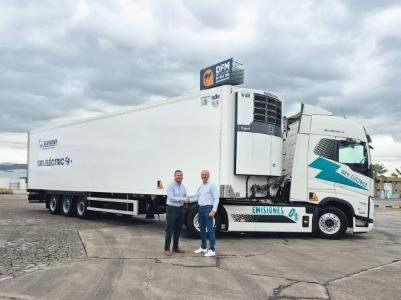
Barquín y Otxoa said it has added a fully electric refrigerated trailer with a Thermo King Advancer-e unit powered by AxlePower. Disfrimur said it has added an Advancer AxlePower system refrigerated trailer as part of its “Invisible Transport” strategy. JCARRION said it has also incorporated the AxlePower system into its trailer fleet.

“Reducing fuel consumption is therefore most powerful lever for cutting emissions and costs,” said Claudio Zanframundo, president Thermo King EMEA Truck, Trailer, Bus and Global Marine, Rail, Air. Thermo King said the projects were carried out in partnership with Frigicoll, its authorized dealer in Spain and Portugal.
Get the daily refrigeration briefing

One email a day. Trusted by 3,000+ RACHP professionals.

More on Cold Chain

All on Cold Chain →

Insights

Secop's Solar Direct Drive (SDD) System Earns WHO PQS Approval – The Team Behind It
Article

Secop’s Solar Direct Drive (SDD) System Earns WHO PQS Approval – The Team Behind It

Partner's material In March 2026, Secop’s Solar Direct Drive Power Management Module was granted WHO PQS prequalification and officially listed in the WHO Catalogue of Prequalified Immunization Devices. The WHO IMD-PQS (Immunization Devices Performance, Quality and Safety programme) is the global benchmark for cold chain equipment used in immunisation. Being listed in its catalogue is

22 Jun 2026
Case Study - Effect of Louvers or diffusers on air flow distribution and cooling time on a meat log during Chill cycle
Tech Guide

Case Study – Effect of Louvers or diffusers on air flow distribution and cooling time on a meat log during Chill cycle

By Kushal Aurangabadkar An experimental analysis was conducted on a cooler space measuring 3.66 m × 6.096 m (12.0 ft × 20.0 ft), equipped with an ammonia refrigeration coil, five 30 cm (12 in.) fans, and five diffusers. The study measured airflow patterns, cooling rates, and heat transfer efficiency in meat storage by testing two configurations:

Kushal Aurangabadkar · 21 Jan 2026
Total Cost of Ownership (TCO) for Modular Refrigeration Systems in Life Sciences Distribution Centers
Tech Guide

Total Cost of Ownership (TCO) for Modular Refrigeration Systems in Life Sciences Distribution Centers

by Ramez Naguib, P.E. Introduction Life sciences distribution centers are under immense pressure to deliver consistent temperature control, comply with increasingly stringent regulations, and optimize operational efficiency. Traditional built-up refrigeration systems often prove cumbersome, costly, and slow to implement. In contrast, modular, factory-assembled refrigeration systems have emerged as a compelling alternative. Drawing on lessons from

14 Jan 2026
Everything on Cold Chain: 2,039 articles, 1 case study, 23 insights

Most read this month

All news →