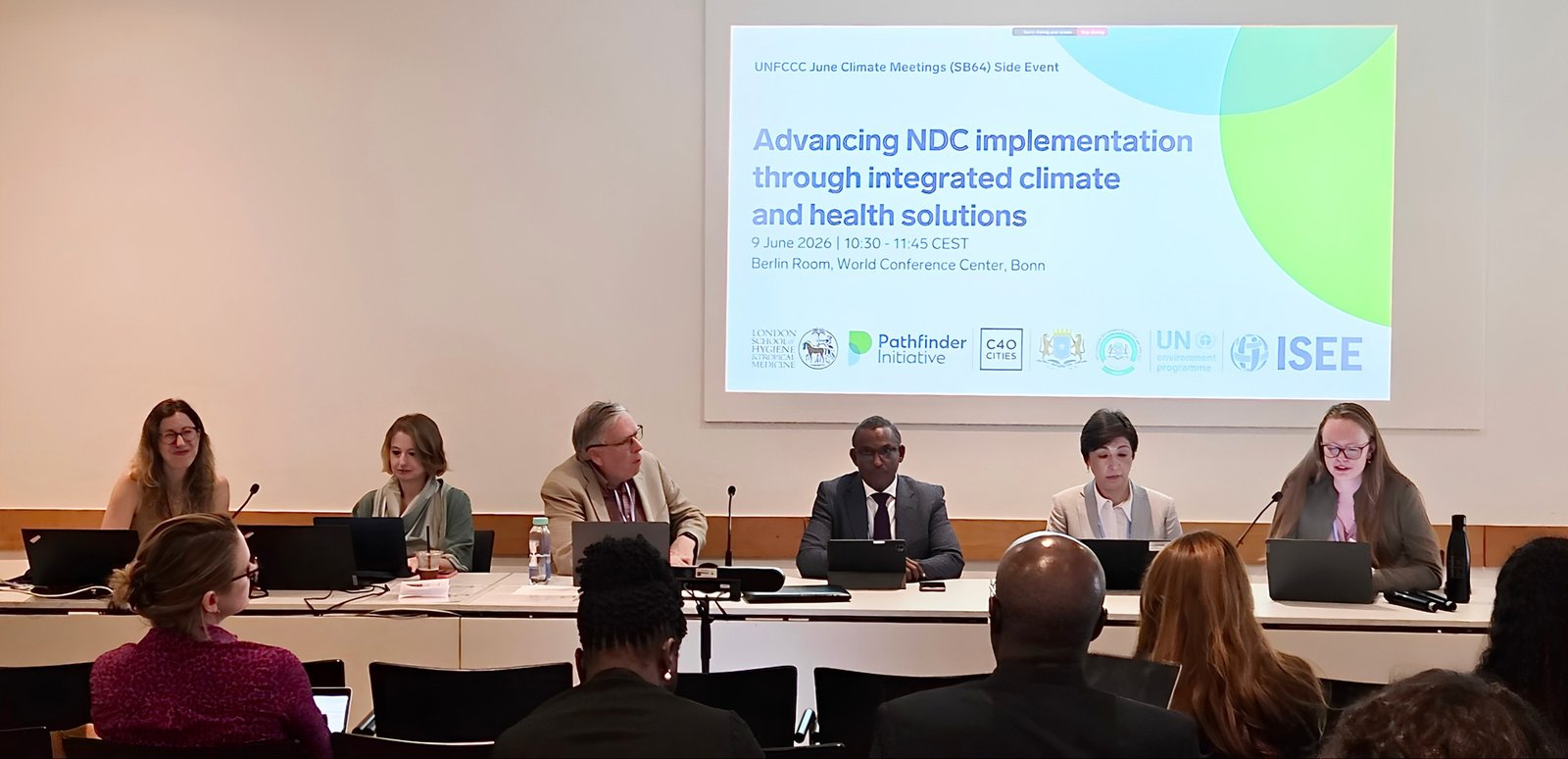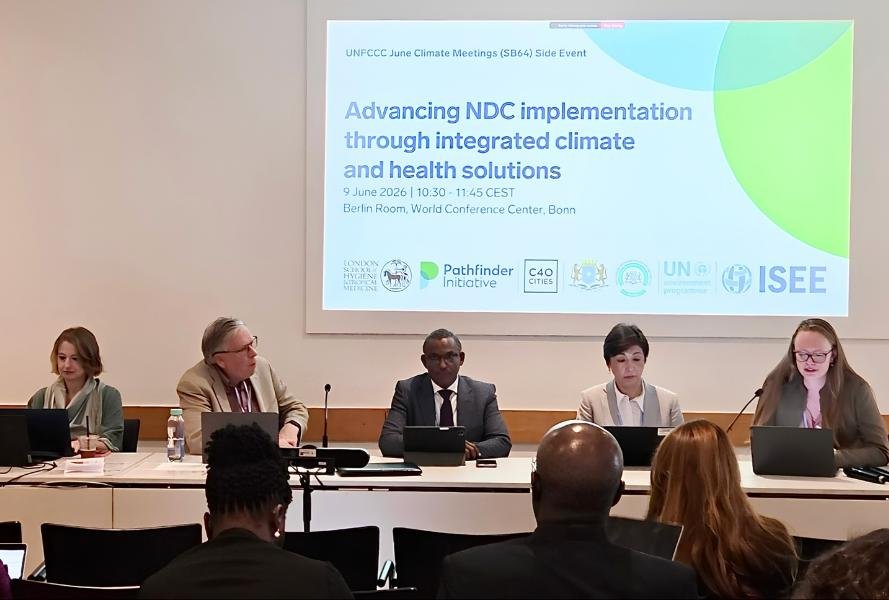
Climate and health integration was highlighted at a side event held during the UNFCCC June Climate Meetings (SB64), where participants examined how coordinated action can support Nationally Determined Contributions and National Adaptation Plans.
The event, “Advancing NDC Implementation through Integrated Climate and Health Solutions,” was hosted by the Pathfinder Initiative at the London School of Hygiene & Tropical Medicine, C40 Cities, the International Society for Environmental Epidemiology and the Government of Somalia. It brought together representatives from national government, cities, public health, climate policy and the United Nations.
Gulnara Roll, Head of the Sectoral Transition Section at the United Nations Environment Programme, discussed how integrated sectoral action can strengthen NDC and NAP implementation. She used sustainable cooling to show links between mitigation, adaptation and health. Through the Global Cooling Pledge, a collective commitment to cut cooling-related emissions by 68% by 2050, the UNEP-led Cool Coalition is supporting more than 70 countries in adding sustainable cooling to national climate plans, building codes, efficiency standards and procurement.
Roll cited Somalia, Nigeria and the United Arab Emirates as examples of how heat resilience and access to cooling are being included in national planning. Abdullahi Khalif, Senior Strategic Advisor on Climate Change at Somalia’s Ministry of Environment and Climate Change, outlined how Somalia is incorporating sustainable cooling, heat resilience, food systems and early warning into NDC implementation.
C40 Cities’ Urszula Kasparek highlighted urban planning, cleaner transport, walking and cycling infrastructure, climate-responsive buildings, improved air quality and green and blue spaces as areas where cities are testing measures that reduce emissions and improve health and quality of life.
Dr George D. Thurston of New York University, representing the International Society for Environmental Epidemiology, referred to evidence from India and Pittsburgh on air pollution measures that can also lower greenhouse gas emissions, prevent illness and generate economic benefits. Dr Lorna Benton of the Pathfinder Initiative cited examples from Paris, Monterrey and Barcelona, noting that scale-up depends on governance, financing, institutional capacity, political support and how costs and benefits are distributed across communities.