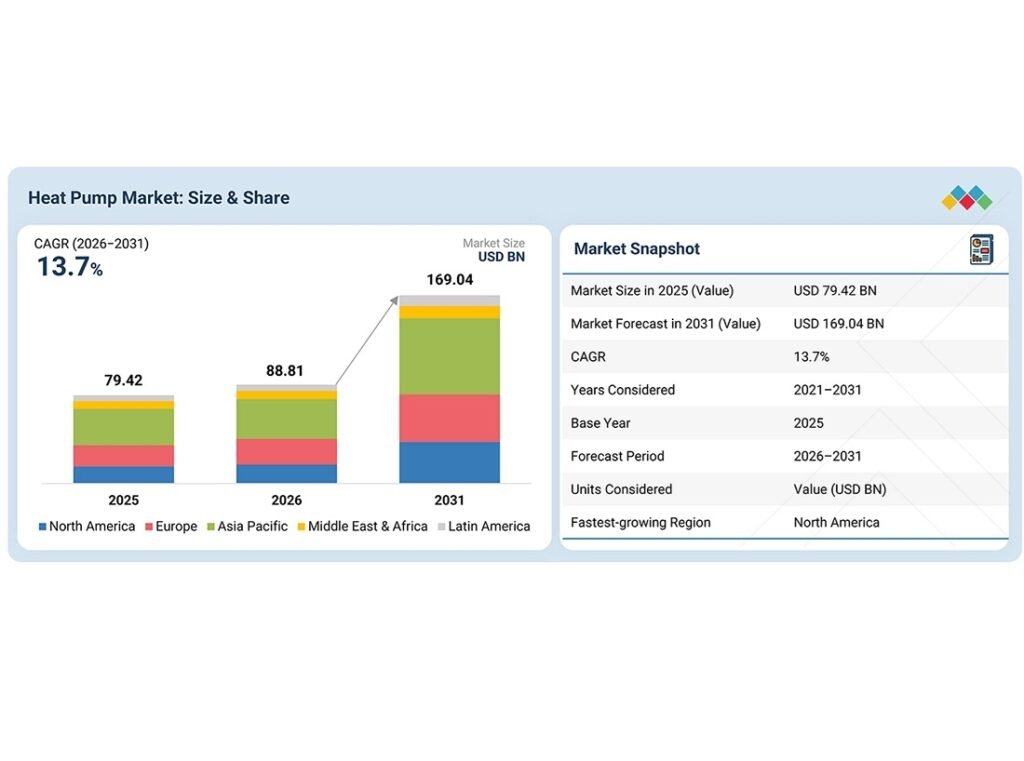
The global heat pump market is projected to grow from $88.81 billion in 2026 to $169.04 billion by 2031, representing a compound annual growth rate (CAGR) of 13.7%, according to MarketsandMarkets. The research firm cites electrification of space and water heating, decarbonization policies and the transition from fossil-fuel heating systems among factors supporting adoption.
Heat pumps supplied around 12% of global space-heating needs in buildings in 2024, with deployment concentrated in the US, China, Europe and Japan. China remained the largest heat pump market, while US heat pump sales exceeded natural gas furnace sales by 30% in 2024.
Air-to-water heat pumps are projected to record the highest CAGR during the forecast period. The report highlights adoption of low-GWP refrigerants including R290 and R32, alongside developments in heat pump water heaters, smart controls and high-temperature heat pump technologies. Natural refrigerants including R290 and CO2 are also contributing to product redesign and technology development.
Commercial buildings are projected to be the fastest-growing end-user segment. The report also identifies industrial process heating and district heating as emerging applications, stating that commercially available heat pumps could technically supply around 20% of global industrial heat demand, mainly in low- and medium-temperature processes.
North America is projected to record the highest regional CAGR at 17.0%. More than 20% of US households use heat pumps for space heating, while approximately two-thirds of US homes have the enabling conditions to replace conventional cooling-only air conditioners with reversible heat pumps, according to the report.