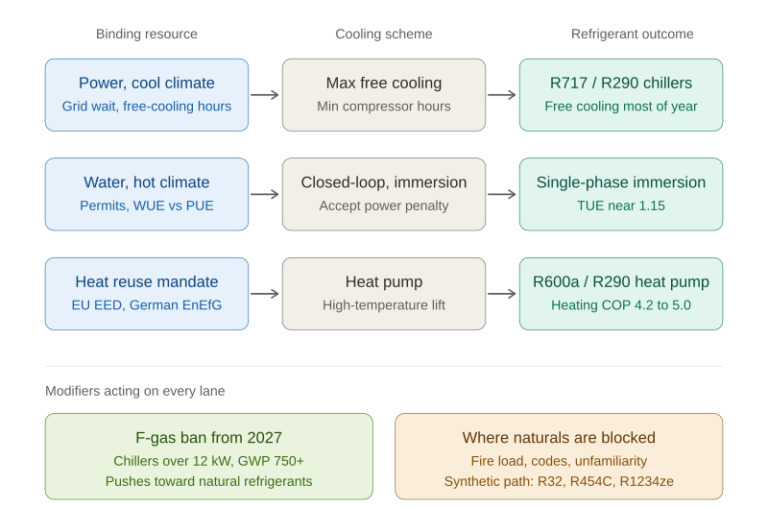
The first part of this series traced a chain of decisions from public data and disclosed projects: what a site can supply in power, water, and demand for waste heat sets the cooling architecture, and the architecture narrows the refrigerant. This part puts that chain to six people who build and supply the equipment.
The first link holds. Suppliers describe resource availability as the starting point of the design, and in some locations a cooling scheme is ruled out by site conditions before any technical comparison begins.
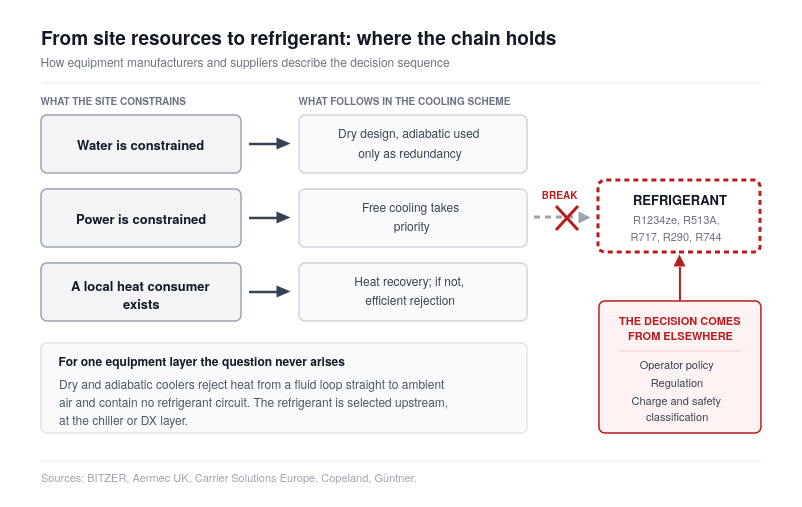
The second link does not. Refrigerant selection turns out to be only loosely coupled to the site. It is set by the operator’s corporate policy and by regulation, and for one entire equipment layer it does not arise at all.
Where the resource logic holds
Water is the constraint that shows up first, and it pushes designs dry.
“Where water is constrained, we lean dry and use adiabatic only as a form of redundancy, which often lets a site avoid on-site water storage entirely,” said Alex Schafer, Director of Sales for Climate Solutions at Güntner in Chicago. He linked this to conditions across the United States, where much of the country is now abnormally dry or in drought, including locations not traditionally treated that way.
Going dry costs energy on site, and Schafer put a number on what it costs and what it returns. A well-optimised adiabatic system may only use on the order of 10 to 20 percent more energy per year on site than an evaporative solution, with a large reduction in water use. Counted net rather than on site alone, the comparison changes. Treating and distributing 1,000 gallons of water takes roughly 3 to 5 kWh, and generating a kWh consumes 2 to 4 gallons, so once those off-site impacts are included the adiabatic system ends up using similar or slightly less total energy while cutting water consumption sharply. These are national averages, he noted, and vary considerably by location and generation mix.
Site conditions can narrow the design space on their own. At a high-ambient, high-humidity location such as Indonesia, with 35 to 40 °C dry bulb and humidity above 80 percent, the wet bulb sets the floor. Without mechanical cooling nothing below it can be supplied, so the decision turns on what fluid temperature the system actually needs.
Yan Evans, Managing Director of Güntner Data Center Solutions, described the same hierarchy. Where no water is available the solution has to be fully dry; where water is available but restricted, evaporative or adiabatic operation is used selectively at peak ambient conditions rather than as the default mode. His summary of the method: understand which resource is under pressure and design around that constraint from the beginning.
Power constraints push in the same direction. Evans framed it as an allocation problem, since every watt spent on cooling is a watt not available for compute.
Michel Grabon, Data Center Vertical Engineering Director and Product Marketing Director at Carrier Solutions Europe in Montluel, France, described the solutions Carrier commonly applies in Europe: primary-loop networks with air-cooled chillers and a hydronic free-cooling option, dry cooling where appropriate to limit water impact, and an option that caps chiller capacity where available power is restricted.
Mike Oakley, Senior Director of Portfolio Marketing at Copeland, linked the shift toward waterless air-cooled designs to public opinion, which he described as placing a premium on water conservation over power consumption, with chip manufacturers responding in turn by developing parts that run hotter and require less cooling.
Waste heat behaves differently from the other two resources, because it depends on conditions outside the fence. Grabon said Carrier offers recovery equipment compatible with district heating and industrial temperature levels up to 85 or 90 °C, and attached three conditions to it: suitable heat demand, infrastructure, and commercial arrangements. Evans set the same threshold, distinguishing sites with a practical local heat consumer from sites without one, where the objective stays efficient rejection. Oakley pointed to industrial heat pumps taking low-grade data center heat up to usable network temperatures for district heating.
Rising rack and chiller temperatures, Schafer said, are making fully air-cooled systems feasible in a way they were not previously, and Oakley described the same trend from the component side.
Where the chain breaks
The proposition that site resources reach through to the refrigerant met direct resistance.
Andy Hawes, General Manager Technical Services at Aermec UK in Rochford, Essex, said site resources are addressed upfront at system selection stage and heavily influence cooling strategy, but that the refrigerant choice “rarely if ever changes” as a result. Aermec supplies data center equipment on R513A and R1234ze, and Hawes was explicit about who picks between them: “Aermec follows the data centre operators’ own policy and does not directly choose the refrigerant.” He described operator requirements as driven by net zero goals, operational risk, and performance, and named the deciding factor as the customer’s own strategy rather than manufacturer preference. In the UK market he sees a preference for R1234ze on GWP and regulatory grounds, while noting that the performance envelope is broadly similar to R513A for most applications. Whichever fluid is chosen, the system is judged against the same criteria: he put European benchmark expectations for new facilities at annual PUE below 1.3, with some operators working toward 1.2 where site conditions allow.
Evans made a structural point that goes further. Dry and evaporative or adiabatic coolers reject heat from a fluid loop directly to ambient air and contain no refrigerant circuit at all. “That decision sits upstream, at the chiller or DX layer, and is made by the customer’s engineering team and equipment suppliers,” he said. For that layer of the system, the refrigerant question does not arise at all; it is settled elsewhere in the architecture.
Oakley described the same allocation of authority, saying operators must evaluate each application against their own goals, constraints, and available resources, with no single answer across systems or refrigerants. Grabon located the decision with customer requirements and applicable standards, led in Europe by the F-gas regulation.
Four companies place refrigerant authority with the operator. That is a consistent account from the supply side of how the decision is taken, and it describes customer behaviour as suppliers observe it.
The disagreement inside the supply side
Suppliers converge on who decides. They do not converge on what they would recommend if asked.
Dirk Schlehuber, Product Manager for Screw Compressors at BITZER in Sindelfingen, Germany, noted that low-GWP refrigerants such as R1234ze and R513A are widely used in established chiller solutions. In the EU market, BITZER recommends the use of natural refrigerants in new systems wherever technically and economically viable. He described the choice between naturals and low-GWP synthetics as application-driven rather than a strict either/or, and named the F-gas phase-down and potential PFAS restrictions as increasingly favouring naturals for new installations in Europe, with safety requirements decisive because flammability and toxicity govern the installation environment and the allowable charge. System architecture and project scale are also important factors in refrigerant selection.
Grabon reached a different conclusion from the same variables. Suitability of naturals depends on application, charge, system design, and safety requirements: R290 and R600a are flammable, R717 carries both flammability and toxicity considerations, and R744 may be less suitable for certain data center chiller applications depending on operating conditions. Carrier applies flammable naturals where the charge is limited, he said, but data center work usually means large capacity and correspondingly large charge, and in those cases the promoted option is A2L applied within the relevant safety standards, with R32 available where a customer accepts higher GWP. The European portfolio, he said, typically uses refrigerants with GWP below 10, such as R1234ze and R1233zd.
Oakley set out a middle position. Copeland compression is offered across A1, A2L, and natural refrigerants including R744, and he described synthetics as offering familiarity, efficiency, and potentially fewer constraints under local building codes, while naturals offer ultra-low GWP and reliable performance at the cost of system complexity driven by efficiency and safety requirements. He also said Copeland is partnering with equipment manufacturers to explore R744 CRAC units, aimed at regions where naturals are preferred over synthetics.
Evans listed the criteria he sees applied when that decision is taken: regulation, safety classification, service capability, energy performance, and long-term availability. Naturals are attractive in the right application, he said, but may require additional safety infrastructure, specialist training, and careful site planning.
The common thread across all four is that charge size and safety classification, rather than GWP on its own, constrain what is available to a large data center project. Where they part company is what follows from that. BITZER sees regulation as an important driver for the adoption of natural refrigerants, alongside safety requirements, system architecture and application-specific considerations, and recommends them for new EU systems where they work technically and commercially. Carrier, facing the large charges typical of data center capacity, promotes A2L for those installations.
What actually forces the decision
What pushes a project away from the technically best option is rarely the technology itself.
Schafer named capital cost first. A more efficient system can be designed by oversizing the heat rejection components, he said, but it may be infeasible in terms of capex. Three further constraints follow from the pace of the market: speed of deployment in a booming construction market, made harder by supply chain limits; skilled labour, increasingly difficult for operators trying to keep complex systems running efficiently and reliably; and infrastructure, where some facilities have ample water available but no means to get water to the site and carry wastewater away.
Oakley named unfamiliarity, describing a landscape evolving faster than many operators and EPC firms can track, with resistance to new technology and a preference for familiar solutions acting as a barrier to efficiency and reliability.
Evans named site selection and timing. Energy and water availability increasingly determine where operators build, so a site may be chosen for grid access, renewable potential, climate, land, or permitting even where another location would offer an easier cooling profile. A system that is technically sound when specified may also be less suitable by the time the site is operational, if regulation, local constraints, or IT loads have moved.
Hawes locates those pressures earlier. Operators weigh fire strategy and insurance requirements, corporate refrigerant policy, familiarity with new technology, and long-term maintenance capability, he said, and Aermec addresses those from the outset; mission critical customers rarely deviate from the agreed plan because they prioritise solutions that are right first time. On that account there is no late departure from the technically best option, because the constraints were written into the specification before it was issued.
The constraints the supply side puts forward are consistent, and none of them are refrigerant properties: capital cost, schedule, skilled labour, supply chain, and the physical connections a site can be given. Codes, insurance, and fire load enter the picture, but as inputs priced into the specification at the start rather than as the reason a design changes late.
Where this account comes from. The six contributors quoted here all build or supply equipment: BITZER, Aermec UK, Carrier Solutions Europe, Copeland, and Güntner. No data center operator or consulting engineer is among them, and operating data from live facilities stays with the operators. Statements about what operators decide, and why, are therefore the supply side’s reading of its customers rather than the customers’ own account.
What the suppliers expect to bind next
Schafer expects density to keep rising, with resource demand rising alongside it, restrictions on power and water tightening, and on-site generation becoming more common while adding complexity around heat island effects and water use. His summary of the real limit: reconciling efficiency and resource savings against capex, space, and proven reliability, and being realistic about what is reliable now against what is still maturing.
Schlehuber expects component requirements to tighten from the load side. Rising thermal loads call for higher capacities with reliable continuous operation, efficiency to meet PUE targets, and wider application limits, because increasing chip temperatures are shifting the levels at which cooling loads have to be managed, influencing the overall cooling architecture. Wider application limits, he added, also help enable heat recovery concepts.
Hawes expects refrigerant availability to bind as manufacturers migrate to lower GWP chemistries, alongside wider A2L adoption and the flammability management that comes with it. Oakley warned that the build-out itself may strain equipment supply chains, on top of competition for land, power, and water at the sites.
Evans put the constraint earlier, in project planning. Cooling architecture, redundancy strategy, and operating assumptions are difficult to reverse once a site is designed, and hybrid systems need the controls strategy, service approach, and operating procedures to be optimised over time. The sites that gain most, he said, treat cooling as a strategic design decision from the start rather than a late-stage equipment choice.
What emerges is a market where the site sets the architecture and the operator sets the refrigerant, and where the practical limits on both are capital, schedule, and people rather than the technical merits of any fluid. The operators’ own account of those decisions is the next piece of work.
Sources
Primary
Written responses provided to Refindustry, July 2026:
- Dirk Schlehuber, Product Manager Screw Compressors, BITZER, Sindelfingen, Germany. Company position.
- Andy Hawes, General Manager Technical Services, Aermec UK, Rochford, Essex, United Kingdom. Company position.
- Michel Grabon, Data Center Vertical Engineering Director and Product Marketing Director, Carrier Solutions Europe, Montluel, France. Personal expert view.
- Mike Oakley, Senior Director Portfolio Marketing, Copeland. Company position, global remit.
- Yan Evans, Managing Director, Güntner Data Center Solutions. Company position.
- Alex Schafer, Director of Sales, Climate Solutions, Güntner, Chicago, United States. Personal expert view.
Secondary
- Refindustry, “Power, Water, and Heat: How Site Resources Now Decide the Refrigerant in a Data Center“, part one of this series.