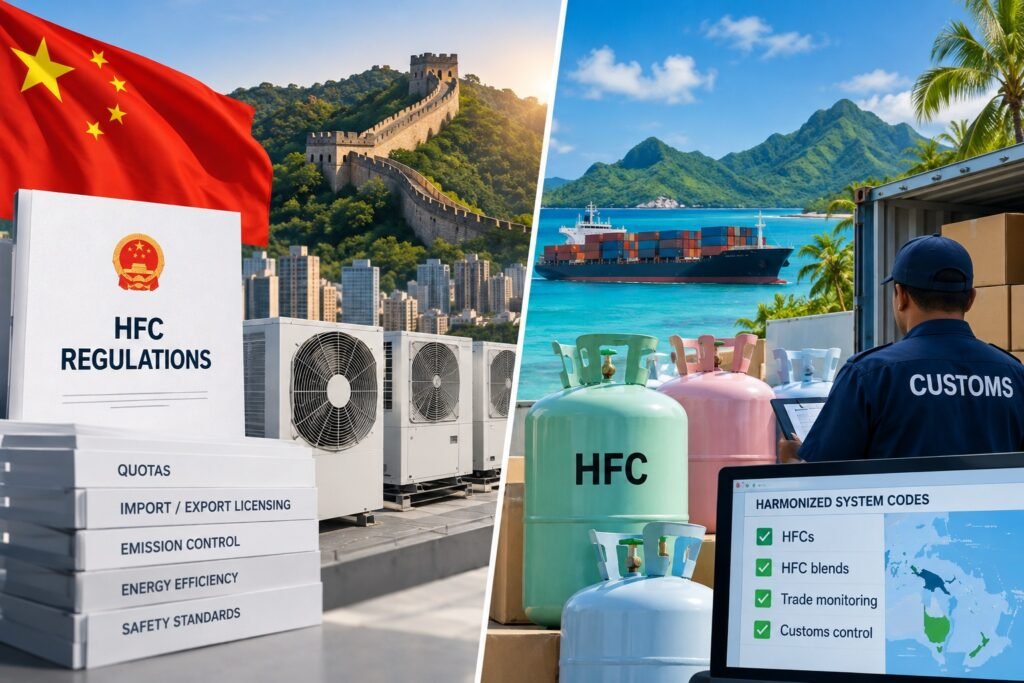
UNEP OzonAction has highlighted China’s HFC regulatory measures and a regional customs initiative involving 14 Pacific Island countries as part of its “10 Years, 10 Perspectives” series marking the 10th anniversary of the Kigali Amendment. The initiatives focus on strengthening refrigerant controls, improving trade monitoring and supporting national HFC reduction commitments.
China introduced annual HFC quota management and a national import and export licensing system in 2024. Its National Implementation Plan for the Montreal Protocol for 2025–2030 establishes phased HFC reduction targets and measures covering mandatory reporting, customs supervision, labelling, refrigerant recovery, recycling and emission control. The framework also incorporates energy-efficiency and safety standards.
A circular issued in February 2026 introduced further controls, including restrictions planned from 1 January 2029 on refrigerants with a global warming potential (GWP) above 750 in specified air conditioners and above 2,500 in most refrigeration equipment. China reports that HCFC consumption in commercial and industrial refrigeration has fallen by 67.5% from its baseline. HFC use was frozen at baseline levels in 2024, with a 10% reduction targeted for 2029.
China also reports phasing out approximately 720,000 tonnes of ozone-depleting substances, with estimated cumulative climate benefits of approximately 26 billion tonnes of CO2-equivalent emissions avoided between 1991 and 2020. These figures relate to the broader Montreal Protocol phase-out of ozone-depleting substances, rather than exclusively to HFC controls under the Kigali Amendment.
Meanwhile, 14 Pacific Island countries have worked with UNEP and the Oceania Customs Organization to establish dedicated Harmonized System codes for HFCs and HFC-containing blends under the Pacific Harmonized Commodity Description and Coding System. The codes help customs authorities identify individual refrigerants and blends, verify trade declarations and reduce misclassification risks. Participating countries also share trade data and periodically review refrigerants and mixtures used in the region to maintain the relevance of the classification system and support national licensing, quota and reporting requirements.