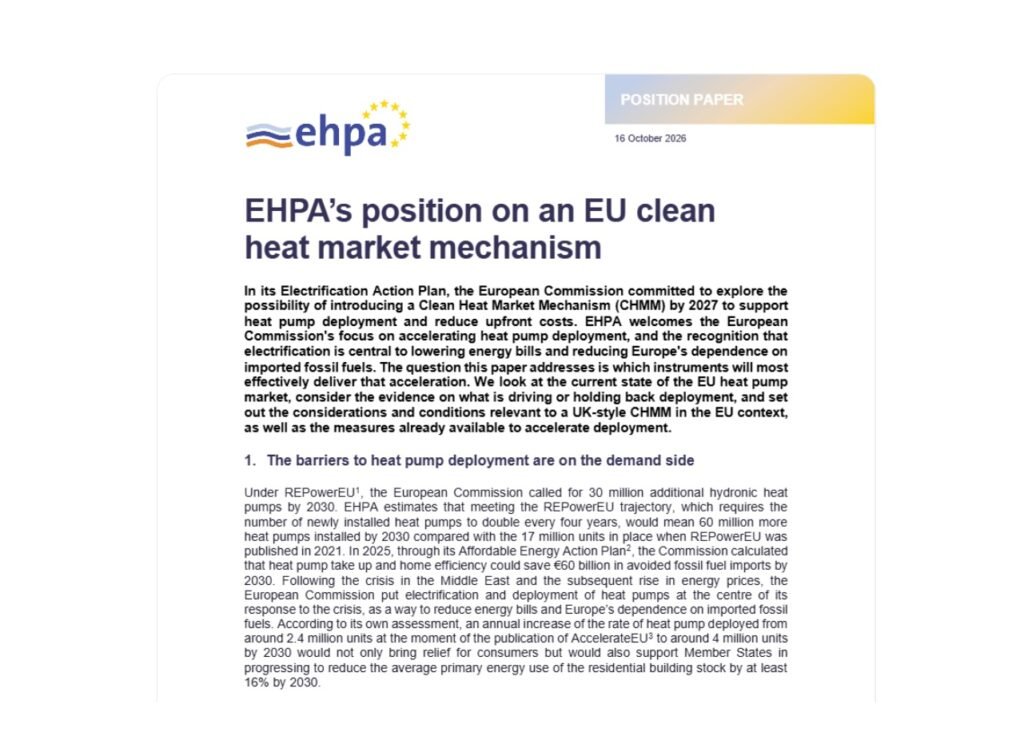
The European Heat Pump Association (EHPA) has called on the European Commission to prioritize measures addressing consumer demand rather than introducing a Clean Heat Market Mechanism (CHMM). In a position paper published in October 2026, EHPA argues that high electricity prices, upfront costs, installer availability and grid capacity are the main barriers to accelerating heat pump deployment across the EU.
The European Commission is exploring a CHMM by 2027 to support heat pump installations and reduce upfront costs. EHPA maintains that European manufacturing capacity is not the primary constraint. The sector supports approximately 433,000 direct and indirect jobs, while manufacturers had committed €7 billion to production capacity expansion by 2023. According to EHPA, more than 80% of monobloc heat pump units and over 90% of indoor units sold in Europe are assembled within the region.
Electricity prices remain a central concern. According to Eurostat data cited by EHPA, household electricity-to-gas price ratios ranged from 1.30 in Sweden to 5.11 in Romania during the second half of 2025. The European Commission’s Electrification Action Plan aims to bring this ratio below 2.5 in every Member State by 2030. EHPA argues that obligations imposed on manufacturers would not directly address the operating costs influencing household purchasing decisions.
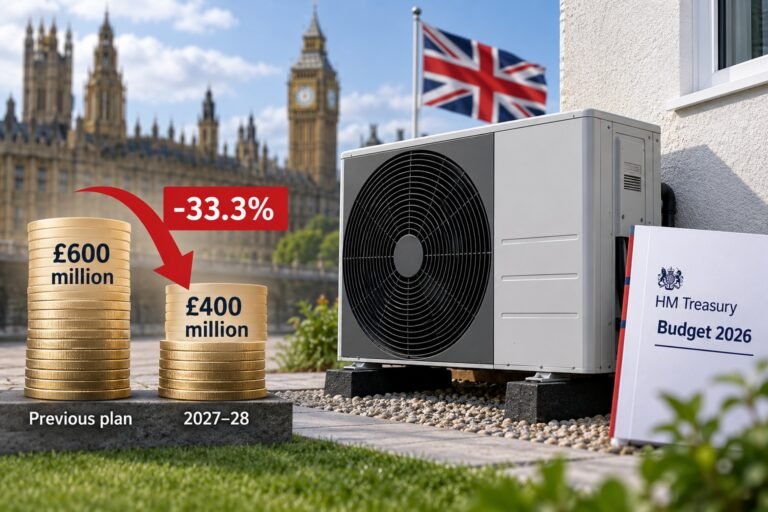
The association also examines the UK’s Clean Heat Market Mechanism, introduced in April 2025. The scheme requires qualifying boiler suppliers to meet heat pump installation targets or pay penalties of £500 per missing credit. Official UK statistics show that retrofit heat pump installations fell by 22% in the first half of 2026 compared with the same period in 2025. However, EHPA cautions that the scheme has operated for too short a period, alongside other support measures, to establish its effectiveness.
Instead, EHPA recommends reforming electricity taxation and network charges, implementing ETS2 fully and on time, enabling 0% VAT on heat pumps, phasing out fossil fuel subsidies through binding legislation, and improving national subsidy schemes and installer training. If the EU proceeds with a CHMM, the association calls for an impact assessment, transparent credit trading, safeguards against market distortion and recognition of the different heat pump technologies used across European markets.
EHPA concludes that a CHMM is not currently the priority for accelerating heat pump deployment. Any future mechanism should demonstrate additional benefits beyond existing policies, provide predictable obligations for manufacturers and reflect differences between EU Member States.