The European Commission’s proposed Industrial Accelerator Act (IAA) would link public support for heat pumps to European manufacturing requirements. Presented on March 4, 2026, the proposal aims to increase manufacturing’s share of EU GDP from 14.3% in 2024 to 20% by 2035. It includes a proposed minimum threshold of 50% EU added value when reviewing the definition of substantial transformation.
According to an analysis by Johann Zirngibl, member of the AICVF International Committee and Vice-President of REHVA, national requirements are already emerging ahead of EU-wide legislation. Since September 2026, France has offered higher subsidies for heat pumps produced in the European Economic Area. Full eligibility under its energy savings certificate scheme requires recognized quality certification and refrigeration circuit assembly within the EEA. The French approach differs from the IAA proposal, which addresses the broader heat pump value chain.
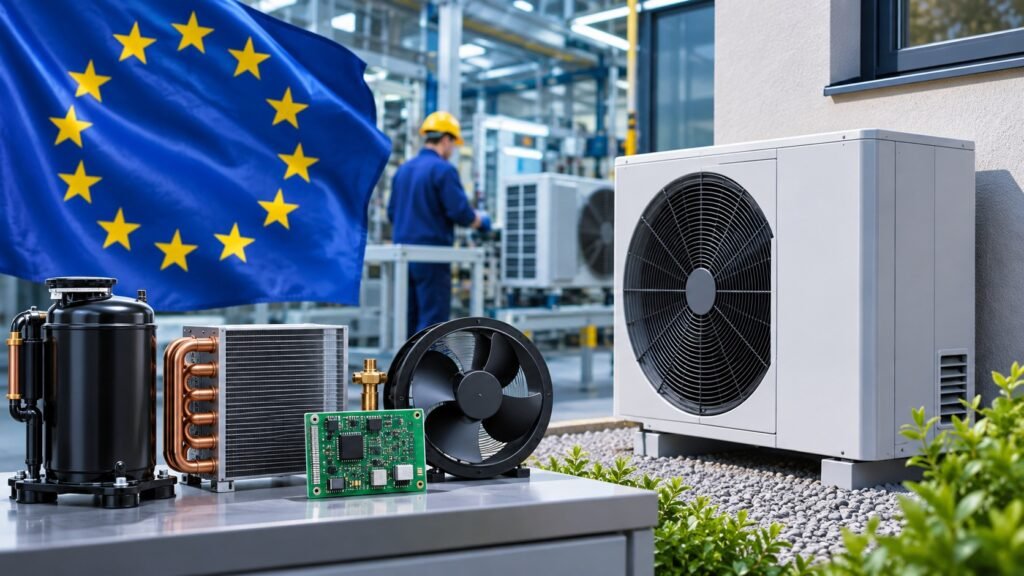
Components account for approximately 60–85% of heat pump production costs, while assembly represents 18–30% of a heat pump’s value. For air-to-air and air-to-water heat pumps, compressors and controls each account for approximately 25% of total value, followed by heat exchangers at 15% and fans, piping and refrigerants at 13%. These figures illustrate the importance of component sourcing in defining European manufacturing.
The analysis reports that the EU shifted from a net exporter to a net importer of heat pumps after 2020, driven by increased imports of compressors, electronics and lower-cost complete units. Although 60–73% of heat pumps installed in the EU are also assembled within the Union, international competitiveness has declined for most components compared with Asia. European manufacturers retain a strong position in heat exchange units, while thermostats are the exception to the reported decline in competitiveness.
Zirngibl warns that growing heat pump demand, supported by public subsidies, could increase dependence on imported equipment and components unless European manufacturing capacity expands. He also highlights the complexity of defining European origin when manufacturers operate production facilities in multiple countries and component supply chains can change for the same product. The European Parliament’s committee vote on the proposed legislation is scheduled for December 1, 2026.