In March 2020 “INGENIUM” completed work on equipping the “Maersk” production and storehouse complex (Saint Petersburg) with refrigeration systems. “INGENIUM” provided the entire process of manufacturing, installation and starting-up and adjustment of the equipment. This project has become another challenge for “INGENIUM” and also the opportunity to implement new developments in the field of CO2 refrigerant use.
The technical features:
- 3 chambers: +13˚/+6˚/-25˚C
- >40,000 pallet locations
- >50,000 tons storage capacity
The use of CO2 as a refrigerant will reduce energy consumption for the “Maersk” company by 25-30%. Implementation of innovative solutions from “INGENIUM” below will make it possible for the “Maersk” warehouse complex to significantly reduce the operating costs and the payback period of this investment project.
Technicalities of the project
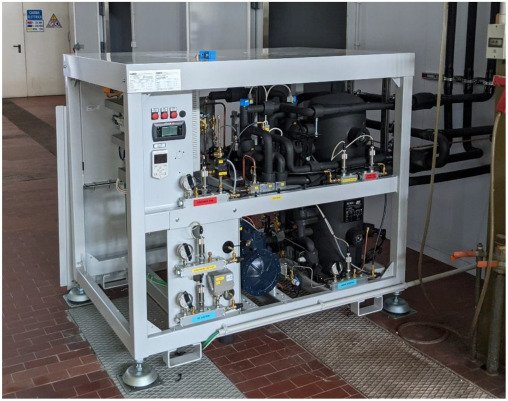
The storage facilities and the ventilation systems of the multi-temperature complex are equipped with three centralized refrigeration systems with two-step CO2 refrigerant compression. These systems operate in transcritical and subcritical cycles depending on the ambient temperature.
High energy efficiency of the refrigeration equipment is achieved through parallel compression refrigeration system. The system is constructed on the basis of “Dorin” semi-hermetic reciprocating compressors. The compressors used for the low-temperature circuit are four-cylinder subcritical compressors of CDS41 type. Three compressors are used for each compressor unit. Middle-temperature compressors for the high-pressure stage and also those of parallel compression are of CD400 type. For each circuit of the compressor unit five and two compressors were used correspondingly.
To provide smooth system control and higher partial load efficiency the leading compressors of each boiling circuit were equipped with frequency converters.
The “Maersk” complex has been equipped with air-coolers for storage facilities manufactured by the “Lu-Ve” company. Defrosting of air-coolers is performed by supply of propylene glycol-based heat transfer fluid (+30C). The heat transfer fluid is supplied into the separate circuit of the tubular-brazed plate heat exchanger and into the coil, located in the drainage pan. This solution has made it possible to significantly reduce energy consumption of the refrigeration system and consequently the operational expenses. Rejection of the use of electric thermal heaters improved the reliability of the defrosting system.
Ground heating under the deep-frozen compartment is performed by means of warm propylene glycol-based heat transfer fluid. The heat transfer fluid is supplied into the pipelines of the ground heating system, running under the insulation layer. The ground heating system was made as multi-circuit to provide redundancy.
Thermal energy for own needs of the refrigeration unit is selected from two high-temperature levels, as well as from parallel compressors. The selection is made from the discharge line of the low-stage compressors (low-temperature compressor) which reduces the load on the upper-stage compressors, and from the high-pressure line of the total compressor discharge in the upper stage of compression (middle-temperature compressor). The thermal energy is accumulated in the buffer tank and after that is distributed over two consumption circuits:
1. Air-coolers deicing system
2. Ground heating system for the protection of soil in the deep-frozen compartment.
The primary circuit compressors of the heat recuperation system and air-coolers deicing circuit compressors are equipped with frequency drives. The frequency drives allow reducing energy consumption while reducing heat transfer fluid consumption during system operation.
The refrigeration of the ventilation system for fresh fruit and vegetable storage facilities is performed by means of intermediate propylene glycol-based coolant. The temperature of the coolant in the brazed plate heat exchanger decreases due to CO2 refrigerant boiling. The compressors supplying the coolant to the heat exchanger of the inflow ventilation are also equipped with frequency drives. This solution reduces energy consumption by reducing coolant consumption during low load system operation.
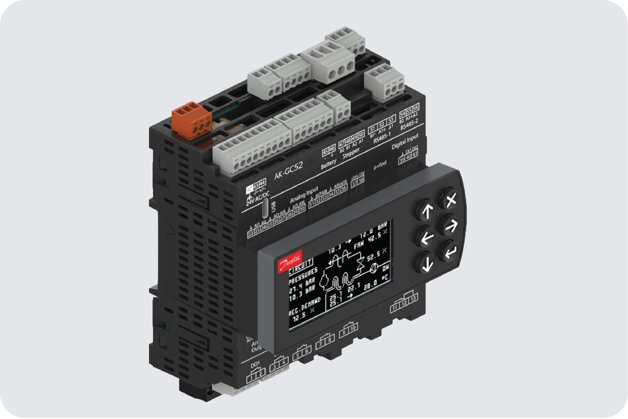
In addition to the above-mentioned energy-efficient technical solutions the controllers of the “Danfoss” company and the refrigeration dispatch system “Danfoss Adap-Kool” was used for the refrigeration system automation. The controllers are equipped with energy-saving operation algorithm for refrigeration units and the system provides the collection of data related to refrigeration unit functioning and optimizes the boiling and deicing pressure.
The ratification by Russia of the Kigali amendment to the Montreal Protocol on Substances that Deplete the Ozone Layer and the Kyoto Protocol on Substances (greenhouse gas) that Affect the Global Warming, and also the strict requirements of the European Regulation contribute to increasing use of environmentally-friendly CO2 refrigerant in Russia and elsewhere.
“INGENIUM” is the leading company in the field of introducing CO2 technologies on the Russian market. The company has implemented about 20 carbon dioxide projects in the last few years and today the company continues to reaffirm its high level of competency concerning the application of the technology in Russia. “INGENIUM” constructs energy-saving refrigeration facilities in accordance with advanced world market trends to increase the cost-efficiency of your business!