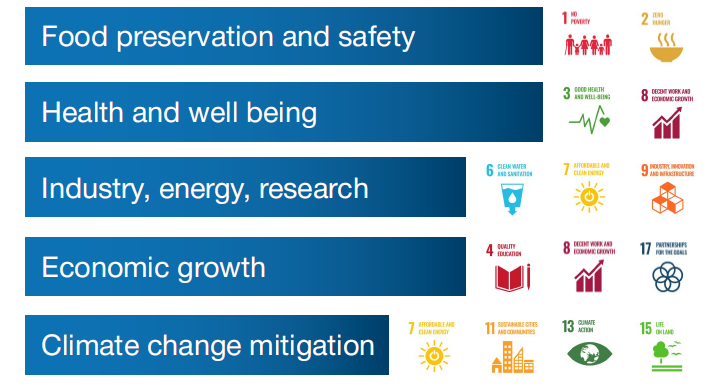
The International Institute of Refrigeration (IIR) has published the updated 3rd edition of the “Technical Brief on Refrigeration Technologies,” authored by Monique Baha, Souhir Hammami, and Jean-Luc Dupont. This extensive report thoroughly examines refrigeration’s indispensable role in the global economy, climate resilience, and human health.
Foreword by Dr. Yosr Allouche Dr. Yosr Allouche, General Director of the IIR, emphasizes the urgency and relevance of this report, particularly given that 2024 was the hottest year on record. Dr. Allouche highlights the paradoxical nature of refrigeration as both an essential solution for climate-driven crises and a significant contributor to environmental challenges. She underscores the critical need for global collaboration in transitioning to low-global-warming-potential (GWP) refrigerants and energy-efficient technologies, stating refrigeration is “the invisible backbone of civilization,” essential for preserving life, enhancing health, and driving economic growth.
Introduction The report underscores the unprecedented heat recorded in 2024, highlighting the urgent global necessity for sustainable refrigeration as a critical component in climate mitigation and adaptation strategies. It identifies that over 1.12 billion people worldwide, primarily among impoverished communities, lack sufficient access to refrigeration, exacerbating food insecurity and health crises.
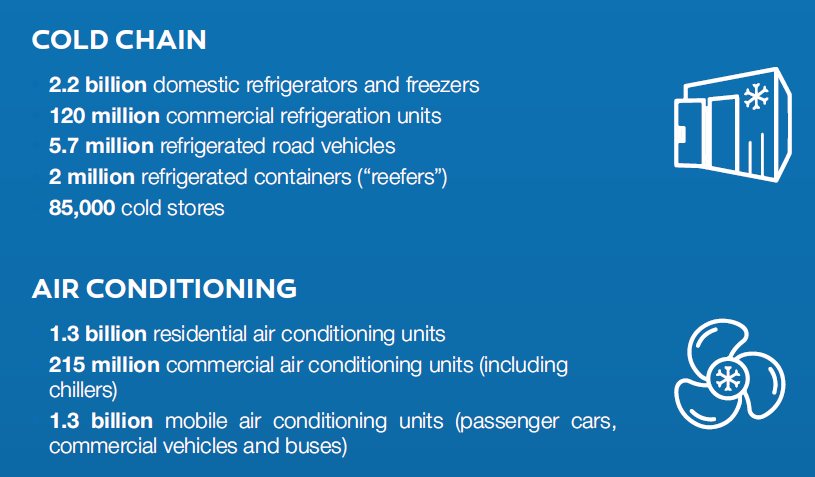
Refrigeration Economics The economic analysis presented reveals the substantial global refrigeration market, with annual sales exceeding USD 300 billion. It identifies approximately 5.4 billion refrigeration units currently in operation globally, emphasizing their significant role in international trade and employment. The refrigeration industry directly supports about 12 million jobs worldwide, highlighting both its economic importance and challenges, such as workforce shortages and the need for enhanced vocational training.
Role and Applications of Refrigeration The brief details refrigeration’s diverse applications across multiple sectors:
-
Food Systems: It highlights the critical role of refrigeration in the global food supply chain, where an efficient cold chain can significantly reduce food waste and losses, thereby potentially feeding an additional 950 million people annually.
-
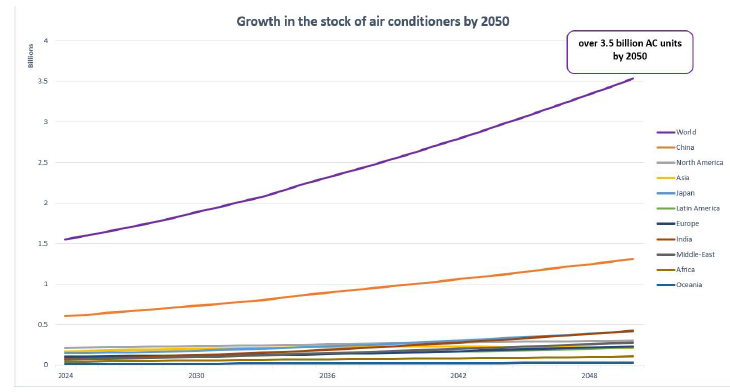
Air Conditioning and District Cooling: The growing global stock of air conditioners is expected to double by 2050, driven by increasing temperatures and urbanization. District cooling is presented as an efficient alternative, with notable adoption in regions like the Middle East, significantly reducing energy use compared to traditional air conditioning systems.
-
Heat Pumps: Emphasized as an energy-efficient solution for both heating and cooling, heat pumps can substantially reduce global CO₂ emissions, with potential savings equating to the annual emissions of all cars in Europe by 2030.
-
Health Sector: Refrigeration’s pivotal role in healthcare, particularly in vaccine storage and distribution, has significantly impacted public health, enabling global vaccination efforts and reducing disease prevalence.
-
Industry, Transport, and Energy: Cryogenic refrigeration technologies are critical in various industrial processes, including natural gas liquefaction and hydrogen storage, significantly contributing to energy efficiency and emission reductions.
-
Science and Research: Advanced refrigeration technologies, such as superconductivity and cryogenics, are facilitating groundbreaking scientific research in physics, computing, biomedical research, and sustainable water solutions.
Refrigeration and Climate The report also addresses refrigeration’s environmental impacts, highlighting its responsibility for approximately 7.5% of global CO₂ emissions due to energy consumption and refrigerant leakage. It stresses the necessity of adopting low-GWP refrigerants and enhancing refrigeration system efficiencies to mitigate these effects.
Recommendations The IIR advocates for national and international measures to support sustainable refrigeration development, including implementing stringent minimum energy performance standards (MEPS), encouraging the transition to natural refrigerants, and strengthening workforce capabilities through targeted training programs.
This comprehensive technical brief serves as a critical resource for policymakers, industry leaders, and sustainability advocates seeking to enhance refrigeration practices globally.