Esta página solo está disponible en inglés. Ir a la portada en español

×

Questa pagina è disponibile solo in inglese. Home page in italiano

×

Diese Seite ist nur auf Englisch verfügbar. Zur deutschen Startseite

×

Cette page est disponible uniquement en anglais. Aller à la page d'accueil en français

×

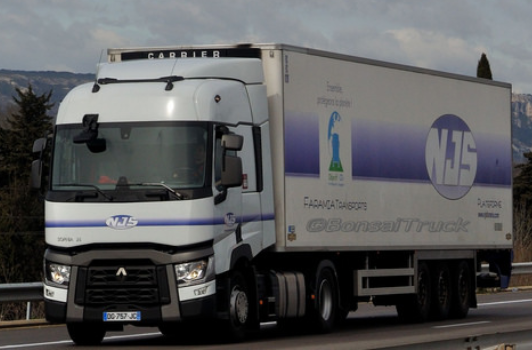
Carrier Transicold Equips Transports NJS Faramia’s First Bioethanol-fuelled Refrigerated Truck

Carrier Transicold Equips Transports NJS Faramia’s First Bioethanol-fuelled Refrigerated Truck

It’s a new refrigerated truck fuelled by bioethanol, produced from grape pulp, and cooled by an engineless refrigeration unit that’s been perfected by Carrier Transicold. Transports NJS Faramia’s first bioethanol-fuelled straight truck is an eco-responsible solution to improve sustainability and Carrier Transicold’s engineless refrigeration unit will help it do just that – reducing its environmental impact by cutting emissions and improving fuel efficiency, whilst also reducing maintenance costs.  

Designed to meet the growing demand for urban distribution, the engineless electric system offers a cooling capacity of up to 18,400 watts and operates with Carrier Transicold’s ECO-DRIVE GenSet to harvest power from the truck’s clean Euro VI engine. Configured with dual compressors and economisers, the unit operates on different refrigerating circuits, which helps maintain maximum capacity, even at idle. The PIEK-certified refrigeration unit also ensures a significant reduction in noise (operating below 60 dB(A)) for use in urban areas.

Carrier Transicold’s engineless refrigeration system enables Transports NJS Faramia to provide an energy-efficient solution that is economically viable and meets its customers’ environmental requirements.

“Since its founding in 1984, Transports NJS Faramia has been providing its customers with transport and logistics services that take into account economic efficiency, social equality and environmental issues,” said Didier Urbaniak, General Sales Director, Carrier Transicold France. “These objectives are part of the company’s core philosophy, aimed at achieving long-term customer satisfaction through a policy of sustainable development – values that we share at Carrier Transicold. We are delighted to support Transports NJS Faramia in this continuous improvement process.”

One of its customers is a well-known frozen-food brand for which Transports NJS Faramia makes many deliveries of frozen products at -18° Celsius. In total, the truck equipped with Carrier Transicold’s engineless refrigeration technology has already covered nearly 38,000 km, which equates to around 9,000 km/month. Transports NJS Faramia plans to equip other trucks with the engineless technology.
Get the daily refrigeration briefing

One email a day. Trusted by 3,000+ RACHP professionals.

More on Cold Chain

All on Cold Chain →

Insights

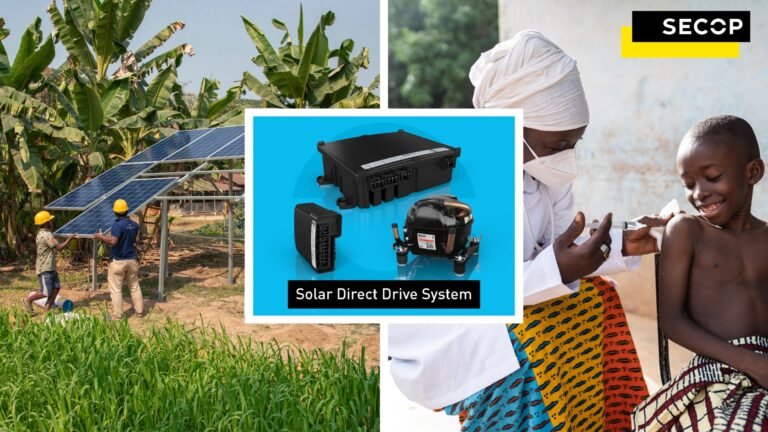
Secop's Solar Direct Drive (SDD) System Earns WHO PQS Approval – The Team Behind It
Article

Secop’s Solar Direct Drive (SDD) System Earns WHO PQS Approval – The Team Behind It

Partner's material In March 2026, Secop’s Solar Direct Drive Power Management Module was granted WHO PQS prequalification and officially listed in the WHO Catalogue of Prequalified Immunization Devices. The WHO IMD-PQS (Immunization Devices Performance, Quality and Safety programme) is the global benchmark for cold chain equipment used in immunisation. Being listed in its catalogue is

22 Jun 2026
Case Study - Effect of Louvers or diffusers on air flow distribution and cooling time on a meat log during Chill cycle
Tech Guide

Case Study – Effect of Louvers or diffusers on air flow distribution and cooling time on a meat log during Chill cycle

By Kushal Aurangabadkar An experimental analysis was conducted on a cooler space measuring 3.66 m × 6.096 m (12.0 ft × 20.0 ft), equipped with an ammonia refrigeration coil, five 30 cm (12 in.) fans, and five diffusers. The study measured airflow patterns, cooling rates, and heat transfer efficiency in meat storage by testing two configurations:

Kushal Aurangabadkar · 21 Jan 2026
Total Cost of Ownership (TCO) for Modular Refrigeration Systems in Life Sciences Distribution Centers
Tech Guide

Total Cost of Ownership (TCO) for Modular Refrigeration Systems in Life Sciences Distribution Centers

by Ramez Naguib, P.E. Introduction Life sciences distribution centers are under immense pressure to deliver consistent temperature control, comply with increasingly stringent regulations, and optimize operational efficiency. Traditional built-up refrigeration systems often prove cumbersome, costly, and slow to implement. In contrast, modular, factory-assembled refrigeration systems have emerged as a compelling alternative. Drawing on lessons from

14 Jan 2026
Everything on Cold Chain: 2,045 articles, 2 case studies, 23 insights

Most read this month

All news →