Esta página solo está disponible en inglés. Ir a la portada en español

×

Questa pagina è disponibile solo in inglese. Home page in italiano

×

Diese Seite ist nur auf Englisch verfügbar. Zur deutschen Startseite

×

Cette page est disponible uniquement en anglais. Aller à la page d'accueil en français

×

Carrier Transicold Launches Three New Refrigeration Units in the UK and Ireland

Carrier Transicold Launches Three New Refrigeration Units in the UK and Ireland

Cold Chain Federation member Carrier Transicold is introducing three new transport refrigeration units into the UK and Ireland, delivering significant operational and environmental benefits for truck, trailer and light commercial vehicle fleets.

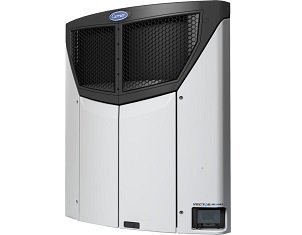
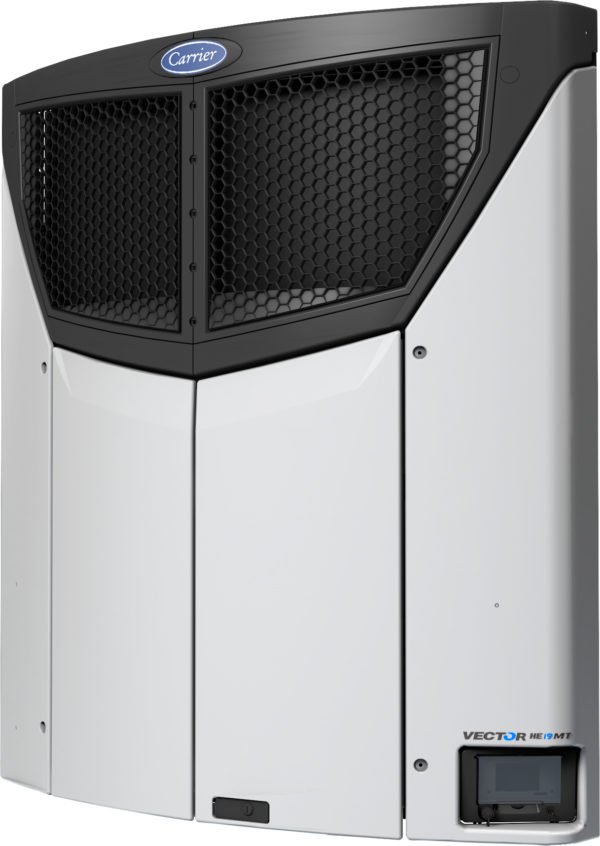
The new models include the first PIEK-certified version of its flagship Vector HE 19 (High Efficiency) trailer unit, which will now operate below 60 decibels, the equivalent of normal conversation, in either a mono or multi-temperature configuration.

“Our new PIEK-compliant Vector HE 19 takes quiet-running to a new level, being perfect for fleets making frequent night-time deliveries to stores in residential areas,” said Scott Dargan, managing director, Northern Europe, Carrier Transicold.

Carrier Transicold has met these strict PIEK levels whilst packaging the new system within the regular Vector HE 19 chassis. The previous generation PIEK-certified Vector 1950 City had its diesel engine housed in an insulated cabinet underneath the trailer.

Available now, the new PIEK-certified Vector HE 19 is an addition to the range, offering operators the same 10% reduction in weight, 19% reduction in energy consumption and up to 30% reduction in fuel consumption versus the previous generation Vector 1950.

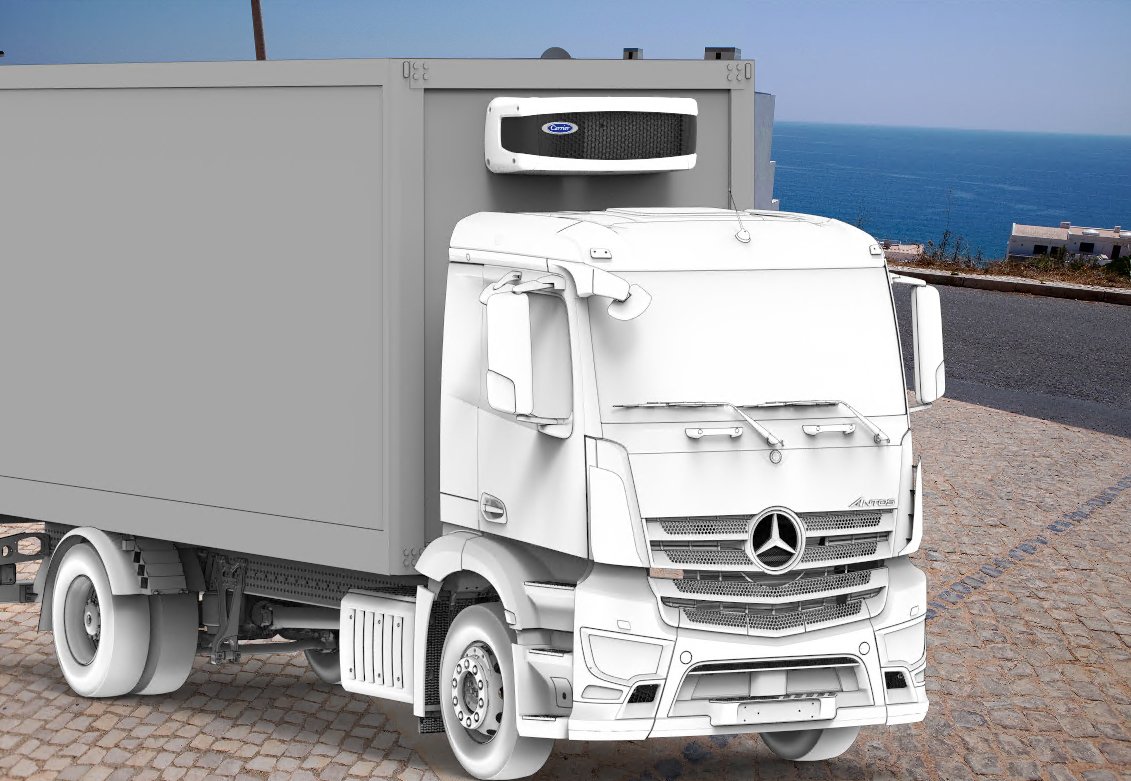
Also debuting in the UK and Ireland this year will be the new Xarios 8 refrigeration system which is ideal for the larger rigid truck market. The Xarios 8 unit has improved efficiency and a third more cooling capacity compared to the current Xarios 600, along with a very low refrigerant charge, a new evaporator ventilation motor and brushless condenser ventilation system to reduce wear on parts, and lower maintenance costs. Additionally, its shell is manufactured by injection moulding, reducing manufacturing steps and improving the build process.

“The new Xarios 8 fits perfectly between the current Xarios 600 and our engineless ICELAND system, enabling us to offer a high capacity direct-drive system which is ideal for larger trucks used in urban distribution,” said Dargan.

The third new model Carrier Transicold will bring to market is the Neos HE 100 S for light commercial vehicles. This electrically driven system optimises energy consumption, while maintaining a cooling capacity and look almost equivalent to the standard Neos 100 S system.

The unit features new technology, enabling a 35% reduction in energy consumption to 58 amps. It also offers precise temperature control of an insulated load space, varying in size from two to 6m3.
Get the daily refrigeration briefing

One email a day. Trusted by 3,000+ RACHP professionals.

More on Cold Chain

All on Cold Chain →

Insights

Secop's Solar Direct Drive (SDD) System Earns WHO PQS Approval – The Team Behind It
Article

Secop’s Solar Direct Drive (SDD) System Earns WHO PQS Approval – The Team Behind It

Partner's material In March 2026, Secop’s Solar Direct Drive Power Management Module was granted WHO PQS prequalification and officially listed in the WHO Catalogue of Prequalified Immunization Devices. The WHO IMD-PQS (Immunization Devices Performance, Quality and Safety programme) is the global benchmark for cold chain equipment used in immunisation. Being listed in its catalogue is

22 Jun 2026
Case Study - Effect of Louvers or diffusers on air flow distribution and cooling time on a meat log during Chill cycle
Tech Guide

Case Study – Effect of Louvers or diffusers on air flow distribution and cooling time on a meat log during Chill cycle

By Kushal Aurangabadkar An experimental analysis was conducted on a cooler space measuring 3.66 m × 6.096 m (12.0 ft × 20.0 ft), equipped with an ammonia refrigeration coil, five 30 cm (12 in.) fans, and five diffusers. The study measured airflow patterns, cooling rates, and heat transfer efficiency in meat storage by testing two configurations:

Kushal Aurangabadkar · 21 Jan 2026
Total Cost of Ownership (TCO) for Modular Refrigeration Systems in Life Sciences Distribution Centers
Tech Guide

Total Cost of Ownership (TCO) for Modular Refrigeration Systems in Life Sciences Distribution Centers

by Ramez Naguib, P.E. Introduction Life sciences distribution centers are under immense pressure to deliver consistent temperature control, comply with increasingly stringent regulations, and optimize operational efficiency. Traditional built-up refrigeration systems often prove cumbersome, costly, and slow to implement. In contrast, modular, factory-assembled refrigeration systems have emerged as a compelling alternative. Drawing on lessons from

14 Jan 2026
Everything on Cold Chain: 2,045 articles, 2 case studies, 23 insights

Most read this month

All news →