Esta página solo está disponible en inglés. Ir a la portada en español

×

Questa pagina è disponibile solo in inglese. Home page in italiano

×

Diese Seite ist nur auf Englisch verfügbar. Zur deutschen Startseite

×

Cette page est disponible uniquement en anglais. Aller à la page d'accueil en français

×

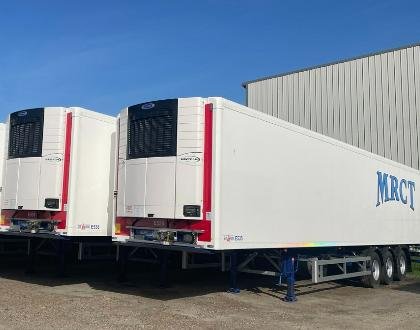
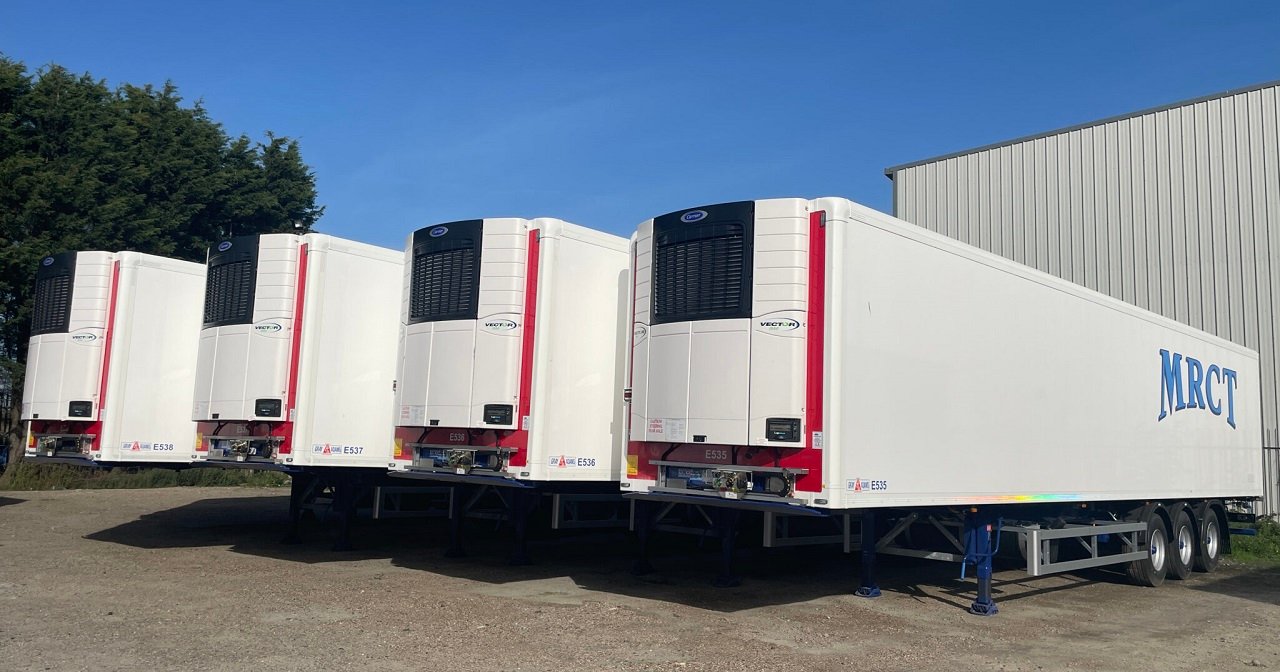
Gray & Adams built eight 14.6m reefers for MRCT

Gray & Adams built eight 14.6m reefers for MRCT

MRCT has been in operation since 1969 and is a family-owned company that describes itself as being deeply committed to its customers and staff. The business delivers a wide range of chilled and frozen food products and operates from their HQ in Suffolk as well as five other depots in strategic locations in England.

As a forward-thinking company, MRCT took part in the trial of operating longer length semi-trailers as soon as it was announced because they could see the environmental and economic benefits that it could bring to both the company and its customer. MRCT found that LST’s carrying 28 pallets to distribute their goods allowed for the best volume to weight balance as well as reducing journey numbers which would ultimately create a positive impact on the reduction of CO2 emissions from the business.

Anticipating the end of the 12-year trial, MRCT approached Gray & Adams to build a further eight 14.6m single deck, single temperature trailers, fitted with Carrier refrigeration units, to be incorporated into the fleet as part of their general replacement programme.

David Brown, Managing Director of MRCT said,

“I re-joined MRCT in 2007 after 10 years at other companies within the industry, I first fostered a good working relationship with Gray & Adams in 1998 and have always found them to be very professional to deal with, their customer service is superb, and the quality of the finished trailers are always excellent. For this reason, we continue to work with G&A and they have recently supplied us with eight 14.6m trailers following a UK wide trial of LSTs.

From MRCT’s perspective and through analysing our own data, we found the 14.6m trailers to be no more challenging, and just as safe to operate as a standard 13.6m trailers, and we could see the cost and environmental benefits it would bring to the business. We were disappointed to see that when the findings of the DfT’s consultation was released it recommends additional regulatory controls. My opinion, from an operator’s perspective is that differences between the operation of 14.6m to a 15.66m trailers should be looked into again and given additional consideration.”

Get the daily refrigeration briefing

One email a day. Trusted by 3,000+ RACHP professionals.

More on Cold Chain

All on Cold Chain →

Insights

Secop's Solar Direct Drive (SDD) System Earns WHO PQS Approval – The Team Behind It
Article

Secop’s Solar Direct Drive (SDD) System Earns WHO PQS Approval – The Team Behind It

Partner's material In March 2026, Secop’s Solar Direct Drive Power Management Module was granted WHO PQS prequalification and officially listed in the WHO Catalogue of Prequalified Immunization Devices. The WHO IMD-PQS (Immunization Devices Performance, Quality and Safety programme) is the global benchmark for cold chain equipment used in immunisation. Being listed in its catalogue is

22 Jun 2026
Case Study - Effect of Louvers or diffusers on air flow distribution and cooling time on a meat log during Chill cycle
Tech Guide

Case Study – Effect of Louvers or diffusers on air flow distribution and cooling time on a meat log during Chill cycle

By Kushal Aurangabadkar An experimental analysis was conducted on a cooler space measuring 3.66 m × 6.096 m (12.0 ft × 20.0 ft), equipped with an ammonia refrigeration coil, five 30 cm (12 in.) fans, and five diffusers. The study measured airflow patterns, cooling rates, and heat transfer efficiency in meat storage by testing two configurations:

Kushal Aurangabadkar · 21 Jan 2026
Total Cost of Ownership (TCO) for Modular Refrigeration Systems in Life Sciences Distribution Centers
Tech Guide

Total Cost of Ownership (TCO) for Modular Refrigeration Systems in Life Sciences Distribution Centers

by Ramez Naguib, P.E. Introduction Life sciences distribution centers are under immense pressure to deliver consistent temperature control, comply with increasingly stringent regulations, and optimize operational efficiency. Traditional built-up refrigeration systems often prove cumbersome, costly, and slow to implement. In contrast, modular, factory-assembled refrigeration systems have emerged as a compelling alternative. Drawing on lessons from

14 Jan 2026
Everything on Cold Chain: 2,041 articles, 1 case study, 23 insights

Most read this month

All news →