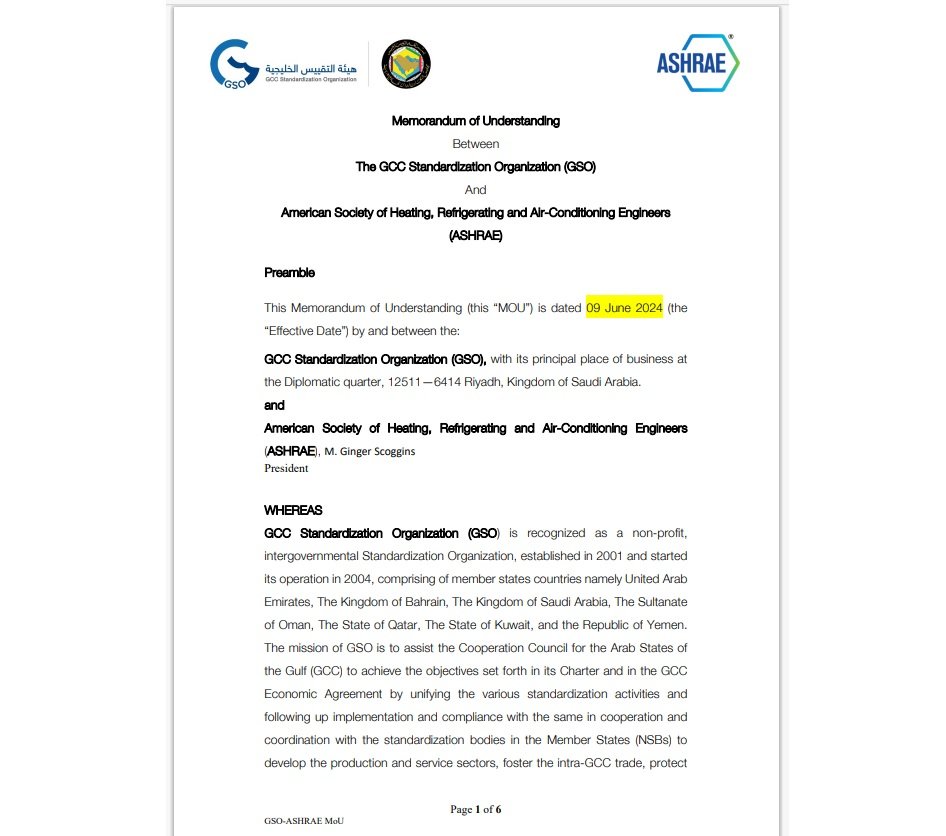
ASHRAE and the GCC Standardization Organization (GSO), the standards organization for the member states of the Gulf Cooperation Council and Yemen, have signed a Memorandum of Understanding (MOU) formalizing the organizations’ relationship.
The agreement defines ASHRAE’s and GSO’s intent to work cooperatively to promote the implementation and use of global buildings standards to support sustainable building design and operations.
“This collaboration signifies a step towards achieving integration and harmonization in our global standardization activities,” expressed Ginger Scoggins, P.E., Fellow ASHRAE, the 2023-24 ASHRAE President. “ASHRAE is delighted to partner with GSO in our shared commitment to fostering a more sustainable global built environment and driving technical innovation. By adopting common positions at international levels, we aim to benefit global trade, consumers, and building occupants worldwide.”
“This MOU with ASHRAE will support the establishment of cooperative and constructive working relationships between GSO and ASHRAE, as well as improved communication and coordination in many areas of mutual interest, emphasized H.E Eng. Nawaf Al Mana, GSO President. “This MOU will contribute positively to meet the needs of Member States and the GSO’s objectives aiming at advancing human well-being through sustainable technology for the built environment, focus on building systems, energy efficiency, indoor air quality and sustainability within the industry.”
The MOU includes, but is not limited to, the following goals:
- Promote communication, cooperation, and exchange of information about standardization and related activities.
- Provide opportunities to participate in and comment on proposed standards, technical regulations, and guidelines.
- Cooperate in organizing seminars, workshops, conferences, joint awareness programs, and symposia on public policy and mutual issues.
- Promote joint research in areas where research results will add to the body of knowledge in fields of mutual interests.
- Harmonizing both parties’ standards related to HVAC, heat pumps between the two regions.
In addition to these goals, ASHRAE’s and GSO’s specific areas of potential collaboration include Standards, Technical Regulations, and Conformity Assessment; Research and Statistics; Capacity Building and Exchange of Information; and Exchange of Experts and Project Teams.