Germany has set ambitious goals for the energy revolution: The proportion of renewable energy relative to overall energy consumption should be 80 per cent by 2050. With the expansion of wind energy, photovoltaics and other regenerative energy sources as well as the increasing electrification of society, the world of business, politics and science are facing a major challenge: the efficient and sustainable storage of locally generated excess energy so that it can be fed into the energy grid during peak times.One highly promising energy efficiency concept is “Power to Gas”, whereby methane is obtained from wind or solar energy by way of electrolysis and methanation. Energy is then stored in gas form and recovered when required. Methanation could also accelerate the rise of gas-powered vehicles in the automotive sector, while the methane required to fuel the vehicles could be produced in an environmentally compatible way. Researchers all over the world are working at full speed to design a technology that is simpler and more relevant in terms of energy efficiency.The Max Planck Institute for Dynamics of Complex Technical Systems in Magdeburg is a leading organization that has already been active in this field of research for seven years. To carry out work in its pilot plant, the institute uses a LAUDA heat transfer system that must meet the very specific requirements of the researchers.
High-precision, rapid cooling required
LAUDA Heating and Cooling Systems, which is the industrial division of temperature equipment manufacturer LAUDA, plans and manufactures customized constant temperature systems exactly according to customer requirements. A type ITH 350 heat transfer system was developed for the Max Planck Institute. The system is used to control the temperature of a reactor. The LAUDA system must be able to provide cooling of 100 Kelvin per minute without falling below the end point. It must therefore cool down quickly but must not fall below a certain temperature point and endanger the actual process.This challenge also posed problems for the LAUDA engineers because heat transfer systems are usually designed for constant temperature control. The research carried out at the Max Planck Institute requires a system that cools extremely quickly.
Cooling from 340 °C to 150 °C in minutes – with extreme precision
The methanation reaction generates a great deal of heat and high temperatures that may damage the reactor, or more importantly, the catalyst. Up to now, this kind of process was typically started up slowly one time and then run constantly for several weeks. Project manager Jens Bremer explains what the researchers are aiming to achieve: “First we are attempting to identify how dynamically this process can be arranged and then develop some basic concepts for new operating strategies and reactor designs.We have already obtained some initial promising results based on computer-assisted calculations and now wish to use the pilot system to verify these results”. Temperature control requirements are correspondingly high. The LAUDA heat transfer system is more than capable of delivering the required precision. “The performance and dynamics of the reactor are primarily determined by the cooling of the reactor. Rapid temperature control enables a flexible response to external influences, such as a decrease in the hydrogen supply, without having to shut down the reactor”, explains Jens Bremer.
During the process, the reactor is heated electrically to 340 °C. Once a defined temperature is reached, an exothermic reaction is triggered and the system must then be rapidly cooled to 150 °C. An electronic valve used in normal situations that serves as a regulating device would be much too slow for this particular application. It may be possible to use the valve to adjust the cooling capacity, depending on the actuating signal.If the system is cooled with cooling water, the cooling capacity for normal cooling tasks is limited to preserve the materials in the event of significant temperature differences. In this case, a rapid opening is required to reach the necessary cooling speed without stressing the material too much. LAUDA engineers have therefore developed a pneumatic 3-way valve that opens in only 2 seconds to ensure that the heat carrier is cooled at more than 150 °C per minute.
The heat transfer system incorporates two thermostatic circuits. While the first circuit controls the temperature in a buffer vessel, the second circuit controls the temperature in the test setup of the Max Planck Institute. Both circuits use the same medium and are connected to one another via the media storage unit. One additional customer requirement for the system was that the heat carrier could be used at temperatures of up to 350 °C. LAUDA therefore selected a thermal oil capable of satisfying the demanding requirements of the material.
Specific customer requirements fulfilled
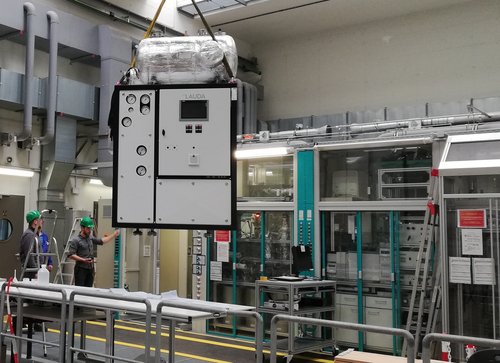
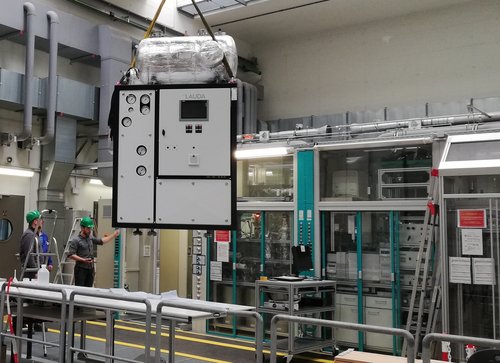
LAUDA developed and designed the special heat transfer system according to the requirements of the Max Planck Institute. The restricted spatial conditions were already taken into consideration during the development phase on the computer. The system had to be enclosed in a special safety dome, which made it necessary to mount the control cabinets on the side. As requested by the customer, some of the nozzles are located on the underside of the device. The LAUDA system was sent to Magdeburg for assembly in two parts, which were lifted into the safety glass enclosure by a crane.
The heat transfer system for methanation research was the second system LAUDA has delivered to the Max Planck Institute. The institute is more than satisfied with the services provided by the temperature control manufacturer: “We received outstanding consultation and customer care all the way from the initial concept design phase to final on-site installation. No other manufacturer was able to provide such flexibility for our specific situation”, explains project manager Jens Bremer.