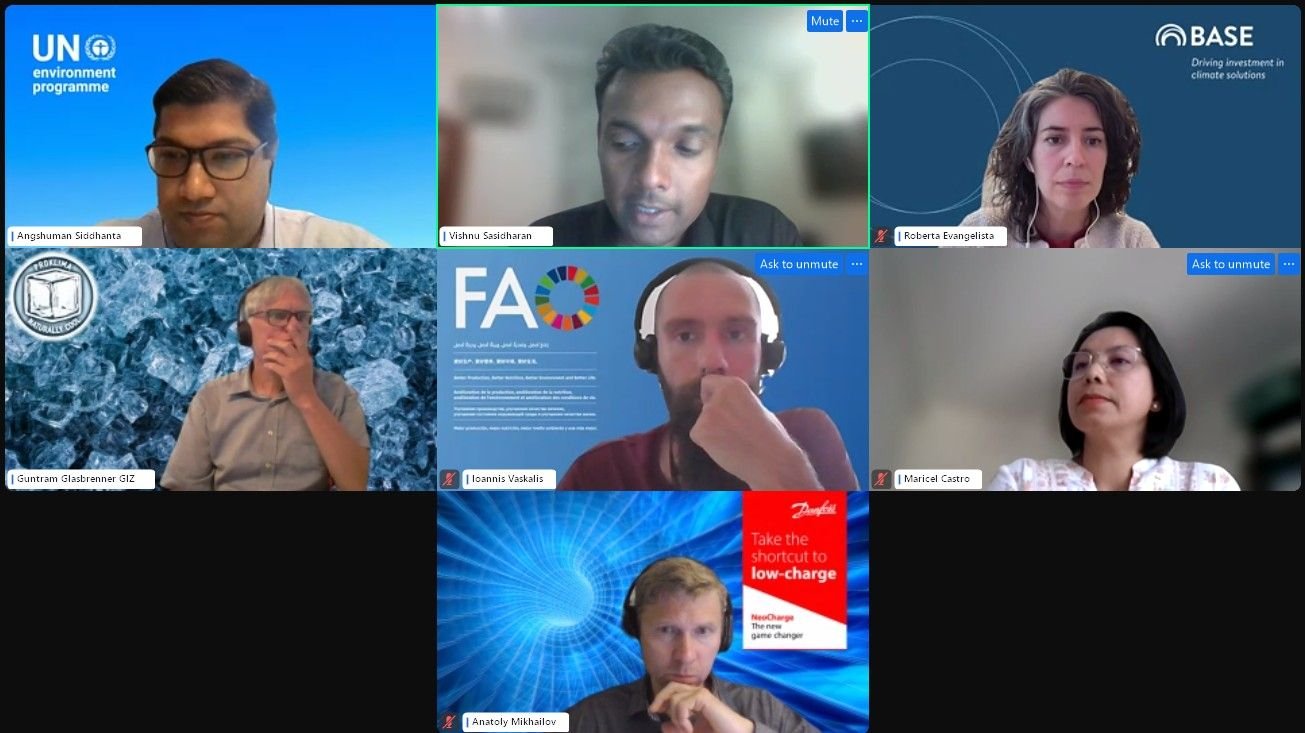
The United Nations Environment Programme (UNEP) Cool Coalition hosted the “Cold Chains for a Hot Planet: Cooling for Resilient Food and Health Systems” webinar on 30 July 2025. The online event, held alongside the 2nd UN Food Systems Summit +4 Stocktaking Moment, explored how sustainable cold chains can reduce food loss, protect health services and cut emissions if scaled through coordinated action.
Moderator Angshuman Siddhanta, Sustainable Cold Chain Expert at UNEP Cool Coalition, emphasized that cold chains are “critical infrastructure for development, climate and equity.” He highlighted projects in India, including a renewable-powered state cold-chain system in Haryana and a net-zero packhouse programme in Bihar, aimed at reducing post-harvest losses. “We lose 12 percent of all food grown each year for lack of reliable refrigeration,” Siddhanta said.
Maricel Castro, Technical Officer for Vaccine Supply Chain and Logistics at the World Health Organization, described cold chains as “strategic lifelines.” She noted that solar direct-drive refrigerators and the Gavi Cold Chain Equipment Optimisation Platform have deployed more than 40,000 units in countries like Niger, improving vaccine delivery and reducing wastage.
From the food sector, Ioannis Vaskalis, Natural Resources Officer at the Food and Agriculture Organization of the United Nations (FAO), presented renewable-powered cold storage initiatives in Jordan, Morocco and Tunisia. He stated that “over 526 million tonnes of food are lost each year due to inadequate refrigeration,” and emphasized that solar-driven cold chains can improve farmer incomes and food security.
Technology demonstrations included the Your Virtual Cold Chain Assistant (Your VCCA) project by the BASE Foundation, which provides solar-powered cold rooms under a Cooling-as-a-Service model. In pilot sites across India, Nigeria, Guinea-Bissau and Iraq, Your VCCA has cut post-harvest losses by up to 60 percent and increased revenues by 40 percent. Vishnu Sasidharan of Pluss Advanced Technologies showcased phase-change materials for energy storage, while Danfoss Vice President Anatoly Mikhailov outlined the energy-saving potential of high-efficiency equipment with natural refrigerants such as ammonia and CO2.
Guntram Glasbrenner of GIZ Proklima International shared experience from solar-powered cold chains in Burkina Faso and Malawi, noting that local training, policy support and tailored financing are essential for long-term success. Closing the session, Siddhanta underscored the urgency of scaling proven solutions: “Cold chains have shifted from background logistics to a frontline adaptation tool. They decide whether farmers prosper, vaccines reach those who need them, and emissions come down.”