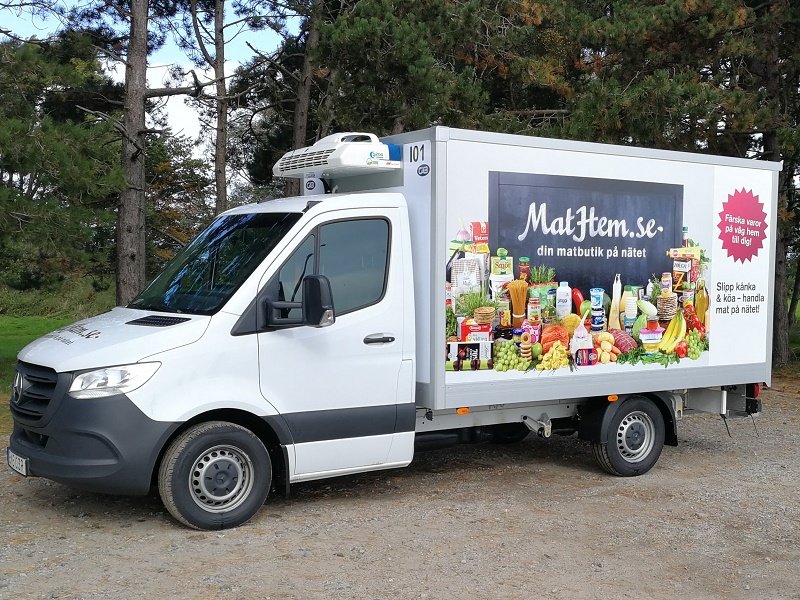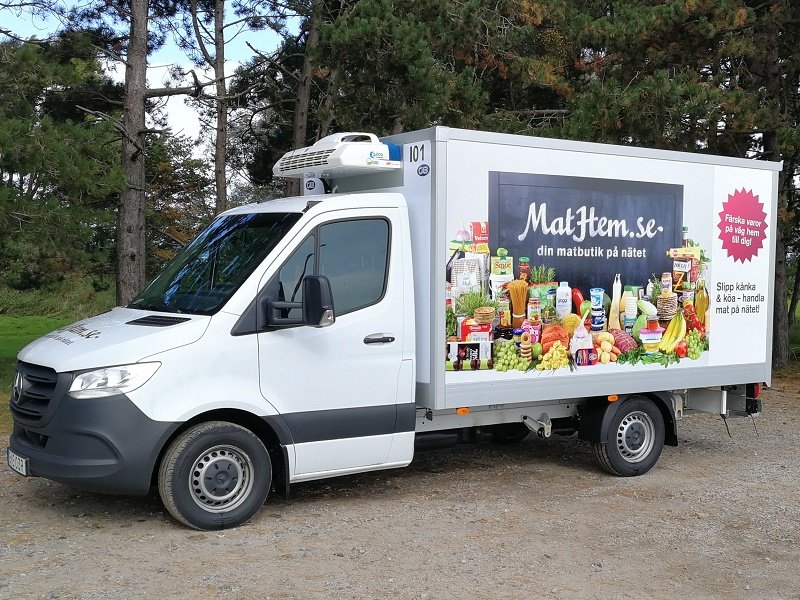
MatHem.se, a Swedish home delivery company, modernized its fleet to increase its operational efficiency and sustainability of the home delivery operations. The 30 new vehicles feature the fully electric E-200 multi temperature refrigeration units from Thermo King, a leader in transport temperature control solutions for a variety of mobile applications and a brand of Ingersoll Rand. Already in operation, the new fleet allows MatHem.se to move the food sustainably and always at the right temperature, and guarantee an unbroken cold chain all the way from their warehouse to the customers’ doorstep.
MatHem.se was looking for an all-in-one transport refrigeration solution that would allow them to maintain two cooling zones in the vehicle – one for cooled and one for frozen– and remove the heavy standalone freezer they had used before to transport frozen goods. They were also looking for an environmentally sustainable way to keep the refrigeration unit operating while the driver stops for delivery, has a lunch break or needs to turn off the vehicle for longer. Thermo King E-200 unit with additional battery pack met all the requirements.
“Sustainability and reduction of our environmental impact is reflected in everything we do, including our delivery operations,” said Frederik Engelfeldt,chief distribution officer at MatHem.se. “We guarantee to our customers that we will keep their food at the right temperature at all times until it reaches their home. An efficient delivery fleet is vital for this commitment and we’re happy to see that the Thermo King solution lives up to its promise. We now not only have more cargo space but the hold over feature keeps the groceries safe at all times during the route minimizing the risk of food waste. This feature also increases the sustainability of our operations as the driver can turn the engine off during stops to reduce fuel consumption and emissions.”
“The E-200 represents the next generation of fully electric refrigeration units and is the latest addition to our growing portfolio of non-diesel solutions. It allows our customers to move foods and goods safely with zero-emission, low noise and maximum convenience for the people in cities,” said Johan Green, account manager Thermo King Sweden. “We take pride in our expertise and reputation for collaborating with our customers and industry leaders to bring in new technologies. We’re very pleased with the positive feedback from MatHem.se following the real life operations and believe that Thermo King solutions will help them keep their customers happy, increase their profitability and lower their environmental footprint.”
The multi-temperature set up of the E-200 units allowed MatHem.se to save approximately 80 kilograms when compared to the previous fleet configuration featuring a standalone freezer. This directly translates to fuel savings and increased cargo space in the vehicle. The hold-over capacity is secured thanks to the additional battery pack, fully independent from the vehicle, which can power the unit during stops for deliveries or breaks. This gives the driver the peace of mind and flexibility to stop at any time without the need to keep the vehicle running on idle to keep the transported goods cooled.
Unlike typical direct drive solutions designed for diesel combustion engines, E-200 delivers constant capacity independently from the vehicles’ engines and associated moving parts, and can work with both electric and engine-powered vehicles.With no road compressor or drive kit, the E-200 is a plug and play solution and features patented power management, which contributes to lower energy consumption, increased vehicle autonomy and higher efficiency and reliability.The unit is also compatible with vehicle’s start-stop features contributing to additional fuel savings.
Being fully-electric, the E-200 allows the vehicles to comply with PIEK standard sand Urban Vehicle Access Regulations (UVARs) for sound levels in urban environments, and enables them to enter low emission zones, and run quiet to complete nighttime deliveries.
The E-200 product development and cooperation with MatHem.se is aligned with Ingersoll Rand 2030 sustainability aspirations, and the commitment to, through the heating, ventilation, air-conditioning (HVAC)and transport refrigeration products and services, reduce customer carbon footprint by one gigaton1CO2e – equivalent to the annual emissions of Italy, France and the United Kingdom combined.