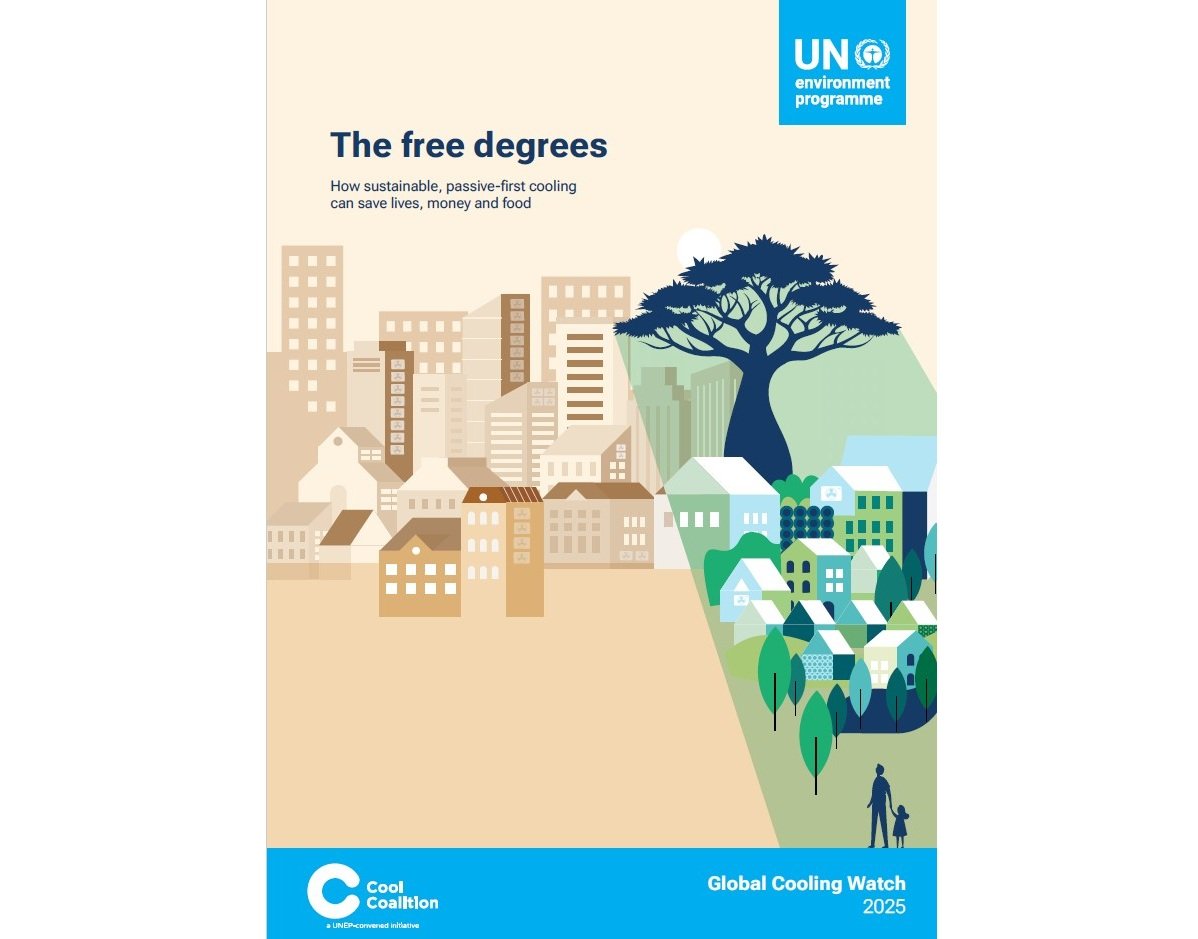
At COP30 in Belém, Brazil, the United Nations Environment Programme (UNEP) launched the Global Cooling Watch 2025 report, warning that global cooling demand could more than triple by 2050 if current trends continue. The projected growth is driven by rising global temperatures, population growth, economic development, and increased access to inefficient cooling technologies in low-income households.
According to the report, this “Business-as-Usual” (BAU) pathway could push cooling-related greenhouse gas emissions to 7.2 billion tons of CO2 equivalent (CO2e) by 2050—nearly double the levels recorded in 2022. This increase would come despite ongoing initiatives to improve energy efficiency and phase down climate-warming refrigerants.
To address this challenge, UNEP proposes a “Sustainable Cooling Pathway,” which includes passive cooling measures, adoption of low-energy and hybrid cooling technologies, high-efficiency equipment, and rapid HFC refrigerant phase-down. This pathway could reduce emissions to 2.6 billion tons CO2e in 2050, or 64 per cent below the BAU projection. Combined with rapid decarbonization of the global power sector, residual cooling emissions could fall to just 0.2 billion tons CO2e—97 per cent below the BAU level.
The report provides the scientific basis for the Global Cooling Pledge, a commitment endorsed by 72 countries and 80 non-state actors by October 2025. The pledge aims to cut cooling-related emissions by at least 68 per cent by 2050 compared to 2022 levels.
“Scaling sustainable cooling is essential to protect people and the planet from the worst impacts of extreme heat,” the report concludes, underlining the urgency of aligning climate policy, technology, and finance to avoid a surge in emissions from the global cooling sector.