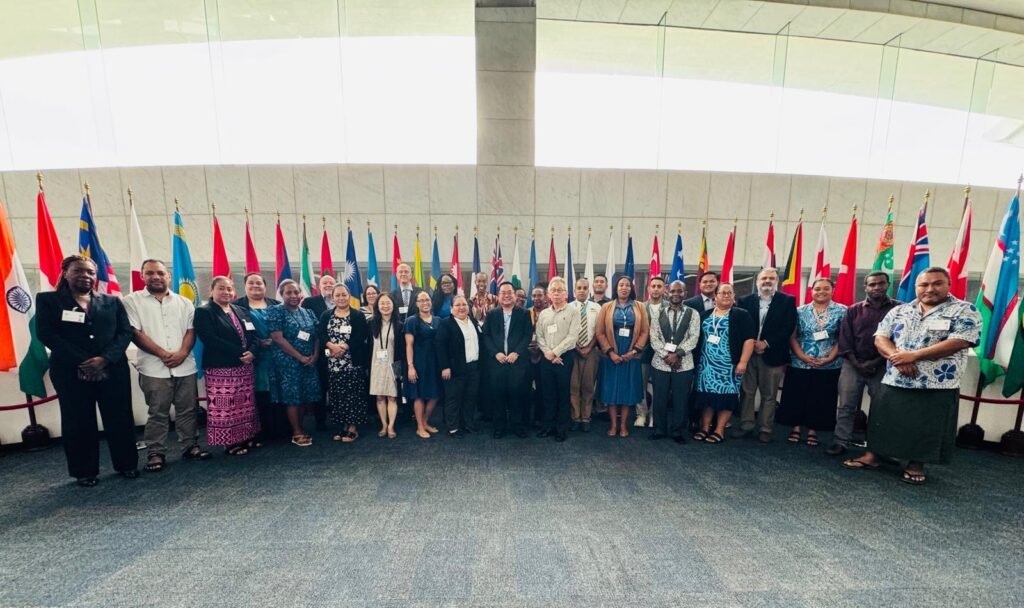
UNEP OzonAction brought together National Ozone Officers from Caribbean and Pacific Island countries in Thailand to strengthen cooperation on hydrofluorocarbon (HFC) licensing and quota systems and energy efficiency in the refrigeration and air-conditioning (RAC) sector. The 2026 inter-regional meeting involved 30 participants, including officers from 17 Caribbean and Pacific Island countries, as well as representatives of UNEP OzonAction, the Ozone Secretariat, the Multilateral Fund Secretariat, partner governments and technical experts.
Participants exchanged experience on HFC quota allocation, implementation and monitoring. Presentations from Fiji and Saint Lucia covered quota allocation, management of new importers, monitoring of quota utilization and administrative challenges, while discussions addressed transparency, eligibility criteria and mechanisms for quota reallocation.
Vanuatu and Barbados presented approaches to monitoring, reporting, verification and enforcement of HFC consumption. These included updated Harmonized System codes, integration of licensing systems into national electronic platforms and National Single Window systems, and closer cooperation between National Ozone Units and Customs authorities. Participants also discussed integrating ozone-depleting substances and HFC licensing modules into electronic customs and trade systems and highlighted UNEP OzonAction’s Informal Prior Informed Consent mechanism for monitoring and controlling international trade in controlled substances.
The meeting also examined energy efficiency in the RAC servicing sector and its links with HCFC phase-out and HFC phase-down efforts. Initiatives discussed included Regional Centres of Excellence for Sustainable Cooling, Regional Energy Efficiency Testing Centres, Minimum Energy Performance Standards and Labelling, demand-side management policies, product registration systems, building energy-efficiency programmes and green building initiatives.
Recommendations included increasing transparency in HFC quota allocation, strengthening electronic licensing platforms, accelerating adoption of updated HS codes, improving data sharing among authorities and expanding formal cooperation mechanisms. Participants also called for integrating energy-efficiency considerations into RAC policies, strengthening MEPS and energy labelling implementation, and using regional platforms to exchange technical expertise.