Esta página solo está disponible en inglés. Ir a la portada en español

×

Questa pagina è disponibile solo in inglese. Home page in italiano

×

Diese Seite ist nur auf Englisch verfügbar. Zur deutschen Startseite

×

Cette page est disponible uniquement en anglais. Aller à la page d'accueil en français

×

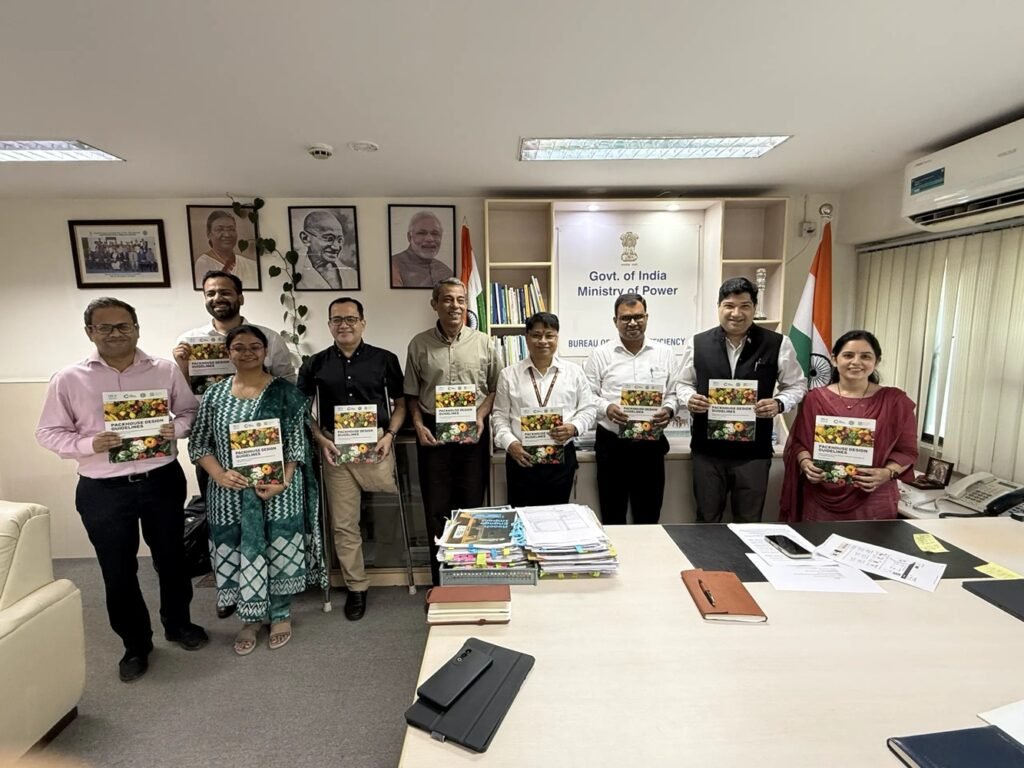
BEE, UNEP and AEEE launch energy-efficient packhouse guidelines in India

The publication promotes passive design, efficient refrigeration, low- and zero-GWP refrigerants, automation and renewable energy.

BEE, UNEP and AEEE launch energy-efficient packhouse guidelines in India

The Bureau of Energy Efficiency (BEE), United Nations Environment Programme (UNEP) Cool Coalition and the Alliance for an Energy Efficient Economy (AEEE) have launched Packhouse Design Guidelines for sustainable, energy-efficient integrated packhouses for horticultural produce in India.

Developed under UNEP’s India Cooling Programme (ICCP) in consultation with BEE and a technical committee, the guidelines address packhouse design and development across building layout, thermal insulation for temperature-controlled areas, refrigeration systems, energy efficiency measures, renewable energy integration and monitoring. Packhouses provide first-mile cold-chain functions including sorting, grading, packing, pre-cooling and staging before refrigerated transport.

The publication promotes passive design, energy-efficient refrigeration equipment, low- and zero-GWP refrigerants, automation, solar energy and other renewable energy options. It is intended for policymakers, cold-chain developers, investors, infrastructure owners and operators, Farmer Producer Organisations, cooperatives and implementing agencies.

The guidelines were developed as part of the “Scaling-up Investment in Clean and Efficient Cold Chain in India” project, implemented by UNEP Cool Coalition in partnership with AEEE. The project focuses on packhouses and reefer transport and contributes to implementation of the India Cooling Action Plan. The guidelines also complement Indian government standards for integrated packhouses, pre-coolers and staging rooms developed by the National Centre for Cold-chain Development.

“India’s transition to a more efficient and sustainable food system will require us to look at energy efficiency across the entire cold chain, including the infrastructure that enables produce to be cooled and moved efficiently from farm to market. These guidelines provide a practical pathway for integrating energy efficiency into packhouse design, helping reduce operating costs while strengthening and scaling up the resilience of India’s cold-chain infrastructure,” said Shri Krushna Chandra Panigrahy, Director General, Bureau of Energy Efficiency.

Launched on World Ozone Day 2026, the guidelines coincide with 10 years of the Kigali Amendment to the Montreal Protocol, which is driving the global phase-down of hydrofluorocarbons (HFCs) and promoting more energy-efficient and sustainable cooling.

Get the daily refrigeration briefing

One email a day. Trusted by 3,000+ RACHP professionals.

More on Cold Chain

All on Cold Chain →

Insights

Secop's Solar Direct Drive (SDD) System Earns WHO PQS Approval – The Team Behind It
Article

Secop’s Solar Direct Drive (SDD) System Earns WHO PQS Approval – The Team Behind It

Partner's material In March 2026, Secop’s Solar Direct Drive Power Management Module was granted WHO PQS prequalification and officially listed in the WHO Catalogue of Prequalified Immunization Devices. The WHO IMD-PQS (Immunization Devices Performance, Quality and Safety programme) is the global benchmark for cold chain equipment used in immunisation. Being listed in its catalogue is

22 Jun 2026
Case Study - Effect of Louvers or diffusers on air flow distribution and cooling time on a meat log during Chill cycle
Tech Guide

Case Study – Effect of Louvers or diffusers on air flow distribution and cooling time on a meat log during Chill cycle

By Kushal Aurangabadkar An experimental analysis was conducted on a cooler space measuring 3.66 m × 6.096 m (12.0 ft × 20.0 ft), equipped with an ammonia refrigeration coil, five 30 cm (12 in.) fans, and five diffusers. The study measured airflow patterns, cooling rates, and heat transfer efficiency in meat storage by testing two configurations:

Kushal Aurangabadkar · 21 Jan 2026
Total Cost of Ownership (TCO) for Modular Refrigeration Systems in Life Sciences Distribution Centers
Tech Guide

Total Cost of Ownership (TCO) for Modular Refrigeration Systems in Life Sciences Distribution Centers

by Ramez Naguib, P.E. Introduction Life sciences distribution centers are under immense pressure to deliver consistent temperature control, comply with increasingly stringent regulations, and optimize operational efficiency. Traditional built-up refrigeration systems often prove cumbersome, costly, and slow to implement. In contrast, modular, factory-assembled refrigeration systems have emerged as a compelling alternative. Drawing on lessons from

14 Jan 2026
Everything on Cold Chain: 2,035 articles, 1 case study, 23 insights

Most read this month

All news →