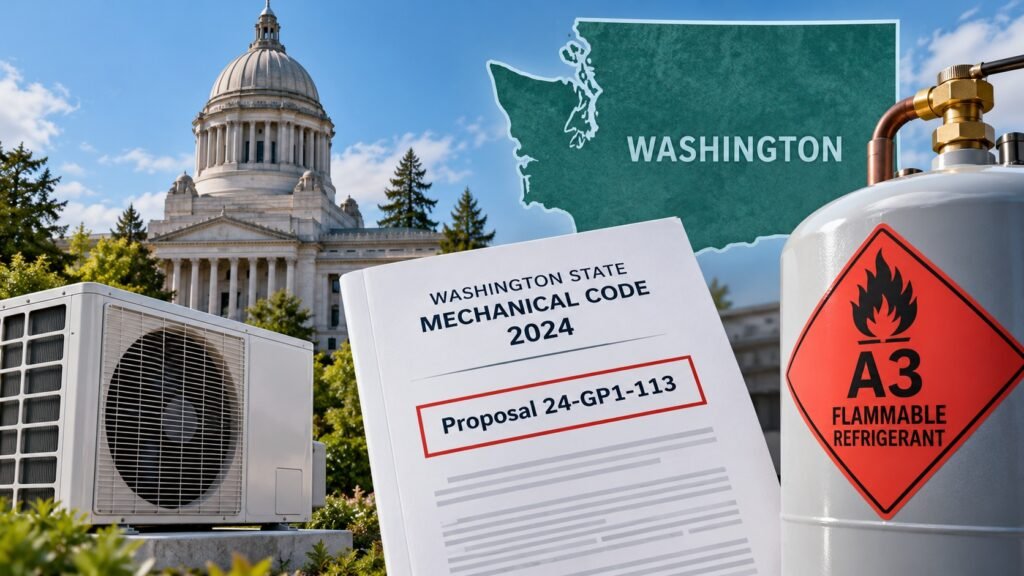
Heating, Air-Conditioning & Refrigeration Distributors International (HARDI) and four HVACR industry associations have urged Washington state leaders to reject a proposed mechanical code exception allowing equipment using highly flammable A3 refrigerants. In an October 6 letter to Governor Bob Ferguson and state legislators, the organizations called for the removal of Proposal 24-GP1-113 from the 2024 Washington State Mechanical Code, citing concerns about safety standards and regulatory compliance.
The proposal would introduce an exception based on international standards, including IEC 60335-2-40 and EN 378, that do not fully align with the North American regulatory framework. According to the associations, UL/CSA 60335-2-40 generally limits highly flammable refrigerants such as propane (R-290) to approximately 114 g (0.25 lb), while IEC 60335-2-40 can permit up to 4.94 kg (10.9 lb) per circuit. The organizations also noted that ASHRAE Standard 15.2 currently provides no installation pathway for A3 refrigerants in low-rise residential applications.
The associations warned that the exception could create uncertainty for HVACR distributors, contractors, designers, and code enforcement officials. They also highlighted restrictions under the U.S. Environmental Protection Agency’s Significant New Alternatives Policy (SNAP) program, which currently permits A3 refrigerants only in limited applications, primarily certain commercial refrigeration and self-contained equipment.
Washington has established a Refrigerant Transition Task Force under legislation enacted in 2025 to evaluate low- and ultra-low-GWP refrigerants. Its work covers equipment availability, safety, workforce training, and implementation timelines. The task force must begin a public comment period on its draft report by June 1, 2027, and submit its final report by December 1, 2027.
HARDI, AHRI, WA ACCA, PHCC, and PHCC WA are asking state officials to prevent adoption of the proposed exception until the relevant safety and implementation requirements are established. The associations maintain that Washington should follow its existing refrigerant transition process rather than introduce an exception ahead of nationally coordinated standards.