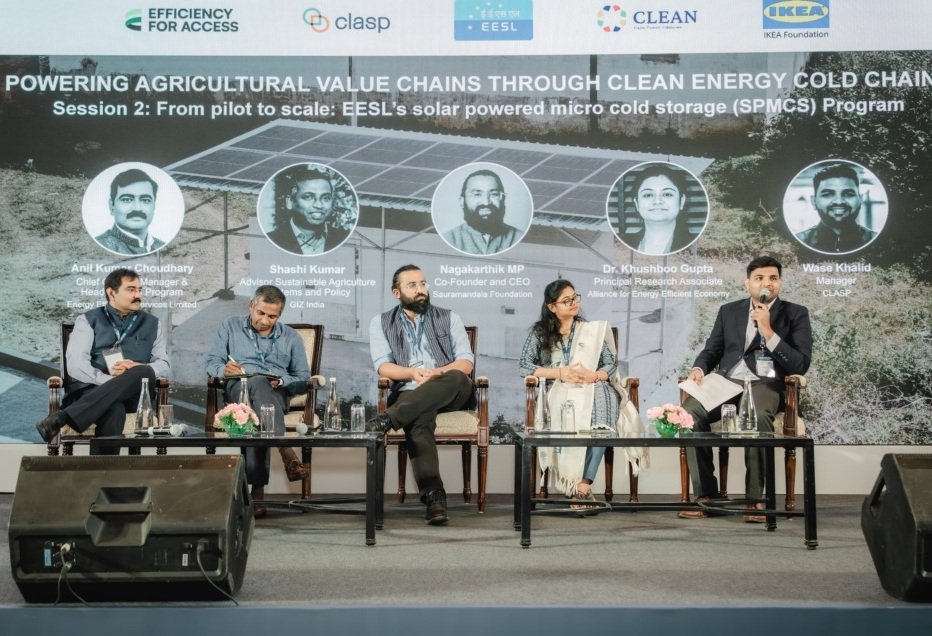
CLASP, through Efficiency for Access, held a national convention in India in June 2026, followed by workshops in Odisha and Himachal Pradesh, to examine how solar-powered cold storage can reduce agricultural losses and support rural businesses. Discussions highlighted the need for demand assessments, viable business models and stronger market connections to improve cold room utilization.
India loses an estimated 4.87–15.05% of fruits and vegetables along the supply chain, while annual post-harvest losses across agriculture are estimated at USD 18.5 billion. At the convention, participants identified inadequate planning and limited understanding of local demand as major barriers to effective cold storage deployment. An upcoming report by Efficiency for Access and the National Institute of Solar Energy (NISE) examines differences in agricultural production, harvest periods, market structures and financing conditions across states and agricultural clusters.
Workshops in Odisha emphasized assessing crop volumes, seasonal demand, facility capacity and potential customers before installation. In Himachal Pradesh, participants highlighted low utilization outside the harvest season for fruits such as apples and kiwis. They discussed integrating cold rooms with produce collection, processing and buyer networks to generate revenue beyond peak storage periods.
Participants recommended five measures to improve utilization: conducting cluster-level demand assessments, connecting operators with farmers and buyers, providing post-installation business support, designing facilities for multiple commodities and services, and adapting financing to seasonal revenue cycles. For subsidized installations, support from operators or NGOs for at least two to four seasons was proposed. Participants also discussed risk mitigation mechanisms funded by governments or philanthropic organizations to support financing.
CLASP is conducting cluster-level demand assessments in Maharashtra, Tamil Nadu, Assam and Meghalaya, building on previous solar pilots with small businesses in Assam and Meghalaya. The organization aims to develop a common framework to help procurement agencies and state departments identify suitable locations for future cold storage installations. Separately, a new global standard developed with VeraSol support establishes testing requirements for refrigerators designed for off-grid and unreliable electricity supplies.