The 17th IIR-Gustav Lorentzen Conference on Natural Refrigerants (GL2026) concluded on 26 August at the University of Waikato in New Zealand, bringing together the international refrigeration, air-conditioning and heat pump community. Held from 23–26 August, the conference focused on “Advancing heat pumps and net-zero carbon energy with natural refrigerants” and reached full capacity ahead of its opening.
Discussions covered energy efficiency, safety, system design and the role of natural refrigerants in meeting climate objectives. The International Institute of Refrigeration (IIR) describes natural working fluids as an important pathway for reducing the carbon footprint of cooling and heating and supporting the transition required under the Kigali Amendment to the Montreal Protocol.
Dr Andy Pearson, Group Managing Director of Star Refrigeration and a member of the GL2026 International Scientific Committee, presented research comparing low-charge ammonia and transcritical CO2 systems at two refrigerated warehouses in the UK. Both installations achieved 100% refrigeration uptime in 2025 under comparable proactive maintenance regimes. The low-charge ammonia system recorded specific energy consumption of 22.63 kWh/m³ per year, compared with 33.5 kWh/m³ per year for the transcritical CO2 installation.
Pearson cautioned that two case studies are insufficient to draw a universal conclusion. His research identified energy efficiency, reliability, maintenance, safety, operating conditions and whole-life cost as factors in selecting industrial refrigeration technology. “There is no single solution that is right for every application,” Pearson said.
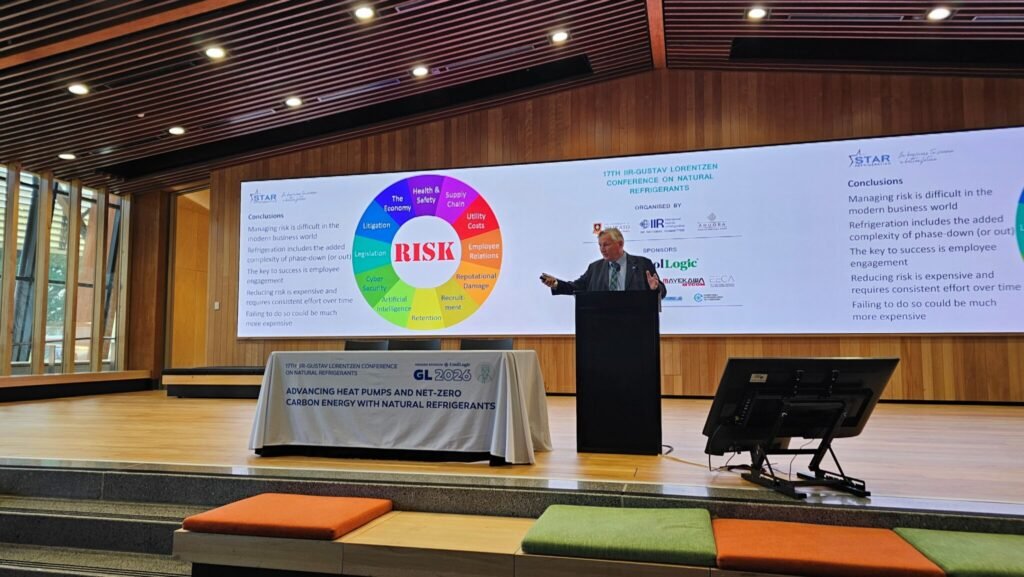
In a separate plenary address, “Reducing Risk in Refrigeration,” Pearson discussed energy and refrigerant price volatility, supply-chain disruption, cybersecurity, artificial intelligence, legislation and litigation. The address concluded that continued investment in workforce skills and qualifications is essential for improving resilience and managing long-term operational risk.
At the closing ceremony, the conference was formally handed over to the United Kingdom, with Bristol confirmed as host city for the 18th IIR-Gustav Lorentzen Conference in 2028. It will be the first edition held in England; previous UK conferences took place in Glasgow in 2004 and at Heriot-Watt University in Edinburgh in 2016.