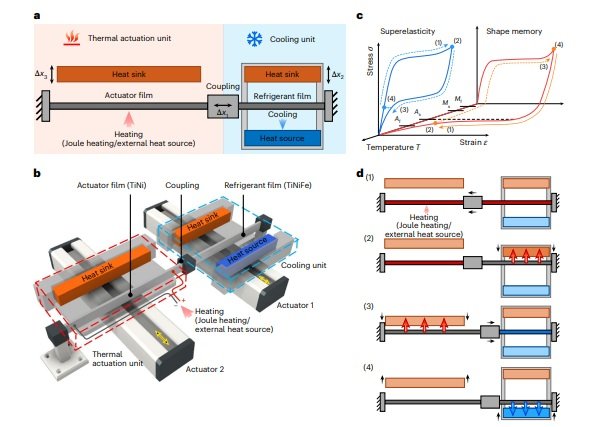
Researchers at Karlsruhe Institute of Technology (KIT) and the University of Tsukuba in Japan have developed a heat-driven elastocaloric cooling system that uses two ultra-thin nickel-titanium shape-memory films. The prototype converts thermal energy into mechanical work and then cooling, providing a way to use heat sources such as waste heat and solar energy for solid-state cooling. The results were published in Nature Energy.
The system couples films with complementary functions. When heated, the first film contracts through the shape-memory effect and generates mechanical work without an electric motor. This motion loads and unloads a second film, where reversible changes in its crystal structure produce the elastocaloric cooling effect.
The prototype uses a 22-µm-thick TiNi actuator film and a 26.5-µm-thick TiNiFe superelastic refrigerant film. Under Joule-heated actuation at an average peak actuator temperature of 86 °C (187 °F), the integrated device achieved a temperature span of 4.0 K, while the refrigerant film reached 12.9 K. Cooling power at zero temperature lift was 2.79 mW, corresponding to a specific cooling power of 4.43 W g−1.
The researchers also demonstrated operation using an external solid heat source at 130 °C (266 °F). In this configuration, the device achieved a steady-state temperature span of 2.2 K and cooling power of 2.09 mW, corresponding to 3.32 W g−1. The researchers are working on connecting multiple films in parallel to increase cooling capacity, with potential applications including processors and automotive electronics.
“The crucial innovation is that we combine two complementary functions of shape memory alloys, with one film converting heat into mechanical work and the other film converting this work into cold,” said Dr. Jingyuan Xu, who leads the Young Investigator Group of the ZEco Thermal Lab at KIT’s Institute of Microstructure Technology. “This way, we’re establishing a new approach to drive solid-state cooling, thereby opening up exciting possibilities for the use of waste heat and solar energy.”