New research by Dr Andy Pearson of Star Refrigeration reveals that the energy consumption of a modern, well-maintained temperature-controlled storage facility can now be less than 30% of the currently accepted UK’s ‘Best Practice’ Guidelines figures.
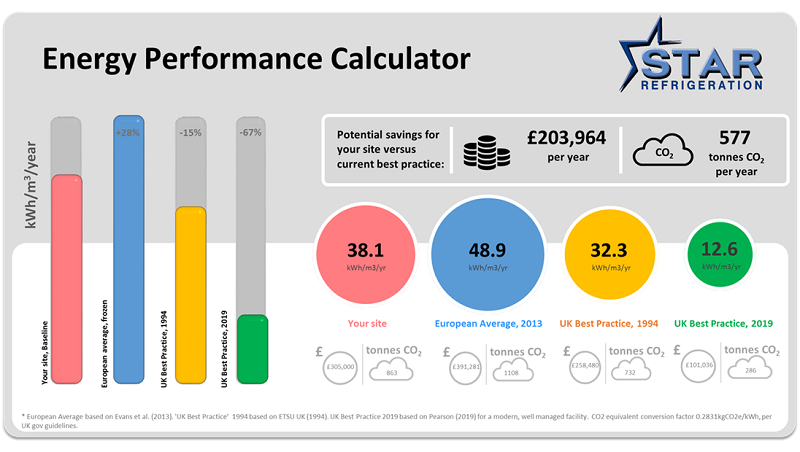
Over the last two decades, various European studies on energy performance, including the UK’s ‘Best Practice’ benchmark identified by The Energy Technology Support Unit, have concluded that the operation of a low-temperature, industrial-size cold store facility (roughly 100,000 m3) requires more than 30 kWh of energy per cubic meter per year (30kWh/m3/yr). However, these guidelines do not account for the significant improvements made in refrigeration plant efficiency over the past years which have the potential to save temperature controlled storage and distribution businesses millions of pounds on energy bills and carbon emissions.
New research presented to The International Institute of Refrigeration by Dr Andy Pearson, Group MD of Star Refrigeration, provides a more accurate benchmark in energy performance best practice as it incorporates data supplied from analysis of various modern cold and chill stores across the country.
The research entitled ‘Energy Performance of Industrial Cold Storage Facilities’ indicates an energy use in larger facilities of between 15%-30% of the generally recognised figure from two decades ago. A well maintained cold store of 100,000 m3 should have a specific energy consumption (SEC) of 10kWh/m3/yr for the refrigeration system while for a 500,000 m3 store the SEC could be less than 5kWh/m3/yr.
Dr Pearson said, “Reassessing energy performance ‘Best Practice’ guidelines was long overdue and an essential step in allowing end-users and operators to accurately assess energy consumption and environmental impact of their cold store cooling plant against modern industry standards. Benchmarking their energy usage against current best practice also enables them to establish whether energy efficiency improvement actions are required and allows them to set specific, time sensitive, measurable targets at every stage of the process from planning, building and construction, refrigeration system design, controls, maintenance, monitoring and system optimisation”
“The new figures demonstrate that cold stores employing best practices with regard to their refrigeration plant’s energy efficiency are making important savings on their final energy bill.”
The research also shows that Specific Energy Consumption (SEC), which is calculated by kWh/m3/yr, is an important benchmark for refrigeration system performance because cold stores cover a wide range of sizes and applications and the key to improvement is to enable operators to compare against the most up to date industry benchmarks for their system.
Recent hikes in energy costs and the stringent targets put in place to mitigate the effects of climate change mean that the demand for energy efficiency in the cold chain is unprecedented. In order to overcome such issues and optimise efficiency, Dr Pearson advice operators to settle upon a consistent definition of ‘cold store efficiency’ such as kWh/m3/yr and improve how this is monitored.
In order to obtain a comprehensive overview of the plant’s performance and areas in which it could improve, it is necessary to install individual power metres for each self-contained module of the plant, while electrical usage figures should be aggregated on a daily basis. Dr Pearson said, “Following these measures will allow cold store operators to gain a clearer picture of the energy performance and how they can improve it.”
The recently published research incorporates data obtained from modern, well maintained temperature controlled facilities including Gist’s chill store in Chesterfield and a cold store
Star Refrigeration has now launched a benchmarking tool to assess how businesses’ electricity usage compares against similar sites across the UK and Europe. Cold and chill store owners and operators can benefit from knowing if they’re paying more than the average on their annual energy bill. Star’s new development energy benchmarking can provide a full confidential report demonstrating how end user’s energy consumption compares to similar size chill/cold stores across the country.
This tool is part of Star Refrigeration’s wider strategy to increase awareness of energy consumption within the temperature controlled storage and distribution industry, reducing carbon emissions and energy costs.
For more information about the 2019 Energy Performance ‘Best Practice’ Guidelines visit /smart-thinking/new-best-practice-guidelines-for-cold-storage.aspx