Esta página solo está disponible en inglés. Ir a la portada en español

×

Questa pagina è disponibile solo in inglese. Home page in italiano

×

Diese Seite ist nur auf Englisch verfügbar. Zur deutschen Startseite

×

Cette page est disponible uniquement en anglais. Aller à la page d'accueil en français

×

Pflaum Logistik Improves Fleet Sustainability with Carrier Transicold Engineless Iceland Units

Pflaum Logistik Improves Fleet Sustainability with Carrier Transicold Engineless Iceland Units

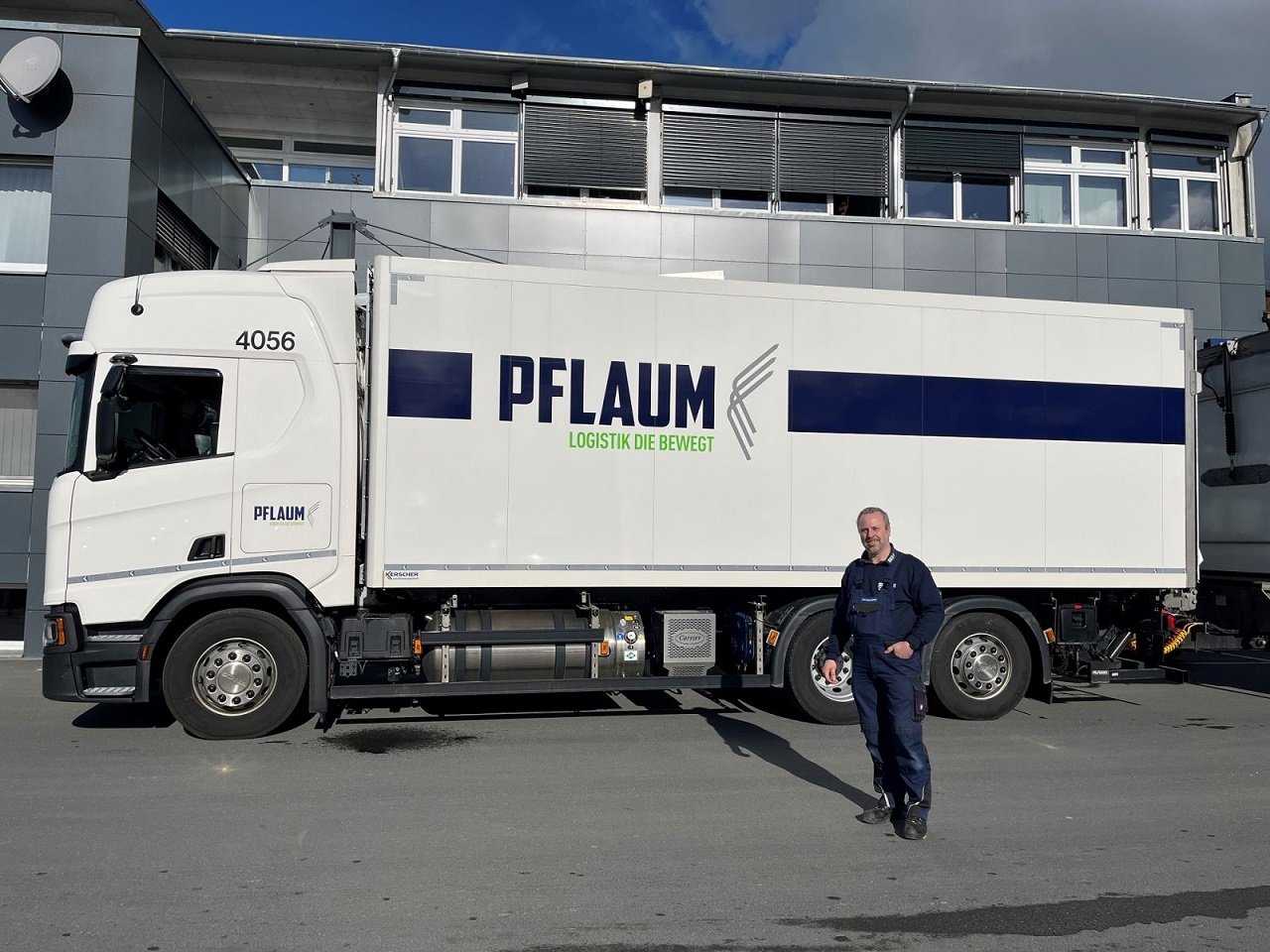
Franconian freight forwarder Pflaum Logistik has taken delivery of five new rigid trucks running on liquified natural gas (LNG), fitted with engineless Carrier Transicold Iceland temperature-controlled units, in a move that significantly improves the sustainability of the company’s commercial vehicle fleet. 

The undermount mono-temperature Iceland units are each mounted to 26-tonne Scania rigid trucks running on LNG. In the coming months, 15 additional trucks will be added, joining a commercial vehicle fleet of nearly 1,000 vehicles, of which 220 are temperature-controlled and 160 of them being Carrier-cooled. The new assets will be used to deliver chilled or frozen food to customers across Germany.

“We have been specifying Carrier units for our fleet since 2015, and the Iceland unit has rapidly become the system of choice for our rigid trucks,” said Dieter Steinsdörfer, Master Refrigeration Engineer, Pflaum Logistik. “As they don’t use a standalone engine, the units help us lower fuel consumption and reduce emissions, while also being significantly quieter – which is very important for our urban deliveries, especially at night.”

The Iceland units run on power derived directly from the truck’s LNG engine, thanks to Carrier Transicold’s ECO-DRIVE™ power module. This unit uses a hydraulic pump connected to the truck’s engine power take-off that drives a generator delivering electrical power capable of providing 100% refrigeration capacity, even at standard idle speed. The unit also boasts rapid temperature pull-down capability and operates at a PIEK-compliant level below 60 dB(A). The low noise level is an important factor for Pflaum as LNG vehicles can be on the road around the clock.

The Pflaum Group workshop – a Scania service partner – manages the installation and maintenance of the Iceland units. The installation and fitting of the ECO-DRIVE modules and Iceland underfloor units has long been routine for Steinsdörfer’s workshop team, even on the LNG vehicles. “On the long three-axle chassis, this is no problem in terms of installation space, even with two LNG tanks on the left and right.” Although the LNG Scania is used as a single-chamber vehicle mainly in the fresh food sector, the superstructures and Iceland units also allow deep-freeze transports.

Carrier Transicold’s Iceland units provide an energy-efficient, environmentally responsible solution supporting Carrier’s goal of reducing its customers’ carbon footprint by one gigaton as part of its 2030 Environmental, Social and Governance (ESG) goals.

Get the daily refrigeration briefing

One email a day. Trusted by 3,000+ RACHP professionals.

More on Cold Chain

All on Cold Chain →

Insights

Secop's Solar Direct Drive (SDD) System Earns WHO PQS Approval – The Team Behind It
Article

Secop’s Solar Direct Drive (SDD) System Earns WHO PQS Approval – The Team Behind It

Partner's material In March 2026, Secop’s Solar Direct Drive Power Management Module was granted WHO PQS prequalification and officially listed in the WHO Catalogue of Prequalified Immunization Devices. The WHO IMD-PQS (Immunization Devices Performance, Quality and Safety programme) is the global benchmark for cold chain equipment used in immunisation. Being listed in its catalogue is

22 Jun 2026
Case Study - Effect of Louvers or diffusers on air flow distribution and cooling time on a meat log during Chill cycle
Tech Guide

Case Study – Effect of Louvers or diffusers on air flow distribution and cooling time on a meat log during Chill cycle

By Kushal Aurangabadkar An experimental analysis was conducted on a cooler space measuring 3.66 m × 6.096 m (12.0 ft × 20.0 ft), equipped with an ammonia refrigeration coil, five 30 cm (12 in.) fans, and five diffusers. The study measured airflow patterns, cooling rates, and heat transfer efficiency in meat storage by testing two configurations:

Kushal Aurangabadkar · 21 Jan 2026
Total Cost of Ownership (TCO) for Modular Refrigeration Systems in Life Sciences Distribution Centers
Tech Guide

Total Cost of Ownership (TCO) for Modular Refrigeration Systems in Life Sciences Distribution Centers

by Ramez Naguib, P.E. Introduction Life sciences distribution centers are under immense pressure to deliver consistent temperature control, comply with increasingly stringent regulations, and optimize operational efficiency. Traditional built-up refrigeration systems often prove cumbersome, costly, and slow to implement. In contrast, modular, factory-assembled refrigeration systems have emerged as a compelling alternative. Drawing on lessons from

14 Jan 2026
Everything on Cold Chain: 2,045 articles, 2 case studies, 23 insights

Most read this month

All news →