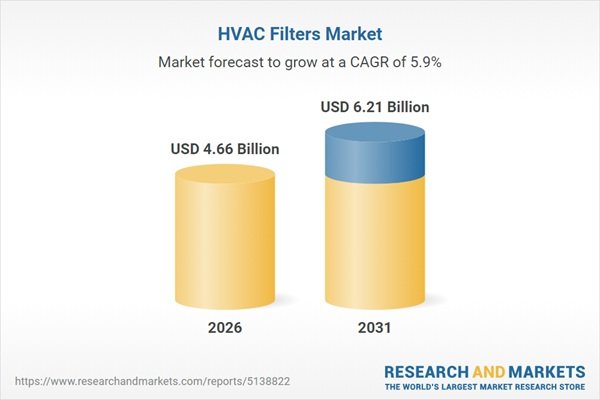
The global HVAC filters market is projected to grow from $4.66 billion in 2026 to $6.21 billion by 2031, according to a Research and Markets report. The forecast represents a compound annual growth rate of 5.9%, supported by attention to indoor air quality, air quality and building regulations, energy-efficiency targets, sustainable infrastructure investment and demand for advanced filtration.
Synthetic polymers are expected to account for the second-largest share of HVAC filter revenue by material. The report cites polyester, polypropylene and other synthetic polymer media, while developments in nonwoven and nanofiber technologies are improving filter performance and service life.
Electrostatic precipitators are projected to be the second-fastest-growing technology segment by value. The report attributes their adoption to fine-particle capture, low airflow resistance and reduced energy consumption, with applications including commercial buildings, industrial facilities and hospitals.
The pharmaceutical sector is forecast to record the second-highest CAGR among end-use industries. Contamination-control and regulatory requirements are supporting demand for HVAC filtration in cleanrooms, including HEPA and ULPA filters, as production of biologics, vaccines, specialty drugs and advanced therapies increases.
Europe is projected to be the second-fastest-growing regional HVAC filters market by value. The report links growth to indoor air quality standards, energy-efficiency targets, sustainable building programs and renovation and retrofit activity, as well as development of data centers, pharmaceutical facilities and green buildings in Germany, France, the UK and the Nordic region.