Esta página solo está disponible en inglés. Ir a la portada en español

×

Diese Seite ist nur auf Englisch verfügbar. Zur deutschen Startseite

×

Cette page est disponible uniquement en anglais. Aller à la page d'accueil en français

×

Secop’s power management module gains WHO PQS prequalification

The listing enables UN procurement and supports vaccine refrigeration in remote and weak-grid settings.

Secop’s power management module gains WHO PQS prequalification

Secop GmbH said its Solar Direct Drive Power Management Module has received WHO PQS prequalification from the World Health Organization. The module is now listed in the WHO Catalogue of Prequalified Immunization Devices, making it eligible for procurement by UN agencies and international health organisations.

According to Secop, the WHO Performance, Quality and Safety programme evaluates immunisation devices used in national vaccination programmes. The company said the prequalification confirms that the module meets performance, quality and reliability standards for field conditions, including remote and low-resource settings where the vaccine cold chain is at risk.

Secop described the SDD Power Management Module as the core certified component of a solar direct drive and weak-grid power management system for vaccine refrigerators. The full system combines the module, the MB3CKV compressor and the solar controller.

The company said the module accepts AC input from 82 V to 274 V and does not require a voltage stabiliser. For solar-powered applications, its MPPT algorithm adjusts compressor speed to available solar energy. Secop added that the module is protected against voltage surges up to 510 V and delivers up to 110 W of constant output power.

A 24 V DC auxiliary output supports data loggers, monitoring devices and USB chargers, according to the company, with compliance to WHO EMS monitoring standards E006/DL01 and E007/DS01. Secop said it developed the module with Global Health Labs to meet WHO PQS specifications for solar direct drive and wide-range, unstable power grids, helping vaccine refrigerator manufacturers meet E007/VS01.6 voltage stabilisation requirements.

Secop Secop GmbH Secop is the expert for advanced hermetic compressor technologies and cooling solutions in commercial refrigeration. We develop high performance static and mobile cooling solutions for leading international commercial refrigeration businesses. View company profile → Gold partner
Get the daily refrigeration briefing

One email a day. Trusted by 3,000+ RACHP professionals.

More on Cold Chain

All on Cold Chain →

Insights

Secop's Solar Direct Drive (SDD) System Earns WHO PQS Approval – The Team Behind It
Article

Secop’s Solar Direct Drive (SDD) System Earns WHO PQS Approval – The Team Behind It

Partner's material In March 2026, Secop’s Solar Direct Drive Power Management Module was granted WHO PQS prequalification and officially listed in the WHO Catalogue of Prequalified Immunization Devices. The WHO IMD-PQS (Immunization Devices Performance, Quality and Safety programme) is the global benchmark for cold chain equipment used in immunisation. Being listed in its catalogue is

22 Jun 2026
Case Study - Effect of Louvers or diffusers on air flow distribution and cooling time on a meat log during Chill cycle
Tech Guide

Case Study – Effect of Louvers or diffusers on air flow distribution and cooling time on a meat log during Chill cycle

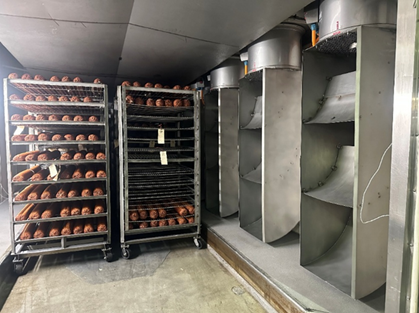
By Kushal Aurangabadkar An experimental analysis was conducted on a cooler space measuring 3.66 m × 6.096 m (12.0 ft × 20.0 ft), equipped with an ammonia refrigeration coil, five 30 cm (12 in.) fans, and five diffusers. The study measured airflow patterns, cooling rates, and heat transfer efficiency in meat storage by testing two configurations:

Kushal Aurangabadkar · 21 Jan 2026
Total Cost of Ownership (TCO) for Modular Refrigeration Systems in Life Sciences Distribution Centers
Tech Guide

Total Cost of Ownership (TCO) for Modular Refrigeration Systems in Life Sciences Distribution Centers

by Ramez Naguib, P.E. Introduction Life sciences distribution centers are under immense pressure to deliver consistent temperature control, comply with increasingly stringent regulations, and optimize operational efficiency. Traditional built-up refrigeration systems often prove cumbersome, costly, and slow to implement. In contrast, modular, factory-assembled refrigeration systems have emerged as a compelling alternative. Drawing on lessons from

Ramez Naguib · 14 Jan 2026
Everything on Cold Chain: 2,059 articles, 2 case studies, 23 insights

Most read this month

All news →