Esta página solo está disponible en inglés. Ir a la portada en español

×

Questa pagina è disponibile solo in inglese. Home page in italiano

×

Diese Seite ist nur auf Englisch verfügbar. Zur deutschen Startseite

×

Cette page est disponible uniquement en anglais. Aller à la page d'accueil en français

×

Sonoco ThermoSafe’s New Pegasus ULD Receives FAA Approval

Sonoco ThermoSafe’s New Pegasus ULD Receives FAA Approval

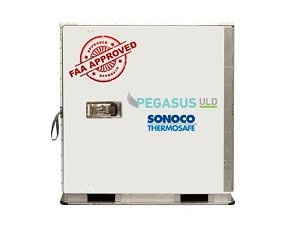
Sonoco ThermoSafe announced that its new Pegasus ULD bulk temperature controlled container has received FAA (Federal Aviation Administration) approval as a unit load device (ULD).

The Pegasus ULD is the world’s first passive bulk temperature-controlled container for pharmaceutical use that is an FAA-approved unit load device, which allows it to speed through existing international ground handling and customs processes at the lowest possible cost. FAA approval officially enables reciprocal EASA (European Aviation Safety Agency) approval, which is anticipated in the very near future.

Engineered with composite materials, the Pegasus ULD will offer a lighter solution that is substantially more damage-resistant than traditional metal containers. Additionally, the Pegasus contains a fully integrated, FAA (Federal Aviation Administration) approved telemetry system, providing real-time, cloud-based data on payload and ambient temperature and key environmental factors, precisely synchronized with GPS location.

To create the Pegasus ULD, Sonoco ThermoSafe signed a long-term exclusive development and manufacturing agreement with AEROTUF, a leading supplier of innovative composite ULD containers. The partnership combines ThermoSafe’s expertise in thermal engineering and pharmaceutical logistics with AEROTUF’s materials science and aeronautical engineering capabilities. The first Pegasus ULD will be the AKP size, which fits a full US pallet and shares the same footprint of the AKE size without the imbalanced overhang section which accounts for over 80% of transit damage in AKE/RKN containers.

“FAA approval of our new Pegasus ULD is an important milestone and puts us another step closer to our launch date for the rental program,” said Ron Haub, Segment Director for Sonoco ThermoSafe. “This approval accelerates the adoption of the Pegasus ULD across the worldwide air freight marketplace during the world’s most dire need for distribution of temperature-sensitive vaccines, treatments, and therapies.”

Get the daily refrigeration briefing

One email a day. Trusted by 3,000+ RACHP professionals.

More on Cold Chain

All on Cold Chain →

Insights

Secop's Solar Direct Drive (SDD) System Earns WHO PQS Approval – The Team Behind It
Article

Secop’s Solar Direct Drive (SDD) System Earns WHO PQS Approval – The Team Behind It

Partner's material In March 2026, Secop’s Solar Direct Drive Power Management Module was granted WHO PQS prequalification and officially listed in the WHO Catalogue of Prequalified Immunization Devices. The WHO IMD-PQS (Immunization Devices Performance, Quality and Safety programme) is the global benchmark for cold chain equipment used in immunisation. Being listed in its catalogue is

22 Jun 2026
Case Study - Effect of Louvers or diffusers on air flow distribution and cooling time on a meat log during Chill cycle
Tech Guide

Case Study – Effect of Louvers or diffusers on air flow distribution and cooling time on a meat log during Chill cycle

By Kushal Aurangabadkar An experimental analysis was conducted on a cooler space measuring 3.66 m × 6.096 m (12.0 ft × 20.0 ft), equipped with an ammonia refrigeration coil, five 30 cm (12 in.) fans, and five diffusers. The study measured airflow patterns, cooling rates, and heat transfer efficiency in meat storage by testing two configurations:

Kushal Aurangabadkar · 21 Jan 2026
Total Cost of Ownership (TCO) for Modular Refrigeration Systems in Life Sciences Distribution Centers
Tech Guide

Total Cost of Ownership (TCO) for Modular Refrigeration Systems in Life Sciences Distribution Centers

by Ramez Naguib, P.E. Introduction Life sciences distribution centers are under immense pressure to deliver consistent temperature control, comply with increasingly stringent regulations, and optimize operational efficiency. Traditional built-up refrigeration systems often prove cumbersome, costly, and slow to implement. In contrast, modular, factory-assembled refrigeration systems have emerged as a compelling alternative. Drawing on lessons from

14 Jan 2026
Everything on Cold Chain: 2,043 articles, 2 case studies, 23 insights

Most read this month

All news →