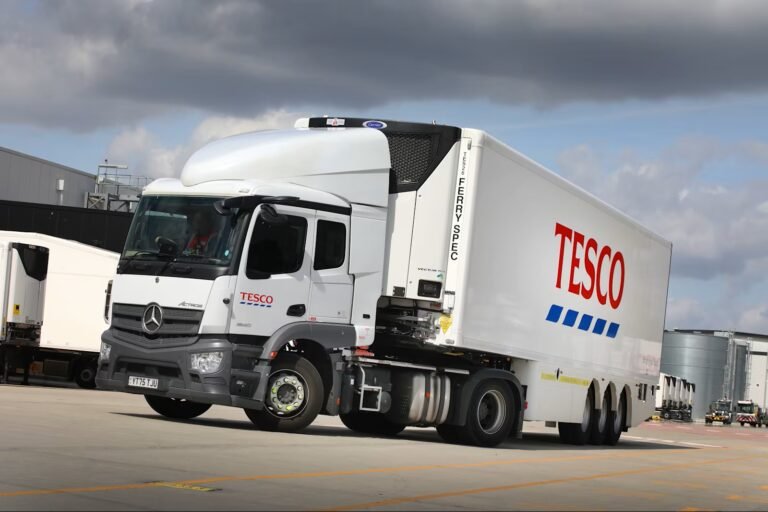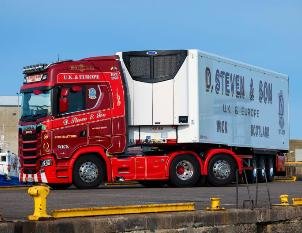
The most northerly haulage company on the UK mainland is celebrating its centenary with the delivery of a new Gray & Adams trailer mounted with Carrier Transicold’s flagship Vector HE 19 MT (multi-temperature) refrigeration unit.
Scrabster-based D Steven & Son, which also has depots in Aberdeen, Glasgow and Wick, has a long history of specifying Gray & Adams trailers with Carrier Transicold refrigeration units.
The latest delivery, part of an order for six trailers, stands out for being the first in the fleet to benefit from the latest generation Vector HE 19 MT unit – which improves fleet efficiency and sustainability. To mark the anniversary, the trailer’s rear barn doors carry the message ‘Servicing Caithness for over 100 years’.
“Being based in one of the most remote parts of Scotland means we need to have absolute confidence in the trucks and trailers we buy for the fleet,” said David Steven, managing director, D Steven & Son. “The Gray & Adams and Carrier Transicold combination works extremely well; we operate all the way down to mainland Europe and we enjoy superb reliability. There’s simply no need to look elsewhere.”
The new 13.6m single-deck trailer joins a fleet of 30 trucks and 50 trailers and will remain in service for the next five years, operating up to seven days per week.
“This is our first Vector HE 19 MT, and it should help us to achieve major performance advantages in almost every area – including a considerable improvement in fuel efficiency,” said David Steven Jr, director, D Steven & Son. “Plus, it’s around 50% quieter than the Vector 1950 we’ve been buying for years, so it’ll be particularly popular with our drivers.”
The Vector HE 19 also benefits from a fully hermetic scroll compressor and economiser which help to deliver a significant increase in refrigeration capacity during pull-down, while reducing the chance of refrigerant and carbon dioxide (CO2) escape, making it an environmentally sustainable choice. Customers can enjoy favourable savings on maintenance costs, thanks to a combination of the new features and extended service cycles. Carrier provides sustainable, effective refrigerated transport solutions for customers, part of its Healthy, Safe, Sustainable Cold Chain Program.
The trailer features high-gloss impact resistant five-element panels and is mounted on a heavy-duty twin member chassis, designed to withstand the demands of long-distance international haulage. Other features include a step neck chassis to reduce overall height, fuel saving vortex generator at the rear of the roof, fully waterproof aluminium floor surface and Michelin tyres as original equipment.