Esta página solo está disponible en inglés. Ir a la portada en español

×

Questa pagina è disponibile solo in inglese. Home page in italiano

×

Diese Seite ist nur auf Englisch verfügbar. Zur deutschen Startseite

×

Cette page est disponible uniquement en anglais. Aller à la page d'accueil en français

×

South African Minister Highlights Cold Chain Priorities at GCCA Africa Conference

South African Minister Highlights Cold Chain Priorities at GCCA Africa Conference

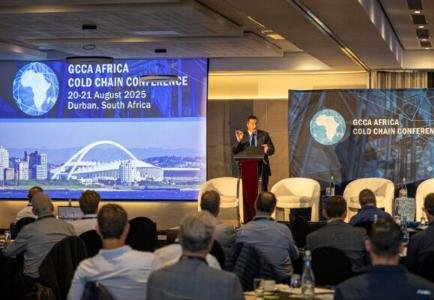
South Africa’s Minister of Agriculture, John Steenhuisen, addressed the GCCA Africa Cold Chain Conference on August 21, 2025, in Durban, emphasizing the importance of cold chain infrastructure for the continent’s food security and economic development.

In his speech, Steenhuisen noted that Africa’s rapidly growing population—projected to surpass two billion by 2050—makes food security a central policy priority. He pointed to South Africa’s own population growth from 55.4 million in 2015 to over 62.3 million in 2025 as a reflection of this trend. “The cold chain is at the heart of answering it,” he said, underlining its role in reducing post-harvest losses, which can reach up to 40% in sub-Saharan Africa for perishables.

Steenhuisen highlighted the economic impact of such losses, linking them to missed market opportunities and income for smallholder farmers across the continent. He cited infrastructure inefficiencies—such as congestion at Cape Town and Durban ports—as key obstacles that affect the reliability of agricultural exports.

To address these challenges, Steenhuisen outlined several government initiatives, including collaboration with the Department of Transport and Transnet to improve port efficiency and integrate cold chain systems. He also emphasized the need to extend cold chain access into rural areas through public–private partnerships, which he described as “smart economics” rather than charity.

Energy reliability was identified as another critical factor. The Minister announced a partnership with the Department of Electricity and Energy to support solar-powered cold rooms in off-grid areas, incentivize energy-efficient refrigeration systems, and expand funding mechanisms for renewable energy in agriculture.

Steenhuisen tied cold chain development to broader global agendas, noting South Africa’s G20 Presidency and the role of the African Continental Free Trade Area (AfCFTA) in boosting intra-African trade. He stressed that without reliable cold chains, such trade opportunities could be lost.

On the role of technology, Steenhuisen pointed to AI for logistics optimization and blockchain for traceability. He referenced pilot projects in South Africa, including blockchain-enabled tracking of table grapes since 2018 and logistics coordination forums in the Western Cape fruit export sector.

“The cold chain is not a side issue,” Steenhuisen concluded. “With it, we can feed more people, create more jobs, and compete more confidently on the world stage.”

Get the daily refrigeration briefing

One email a day. Trusted by 3,000+ RACHP professionals.

More on Cold Chain

All on Cold Chain →

Insights

Secop's Solar Direct Drive (SDD) System Earns WHO PQS Approval – The Team Behind It
Article

Secop’s Solar Direct Drive (SDD) System Earns WHO PQS Approval – The Team Behind It

Partner's material In March 2026, Secop’s Solar Direct Drive Power Management Module was granted WHO PQS prequalification and officially listed in the WHO Catalogue of Prequalified Immunization Devices. The WHO IMD-PQS (Immunization Devices Performance, Quality and Safety programme) is the global benchmark for cold chain equipment used in immunisation. Being listed in its catalogue is

22 Jun 2026
Case Study - Effect of Louvers or diffusers on air flow distribution and cooling time on a meat log during Chill cycle
Tech Guide

Case Study – Effect of Louvers or diffusers on air flow distribution and cooling time on a meat log during Chill cycle

By Kushal Aurangabadkar An experimental analysis was conducted on a cooler space measuring 3.66 m × 6.096 m (12.0 ft × 20.0 ft), equipped with an ammonia refrigeration coil, five 30 cm (12 in.) fans, and five diffusers. The study measured airflow patterns, cooling rates, and heat transfer efficiency in meat storage by testing two configurations:

Kushal Aurangabadkar · 21 Jan 2026
Total Cost of Ownership (TCO) for Modular Refrigeration Systems in Life Sciences Distribution Centers
Tech Guide

Total Cost of Ownership (TCO) for Modular Refrigeration Systems in Life Sciences Distribution Centers

by Ramez Naguib, P.E. Introduction Life sciences distribution centers are under immense pressure to deliver consistent temperature control, comply with increasingly stringent regulations, and optimize operational efficiency. Traditional built-up refrigeration systems often prove cumbersome, costly, and slow to implement. In contrast, modular, factory-assembled refrigeration systems have emerged as a compelling alternative. Drawing on lessons from

14 Jan 2026
Everything on Cold Chain: 2,043 articles, 2 case studies, 23 insights

Most read this month

All news →