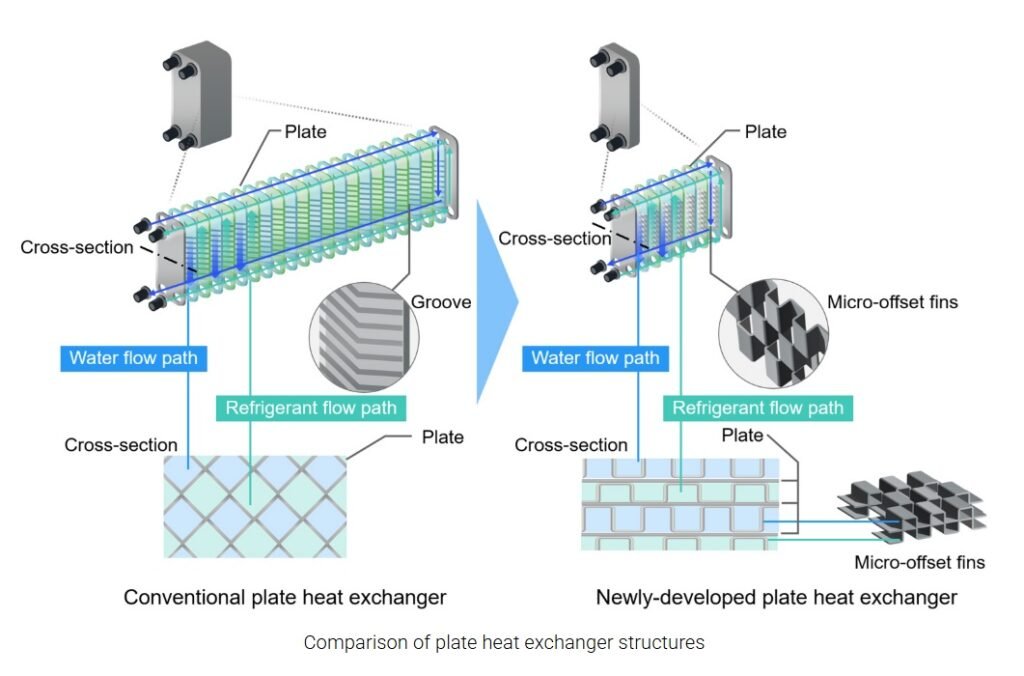
Mitsubishi Electric Corporation has developed a plate heat exchanger for heat pump cooling and heating equipment that delivers approximately three times the heat transfer performance of its conventional grooved plate heat exchangers. The company said the design reduces the required refrigerant charge to approximately one-third of conventional levels, lowering environmental impact and improving safety.
The heat exchanger uses micro-offset fins between flat plates to promote turbulence and heat transfer. Mitsubishi Electric added distribution channels at the fluid inlets and outlets to provide uniform refrigerant flow across the plates and evenly distribute gas-liquid two-phase refrigerant.
The placement of the channels was optimized using Mitsubishi Electric’s proprietary analysis technology, which simulates the flow of two-phase refrigerants between fine fins. According to the company, the resulting heat transfer performance is industry-leading as of September 14, 2026, based on its research into plate heat exchangers for heat pump cooling and heating equipment.
Mitsubishi Electric said reducing refrigerant charge is increasingly important as refrigerant regulations become stricter. Next-generation refrigerants such as R32 have lower Global Warming Potential, but many are flammable, making reduced refrigerant volume important for limiting risks associated with accidental leaks.
The technology can be applied to water-based cooling and heating equipment, heat pump systems for electric vehicles and air-cooled air conditioners. Mitsubishi Electric plans to incorporate the technology into its product lineup.