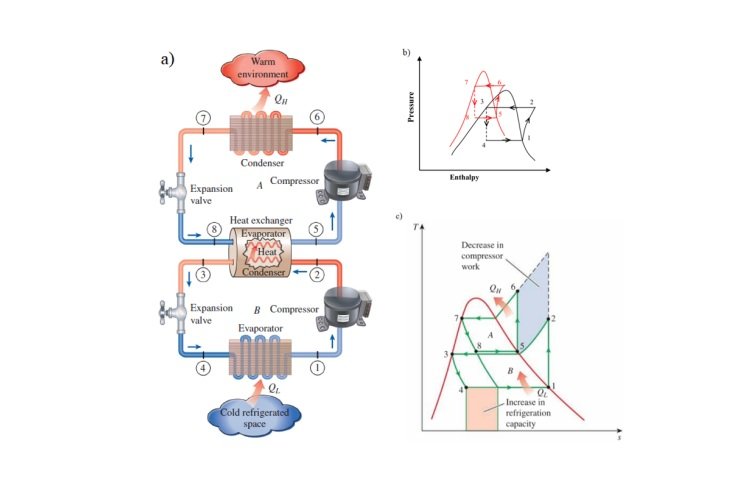
A study published in the International Journal of Fluid Mechanics & Thermal Sciences on September 30, 2026, found that R-23 achieved the highest coefficient of performance (COP) among four refrigerants evaluated for the low-temperature circuit of a cascade refrigeration system. Conducted by Ronit Singh BK, the research examined a system designed for an evaporator temperature of -80°C (-112°F), targeting vaccine storage and cryogenic applications.
The two-stage system used R-134a in the high-temperature circuit and compared R-13, R-23, R-170, and R-290 in the low-temperature circuit. Thermodynamic simulations performed using Engineering Equation Solver (EES) evaluated system efficiency, refrigerant mass flow rates, and operating conditions. R-23 delivered the highest overall COP of 1.816, followed by R-170 at 1.704, R-290 at 1.695, and R-13 at 1.538.
The R-23 configuration achieved a low-temperature circuit COP of 5.758, compared with 4.974 for R-170, 4.914 for R-290, and 4.016 for R-13. The high-temperature circuit maintained a COP of 3.113 across all four configurations, while heat transfer through the intermediate heat exchanger remained at 30 kW (approximately 102,400 BTU/h). The study also identified differences in environmental characteristics, with R-170 and R-290 having substantially lower global warming potential than R-23.
A parametric analysis showed that reducing the investigated evaporator temperature from -20°C (-4°F) to -50°C (-58°F) decreased overall COP from 1.538 to 1.202, while the low-temperature circuit COP increased from 4.016 to 9.544. In a separate ambient-temperature analysis covering 25°C to 35°C (77°F to 95°F), overall COP remained at 1.538, although refrigerant mass flow rates increased.
The research also calculated a cooling load of 72 kW (approximately 245,700 BTU/h) for a 1 m³ (35.3 ft³) insulated chamber maintained at -80°C (-112°F) with an ambient temperature of 40°C (104°F). The calculation assumed polyurethane foam insulation 0.25 m (9.84 inches) thick. The study concluded that refrigerant selection and insulation properties are important parameters in optimizing cascade refrigeration systems for ultra-low-temperature storage applications.