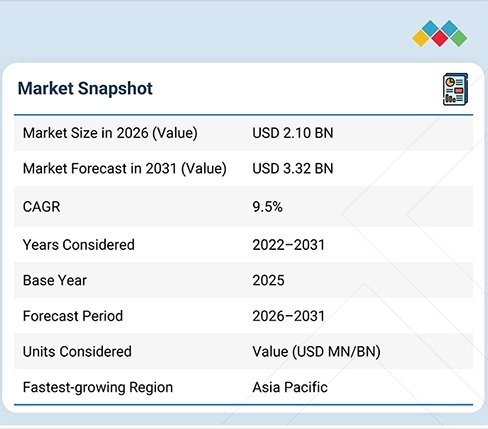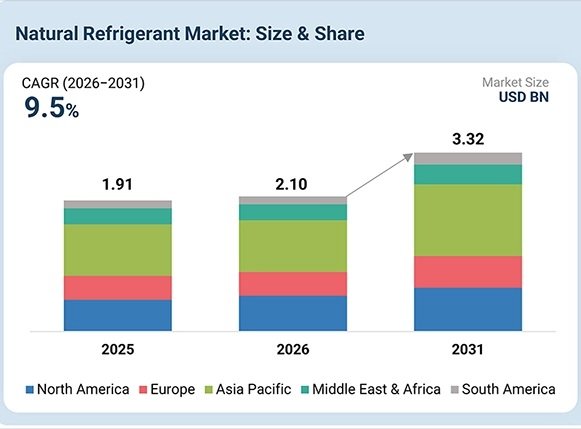
The global natural refrigerants market is projected to grow from USD 2.10 billion in 2026 to USD 3.32 billion by 2031, according to a new report by MarketsandMarkets. The forecast represents a compound annual growth rate (CAGR) of 9.5%, driven by demand for low-global-warming-potential (GWP) refrigerants, environmental regulations, and expanding refrigeration and cold chain infrastructure.
Asia Pacific accounted for 39% of the global market by value in 2025, making it the largest regional market. Growth in China, India, Japan, and South Korea is supported by industrialization, food processing, supermarkets, and industrial refrigeration. Hydrocarbons held the largest share among refrigerant types at 37% in 2025.
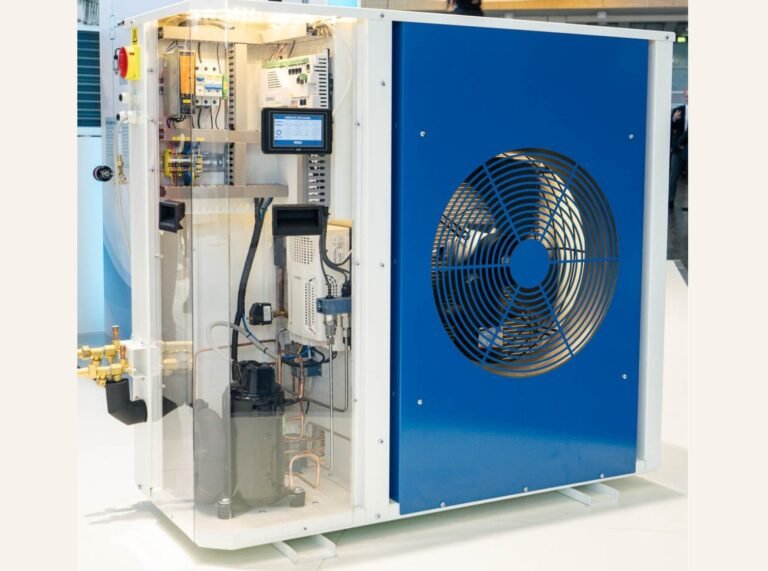
CO2 is projected to be the fastest-growing refrigerant type by value through 2031. The report identifies increasing adoption of transcritical CO2 systems in food retail, cold storage, cold chains, and food processing. Technological developments aimed at improving system efficiency in warm climates are also supporting adoption.
Commercial refrigeration is expected to record the highest growth among applications, with a projected CAGR of 12% during 2026–2031. Demand is linked to supermarkets, convenience stores, restaurants, and food retailers adopting CO2, hydrocarbon, and ammonia-based refrigeration technologies as regulations restrict high-GWP HFC refrigerants.
The report also highlights investments in refrigerant production and lifecycle management. In June 2025, Linde announced plans to double CO2 production at its Freeport, Texas, facility by adding a second liquefaction unit for future R744 production. In March 2025, A-Gas acquired Refrigerant Services Inc. in Canada, expanding its refrigerant recovery, recycling, and reclamation capabilities.
MarketsandMarkets identifies energy-efficient refrigeration systems, safety technologies, and wider adoption of CO2 and ammonia systems as factors supporting future market growth.