Esta página solo está disponible en inglés. Ir a la portada en español

×

Questa pagina è disponibile solo in inglese. Home page in italiano

×

Cette page est disponible uniquement en anglais. Aller à la page d'accueil en français

×

Austria Opens First DGNB Gold-Certified Frozen Storage Facility

The facility pairs more than 4,500 m² of space with a 1.2 MW solar array supplying about 75% of its electricity.

Austria Opens First DGNB Gold-Certified Frozen Storage Facility
Created by Refindustry using AI

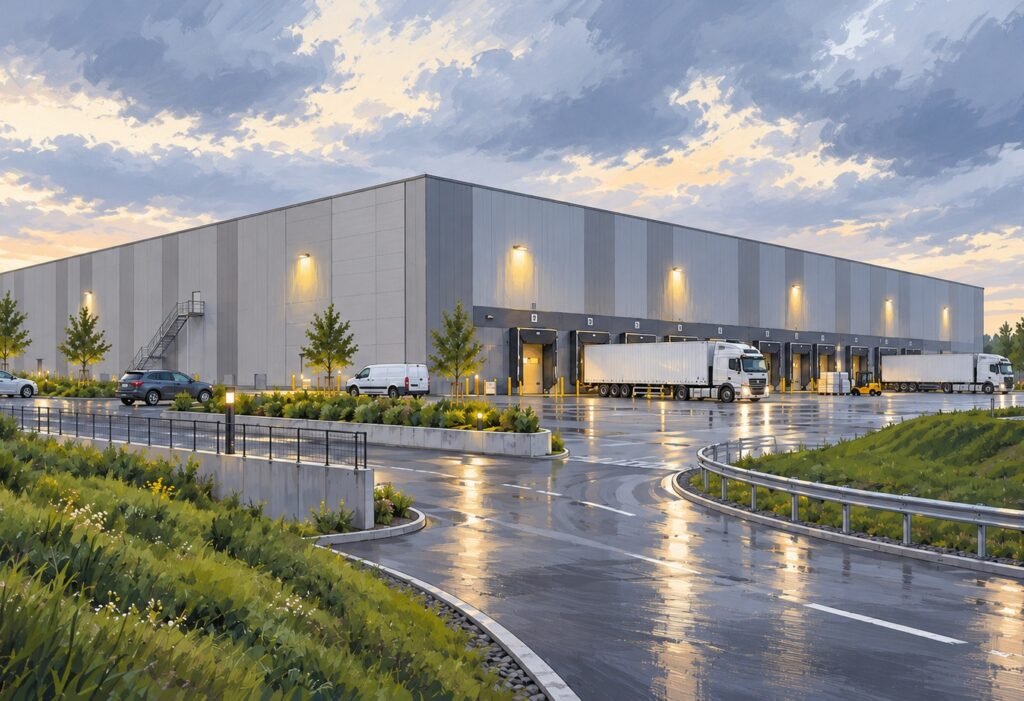
Austria’s first DGNB Gold-certified frozen storage facility has opened in Loosdorf, Lower Austria. Developed by F & S Real Estate Solutions GmbH and Schisernig Real Estate Investor, the facility provides more than 4,500 m² (48,438 sq ft) of usable space within the Green Logistics Park. The developers handed over the building to GMS Gourmet GmbH, an Austrian provider of meal, catering and foodservice solutions.

The facility is designed to operate at temperatures as low as -22°C (-7.6°F), requiring particular attention to thermal insulation. A 1.2 MW photovoltaic system supplies approximately 75% of the warehouse’s total electricity consumption. The site also features emergency backup power, which GMS Gourmet Managing Director Hannes Hasibar identified as an important factor in maintaining operational reliability during challenging conditions.

The building received Gold certification under the German Sustainable Building Council (DGNB) assessment system, which evaluates technical, environmental, economic and sociocultural aspects of construction projects. According to F & S Solutions Managing Director Alexander Liebewein, the developers also sought to minimize earthmoving during excavation and reuse excavated soil on site.

The warehouse marks the provisional completion of the commercial area’s development. Over the past five years, the project developers have invested approximately EUR 110 million (around USD 128 million) in the location. Walter Schisernig, one of the developers, emphasized the importance of sustainability standards throughout the property’s value chain for long-term asset value and building quality.

The project’s completion has also renewed discussions about logistics infrastructure development in Austria. Loosdorf Mayor Thomas Vasku called for coordinated planning between municipalities to reduce land sealing and improve the availability of commercial sites. Schisernig additionally pointed to lengthy approval procedures as an obstacle to meeting demand for logistics properties.

Get the daily refrigeration briefing

One email a day. Trusted by 3,000+ RACHP professionals.

More on Cold Chain

All on Cold Chain →

Insights

Secop's Solar Direct Drive (SDD) System Earns WHO PQS Approval – The Team Behind It
Article

Secop’s Solar Direct Drive (SDD) System Earns WHO PQS Approval – The Team Behind It

Partner's material In March 2026, Secop’s Solar Direct Drive Power Management Module was granted WHO PQS prequalification and officially listed in the WHO Catalogue of Prequalified Immunization Devices. The WHO IMD-PQS (Immunization Devices Performance, Quality and Safety programme) is the global benchmark for cold chain equipment used in immunisation. Being listed in its catalogue is

22 Jun 2026
Case Study - Effect of Louvers or diffusers on air flow distribution and cooling time on a meat log during Chill cycle
Tech Guide

Case Study – Effect of Louvers or diffusers on air flow distribution and cooling time on a meat log during Chill cycle

By Kushal Aurangabadkar An experimental analysis was conducted on a cooler space measuring 3.66 m × 6.096 m (12.0 ft × 20.0 ft), equipped with an ammonia refrigeration coil, five 30 cm (12 in.) fans, and five diffusers. The study measured airflow patterns, cooling rates, and heat transfer efficiency in meat storage by testing two configurations:

Kushal Aurangabadkar · 21 Jan 2026
Total Cost of Ownership (TCO) for Modular Refrigeration Systems in Life Sciences Distribution Centers
Tech Guide

Total Cost of Ownership (TCO) for Modular Refrigeration Systems in Life Sciences Distribution Centers

by Ramez Naguib, P.E. Introduction Life sciences distribution centers are under immense pressure to deliver consistent temperature control, comply with increasingly stringent regulations, and optimize operational efficiency. Traditional built-up refrigeration systems often prove cumbersome, costly, and slow to implement. In contrast, modular, factory-assembled refrigeration systems have emerged as a compelling alternative. Drawing on lessons from

14 Jan 2026
Everything on Cold Chain: 2,045 articles, 2 case studies, 23 insights

Most read this month

All news →