Esta página solo está disponible en inglés. Ir a la portada en español

×

Questa pagina è disponibile solo in inglese. Home page in italiano

×

Diese Seite ist nur auf Englisch verfügbar. Zur deutschen Startseite

×

Cette page est disponible uniquement en anglais. Aller à la page d'accueil en français

×

Carrier Transicold Shanghai Provides 370 Citimax Refrigeration units to New School Meal Distribution Program in China

Carrier Transicold Shanghai Provides 370 Citimax Refrigeration units to New School Meal Distribution Program in China

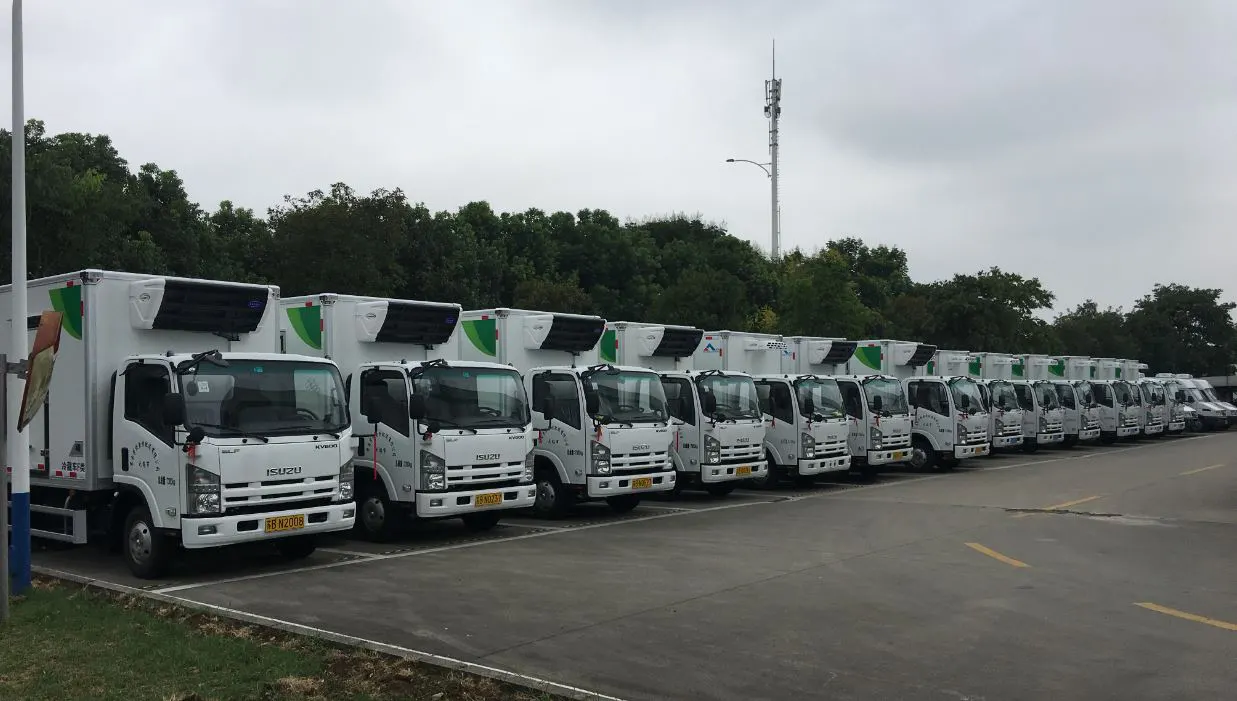
Carrier Transicold Shanghai was selected as the transport refrigeration unit provider for the first city-wide school meal distribution program in Wuxi, China. The program supports thousands of children at more than 650 educational facilities by providing fresh, healthy meals. 

Carrier Transicold Shanghai has delivered 370 Citimax refrigeration units, which are specifically designed for the transport of fresh or frozen goods in small-to-medium sized delivery vehicles and help maintain cold chain integrity by ensuring temperature-sensitive cargo is delivered in ideal condition. Each vehicle is equipped with four temperature sensors to ensure the safe transport of food, which aligns with Carrier’s Healthy, Safe, Sustainable Cold Chain.

“Ensuring the school children of Wuxi receive fresh, quality meals on a daily basis is essential. The reliable Citimax units provide the school system the confidence to safely serve hundreds of schools, while the direct-drive technology improves efficiency for the multi-drop route,” said Cynthia Lu, managing director, Carrier Transicold Asia.

In response to China’s growing demand for reliable and cost-efficient cooling units, Carrier Transicold China launched the Citimax range of light commercial vehicle (LCV) and truck refrigeration in 2012. The units offer precise temperature control with set points maintained within 1° Celsius of the pre-determined temperature, ensuring that perishable goods are maintained in the proper condition from depot to destination.

The Citimax range is an easy-to-install and simple-to-use product that builds on Carrier Transicold’s experience in developing quality refrigerated solutions in line with market needs. The range was developed at the Carrier Shanghai Global Lead Design Center. Designed to operate in urban applications, Citimax units offer a standard and proven direct-drive technology with power derived directly from the vehicle engine.

Get the daily refrigeration briefing

One email a day. Trusted by 3,000+ RACHP professionals.

More on Cold Chain

All on Cold Chain →

Insights

Secop's Solar Direct Drive (SDD) System Earns WHO PQS Approval – The Team Behind It
Article

Secop’s Solar Direct Drive (SDD) System Earns WHO PQS Approval – The Team Behind It

Partner's material In March 2026, Secop’s Solar Direct Drive Power Management Module was granted WHO PQS prequalification and officially listed in the WHO Catalogue of Prequalified Immunization Devices. The WHO IMD-PQS (Immunization Devices Performance, Quality and Safety programme) is the global benchmark for cold chain equipment used in immunisation. Being listed in its catalogue is

22 Jun 2026
Case Study - Effect of Louvers or diffusers on air flow distribution and cooling time on a meat log during Chill cycle
Tech Guide

Case Study – Effect of Louvers or diffusers on air flow distribution and cooling time on a meat log during Chill cycle

By Kushal Aurangabadkar An experimental analysis was conducted on a cooler space measuring 3.66 m × 6.096 m (12.0 ft × 20.0 ft), equipped with an ammonia refrigeration coil, five 30 cm (12 in.) fans, and five diffusers. The study measured airflow patterns, cooling rates, and heat transfer efficiency in meat storage by testing two configurations:

Kushal Aurangabadkar · 21 Jan 2026
Total Cost of Ownership (TCO) for Modular Refrigeration Systems in Life Sciences Distribution Centers
Tech Guide

Total Cost of Ownership (TCO) for Modular Refrigeration Systems in Life Sciences Distribution Centers

by Ramez Naguib, P.E. Introduction Life sciences distribution centers are under immense pressure to deliver consistent temperature control, comply with increasingly stringent regulations, and optimize operational efficiency. Traditional built-up refrigeration systems often prove cumbersome, costly, and slow to implement. In contrast, modular, factory-assembled refrigeration systems have emerged as a compelling alternative. Drawing on lessons from

14 Jan 2026
Everything on Cold Chain: 2,045 articles, 2 case studies, 23 insights

Most read this month

All news →