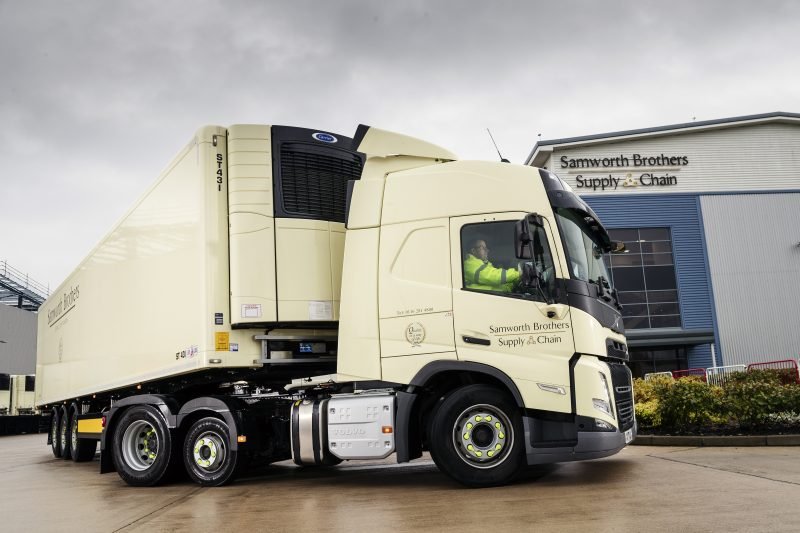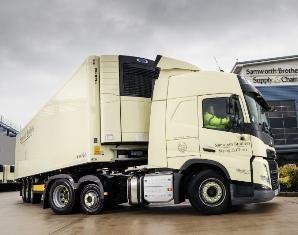
Temperature-controlled distribution company Samworth Brothers has become the latest UK business to add the Carrier Transicold Vector eCool unit into its fleet, taking delivery of six of the world’s first fully autonomous, all-electric engineless refrigerated trailer system already operating on roads in 10 European countries.
A Carrier Transicold customer for 23 years, Samworth Brothers Supply Chain currently operates a 240-strong, 100% Carrier-cooled trailer fleet. To improve sustainability and increase efficiency, the business has specified the new engineless Carrier Transicold Vector eCool unit to six 13.6-metre Gray & Adams trailers, after success with a demonstrator unit during a four-week trial. Aligned with Carrier’s 2030 ESG goals to reduce customers’ carbon footprint by more than one gigaton, these engineless units will help reduce emissions across the Samworth Brothers Supply Chain fleet.
“Seeing the Vector eCool unit in action made making the switch an easy decision,” said Ian Cooper, Regional Fleet Manager at Samworth Brothers Supply Chain. “It will play a key role in reducing our carbon footprint, helping us to focus on our path to net zero, while forming a vital part of our duty of care to the environment. Of course, given the current cost of diesel, any way to lower our fuel usage across the fleet is also a welcome bonus.”
The Vector eCool unit combines Carrier’s E-Drive all-electric technology with a new cutting-edge energy recovery and storage system. This converts kinetic energy generated by the trailer axle and brakes into electric power, which is stored in a battery pack that powers the refrigeration unit – a loop that creates the industry’s first fully autonomous system, producing no direct carbon dioxide (CO2) or particulate emissions. The all-electric Vector eCool is also PIEK-compliant, which combined with its emissions performance, means that the system offers the ultimate solution to tightening inner city and urban regulations.
The new trailers will be put through their paces, with each expected to clock up around 250,000 kilometres per year, operating out of the firm’s Penrith and London depots. They replace older assets and form part of a larger order which includes 19 additional Carrier Transicold Vector HE 19s, which will be mounted to new Gray & Adams double deck trailers.