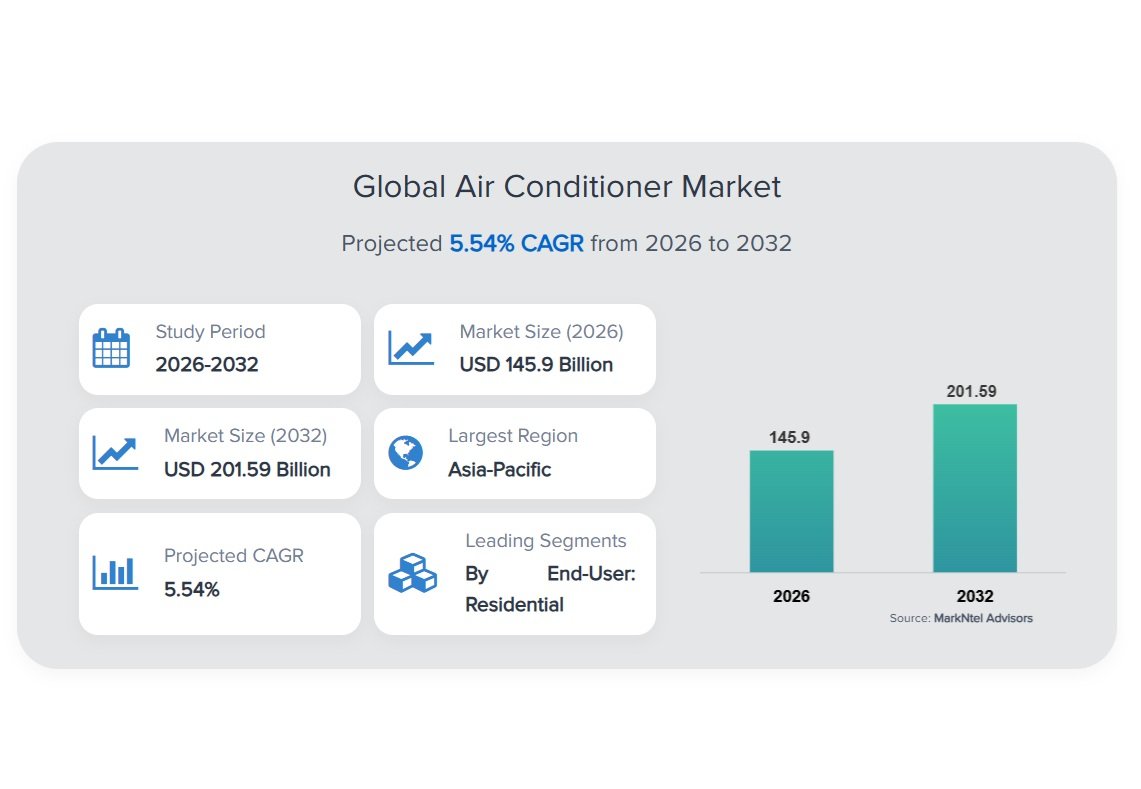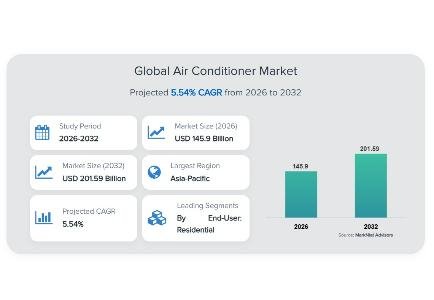
MarkNtel Advisors projects the global air conditioners market to grow at a CAGR of about 5.54% from 2026 to 2032, reaching USD 201.59 billion by 2032 from USD 145.9 billion in 2026. The report said the market was valued at USD 134.51 billion in 2025 and linked growth to rapid urbanization, rising temperatures, expanding residential infrastructure, and wider adoption of energy-efficient cooling technologies.
Asia-Pacific accounted for about 56% of the global market share in 2026, making it the leading region in the study. MarkNtel attributed the region’s position to demand in rapidly urbanizing economies, rising disposable incomes, and residential construction activity, with China and India identified as key demand markets.
By product type, room air conditioners held nearly 65% of the market in 2026, supported by demand in residential buildings and small commercial establishments. The report said split air conditioners remained popular because of quiet operation, improved energy efficiency, and advanced cooling features, while portable and window units also supported the segment in compact living spaces and rental housing.
By end user, the residential segment represented around 58% of the market share in 2026. MarkNtel said household demand for comfort and climate control, awareness of heat-related health risks, rising incomes, and expanding urban housing infrastructure supported sales, while offices, hotels, retail stores, and healthcare facilities also contributed to market growth.
The report said manufacturers are investing in inverter compressors, smart connectivity, AI-based cooling optimization, and refrigerants described as environmentally friendly. It also identified high energy consumption and environmental concerns as a key challenge, noting that stricter energy-efficiency standards and refrigerant regulations may raise manufacturing and compliance costs for HVAC suppliers.